





For a global company setting up a Global Capability Center (GCC) in India, choosing the right leader is not simply about finding someone who understands India. It is about finding someone who can connect the center to the global organization, build the right capabilities, and lead it for the long term. Three leadership models can work, but each comes with distinct strengths and trade-offs.
Key takeaways
For a companies establishing a GCC in India, one of the earliest decisions is who should lead it.
Should the company relocate a senior executive from headquarters? Appoint someone who has worked in both India and the US? Or hire an experienced leader from India’s GCC ecosystem?
Each option can work. But each creates different opportunities and challenges for the center.
Nitika Goel, Managing Partner and CMO at Zinnov, explains:
“There is no single right answer. We see three leadership models work, and each comes with its own strengths and trade-offs.”
The choice matters because the first GCC leader does more than manage operations. They establish the relationship between headquarters and India, shape the center’s culture, and influence how much responsibility the organization can eventually take on.
Zinnov identifies three leadership models: the global culture champion, the conduit, and the India-based global leader.
The differences lie in where the leader’s experience comes from, how they connect with headquarters, and whether they can build the center for the long term.
Three GCC leadership models and their trade-offs
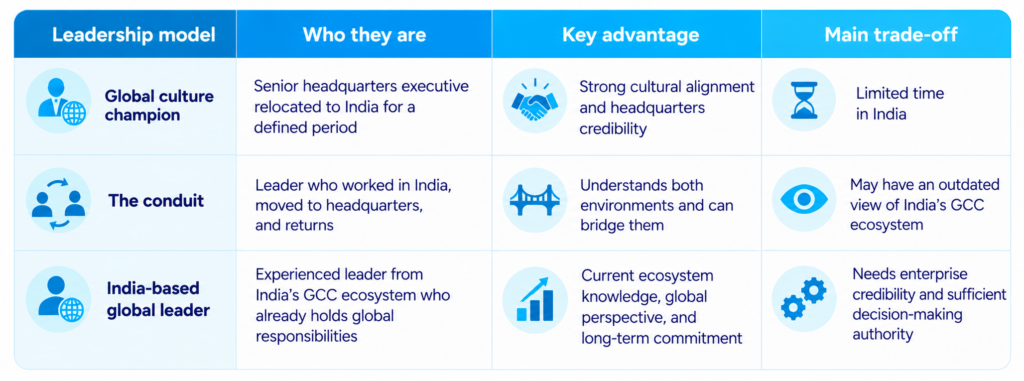
The first model is the global culture champion. This is typically a senior leader from the US headquarters who relocates to India for a defined period to establish and lead the GCC.
Nitika Goel describes their role:
“They bring the company’s culture with them, connect the India team into the global organization, and often go back as the center’s strongest advocate.”
For a new GCC, that connection can be valuable.
The headquarters executive can help the India team understand the enterprise’s priorities while giving global stakeholders confidence that the new center is aligned with the organization.
The trade-off is time.
Most headquarters assignments are temporary. The leader may spend a few months or years establishing the center before returning to the US.
If the GCC depends too heavily on that individual, the transition can create a leadership gap.
The company therefore needs to build local leadership capabilities before the headquarters executive leaves. A global culture champion can be particularly effective during the initial setup phase, provided the organization has a clear plan for long-term leadership continuity.
The second model is the conduit.
However, there is an important trade-off.
“Someone who last worked here 15 years ago remembers an ecosystem built on cost and delivery. Today it runs on product ownership and AI.”
India’s GCC ecosystem has evolved considerably. Centers that were once primarily focused on operational efficiency and delivery increasingly take responsibility for product engineering, advanced technology, AI, and global functions.
A leader who relies on an outdated understanding of the ecosystem may underestimate the capabilities that can be built in India.
The risk is not that the leader lacks India experience. It is that their experience may no longer reflect what India can deliver today.
The conduit model can work well when the leader combines cross-border experience with an up-to-date understanding of India’s technology talent, leadership capabilities, and GCC ecosystem.
The third model is the India-based global leader.
This is an executive who has built their career within India’s GCC ecosystem, already manages global responsibilities, and intends to remain in India for the long term.
There are two reasons where this model is observed to be the strongest:
Also, Nitika Goel highlights two figures-
These figures illustrate the depth of global leadership experience within India’s GCC ecosystem.
An India-based global leader understands the local talent market, knows how the ecosystem operates, and has experience managing responsibilities beyond India.
The advantage is the combination of local ecosystem knowledge, global business experience, and long-term commitment.
However, the model works only when the leader has genuine authority and credibility within the global organization.
A strong India-based leader without access to enterprise decisions may still struggle to expand the GCC’s responsibilities.
Regardless of which leadership model a company chooses, Zinnov recommends evaluating candidates against the same four criteria.
“Do they understand the local context? Do they understand your business? How committed are they? And how quickly can they move?“- Nitika Goel
These questions help companies look beyond a candidate’s previous title, location, or experience.
Four tests for choosing the right GCC leader
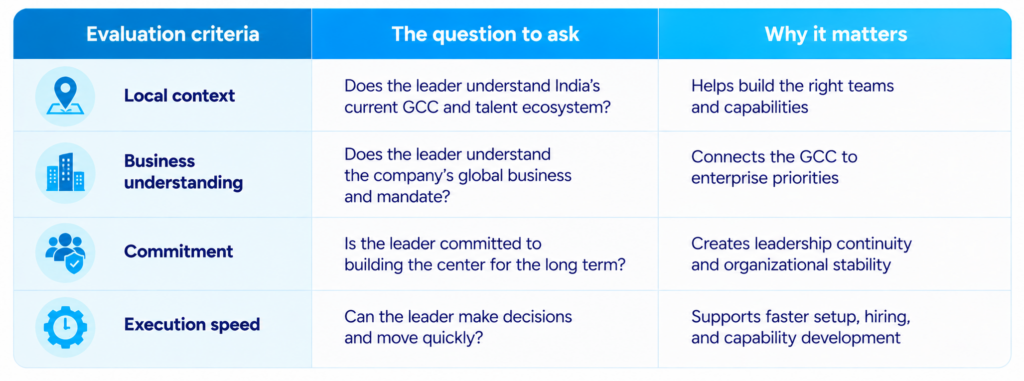
The four criteria are interconnected.
The first GCC leader shapes more than the center’s initial operations.
They influence how the organization hires, how decisions are made, how headquarters perceives the India team, and what responsibilities the center can eventually own.
Case in point: Consider a US technology company establishing a 100-person engineering GCC in India.
Companies should therefore choose GCC leadership with both the initial launch and the center’s future mandate in mind.
This is particularly important for US-headquartered companies building their first GCC in India, where the initial leadership decisions establish the foundation for the organization’s future growth.
All three leadership models can work.
“If you want the best of both, pair that leader with a champion from headquarters for the first few months.”
Under this approach, a senior headquarters executive helps establish the GCC’s culture, strategic priorities, and relationships with the global organization. At the same time, an India-based leader takes responsibility for building the team, developing capabilities, and preparing the center for long-term ownership.
A hybrid leadership approach for GCC setup
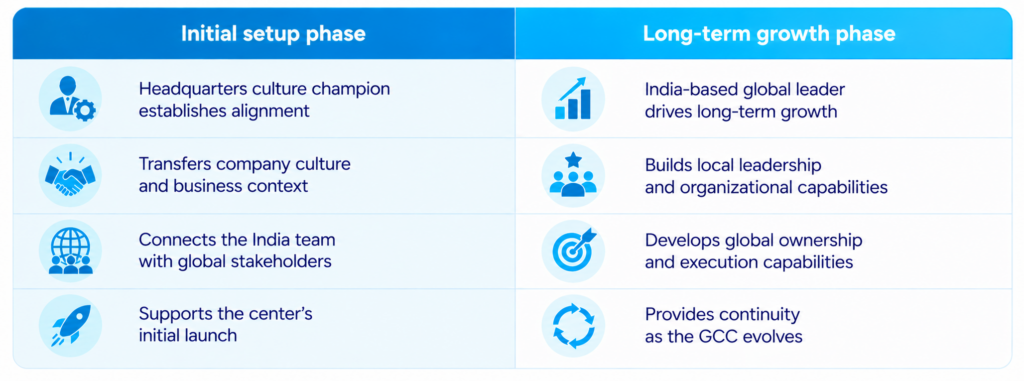
The objective is to establish strong headquarters connections without making the GCC permanently dependent on a leader temporarily assigned from the US.
There is no universal answer. A headquarters executive can establish the company’s culture and build early trust. A conduit can bridge the India and US organizations. An India-based global leader can bring deep ecosystem expertise and sustained commitment.
But the decision should ultimately come down to the individual.
Does the leader understand India’s current capabilities? Can they connect the GCC to the company’s global business? Are they committed to building the organization? And can they execute quickly?
Appoint a leader who understands India’s ecosystem and thinks globally, while using a headquarters culture champion to establish alignment during the initial phase.
The goal is not simply to find someone who can run an India office.
It is to build a GCC that becomes an integrated, long-term part of the global enterprise.
Having supported the setup of more than 220 GCCs, Zinnov helps organizations align leadership decisions with their business mandates and long-term growth objectives.
Its GCC setup and execution approach covers leadership planning, center head hiring, organizational design, talent strategy, and operational setup.
For US-headquartered companies establishing their first GCC in India, these decisions are especially important.
The first leadership team determines how the center connects with headquarters, how its capabilities develop, and how effectively it can take on global responsibilities.
Zinnov helps enterprises identify the leadership capabilities and organizational structures needed to build GCCs designed for long-term growth.



 THANK YOU
FOR YOUR RESPONSE
