





For a US-headquartered company setting up a Global Capability Center (GCC) in India, choosing the right leader is about more than local market knowledge or operational experience.
The first GCC leader must build trust between headquarters and India, establish enterprise credibility, develop future leaders, and create the foundation for global ownership.
Key takeaways
For a US-headquartered company setting up a GCC in India, one of the first questions is: who should lead it? The obvious answer is someone who understands India. That is necessary, but it is not enough.
The first GCC leader has a more complex responsibility. They must connect two organizations that may operate with different expectations, decision-making processes, and levels of understanding.
Nitika Goel, Managing Partner and CMO at Zinnov, describes the challenge:
“The first GCC leader has to do something much harder: make two organizations trust each other before they fully understand each other.”
That trust determines how effectively the India center can work with headquarters, influence decisions, and eventually take ownership of global responsibilities.
Zinnov identifies four qualities that matter when selecting the first GCC leader: enterprise credibility, translation ability, the ability to give away power, and ambition without insecurity.
Together, these qualities determine whether a leader can build more than an operationally efficient center.
Four qualities of an effective GCC leader
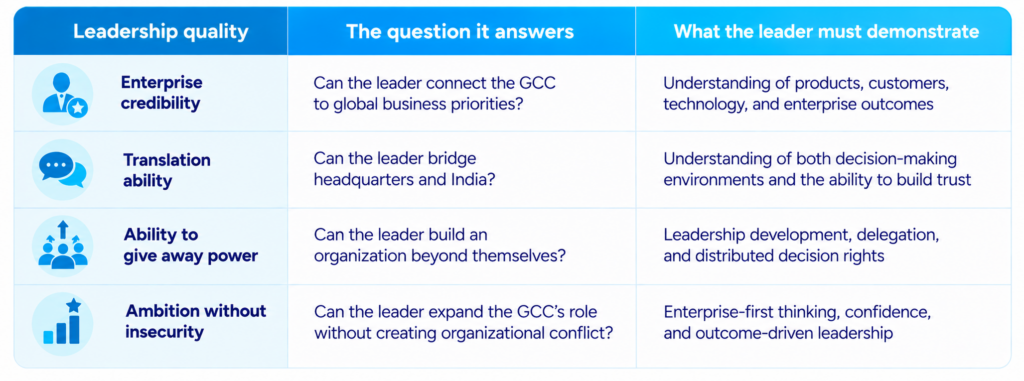
The first quality is enterprise credibility. A GCC leader must understand the company’s business, not simply manage its India operations. They need to connect the center’s responsibilities to the products, customers, technology priorities, and business outcomes of the global organization.
Nitika Goel explains:
“If they cannot connect the GCC to product, customers, technology, or enterprise outcomes, the center risks becoming operationally strong but strategically peripheral.”
Consider a US technology company establishing an engineering GCC in India. The center may successfully recruit hundreds of engineers, meet delivery timelines, and operate efficiently. But if its leader cannot participate meaningfully in product strategy or technology decisions, the center may remain primarily an execution unit.
The organization is performing well, yet its influence on the enterprise remains limited.
A leader with enterprise credibility can make a different contribution.
They understand why a product matters, how technology investments support business objectives, and where the India team can create greater value. That understanding allows them to negotiate responsibilities with headquarters, challenge assumptions, and advocate for the capabilities the center can build.
The distinction is between a leader who can run the GCC efficiently and one who can make the GCC strategically relevant.
For US companies, this means evaluating candidates on their business understanding and global stakeholder credibility, not just their experience managing large teams in India.
The second quality is translation ability.
A GCC leader operates between two environments that may have different assumptions about talent, execution, decision-making, and organizational capabilities. Headquarters may understand the company’s strategic priorities but have limited visibility into India’s current talent ecosystem.
The India team may understand what can be built locally but lack the enterprise context needed to make the right decisions.
The GCC leader must connect these perspectives.
Nitika Goel describes the best leaders as:
“Bilingual in a deeper sense. They understand how decisions get made at HQ, and how talent, speed, and execution actually work in India.”
This is not simply about communication skills or cultural familiarity.
It is about understanding how both organizations operate and helping each make better decisions.
Consider a US-headquartered company transferring responsibility for a technology platform to its India GCC.
Headquarters may initially hesitate to give the center full ownership because it is unfamiliar with the leadership team’s capabilities. Meanwhile, the India team may believe it has the talent and technical expertise to take on the mandate.
Without effective leadership, these different perspectives can create frustration.
Headquarters may interpret requests for greater responsibility as premature. The India team may interpret hesitation as a lack of confidence.
Nitika Goel identifies the underlying challenge:
“They reduce what I would call the context gap before it becomes a trust gap.”
An effective GCC leader makes expectations explicit, establishes shared measures of success, and ensures both organizations understand the reasons behind important decisions.
They help headquarters see what India can deliver while ensuring the India team understands the enterprise’s priorities and constraints.
Trust develops when both organizations have enough context to make decisions together.
For a new GCC, this ability can be as important as technical or operational expertise.
The third quality is the ability to build leadership beyond oneself.
During the initial setup phase, a strong GCC head often becomes central to nearly every important decision.
They recruit the first leadership team, establish relationships with headquarters, oversee operations, and resolve challenges.
That level of involvement may be necessary at the beginning.
But it can become a constraint if the organization continues to depend on one individual as it grows.
Nitika Goel highlights the risk:
“A surprising amount of GCC leadership failure comes from building a center around one heroic leader.”
A GCC built around a single leader may operate effectively while that person remains in charge. However, it can struggle to scale, delegate responsibilities, or develop future leadership.
Consider a GCC that begins with 100 employees and grows toward 500.
In the early stages, the center head may directly manage most decisions involving hiring, delivery, and headquarters coordination.
As the organization expands, the same approach becomes difficult to sustain.
The center needs functional leaders, engineering heads, product owners, and technical architects who can make decisions within their areas of responsibility.
The GCC head must therefore create a leadership structure that distributes authority.
From leader-dependent to institution-led GCCs
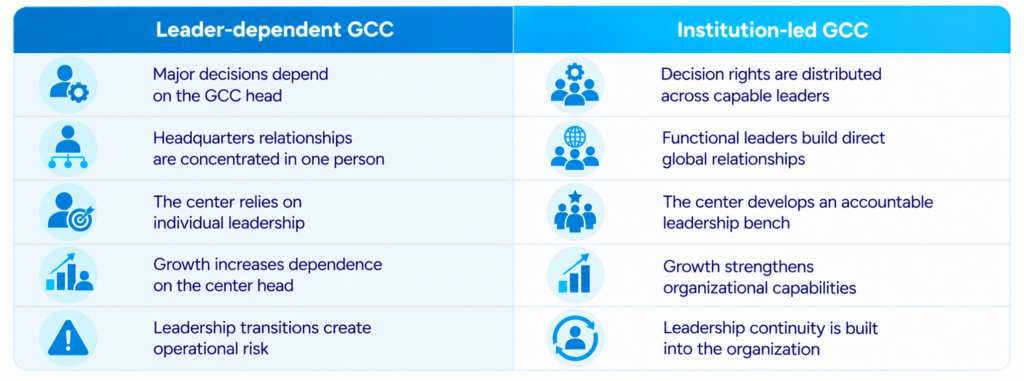
The stronger GCC leader hires and develops people who can eventually take ownership of major responsibilities.
They create decision rights below them, build direct relationships between India and global functional teams, and make themselves progressively less central to day-to-day operations.
The measure of strong GCC leadership is not how many decisions the leader controls, but how many capable leaders and decision-makers they develop.
That becomes particularly important as the center moves from execution to global capability ownership.
The fourth quality is ambition without insecurity.
A GCC leader must advocate for the center’s capabilities and help the enterprise recognize the value India can create.
But there is a difference between advocating for greater responsibility and treating every conversation with headquarters as a competition for control.
Nitika Goel explains:
“The leader has to advocate for India aggressively without turning every conversation into a fight for mandate.”
This balance matters because a GCC is part of a larger enterprise.
Its success depends on collaboration with global business units, technology teams, product leaders, and functional stakeholders.
A leader who constantly pushes for additional scope without demonstrating enterprise value may create unnecessary friction.
By contrast, a leader who consistently delivers outcomes, develops capabilities, and builds credibility can create a stronger case for expanding the center’s responsibilities.
Consider a GCC initially responsible for supporting a global product engineering team.
The center could immediately request full product ownership.
Alternatively, its leadership could establish technical credibility, demonstrate reliable execution, develop product expertise, and gradually take accountability for larger components of the platform.
As confidence grows, headquarters may become more willing to expand the center’s mandate.
The difference is how responsibility is earned.
The strongest GCCs earn larger roles by becoming indispensable to the enterprise, not simply by asking for more scope.
For GCC leaders, ambition should therefore be directed toward enterprise outcomes rather than organizational influence alone.
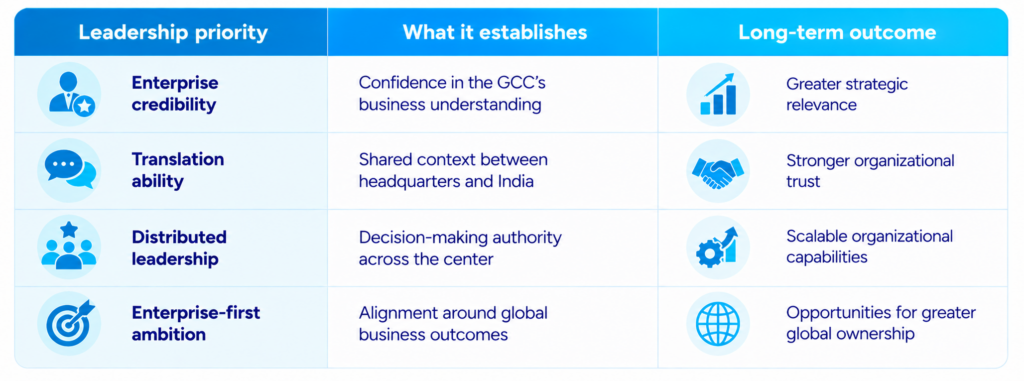
Trust is one of the foundations of an effective GCC operating model.
A US-headquartered company may establish a center in India with a clear business case, strong talent availability, and well-defined operational processes.
But those elements do not automatically create confidence between headquarters and the new organization.
Trust develops through shared business understanding, consistent execution, transparent decision-making, and clear accountability.
The first GCC leader plays an important role in establishing these conditions.
How GCC leadership builds trust and global ownership
The relationship is particularly important during the early stages of GCC setup.
Headquarters needs confidence that the India team understands the business and can deliver on its commitments.
The India team needs clarity on its responsibilities and the authority required to execute them.
The leader must build both.
Over time, this creates the conditions for the GCC to move beyond assigned work and take ownership of products, platforms, functions, and enterprise outcomes.
The leadership requirements of a new GCC are not necessarily the same as those of a mature center.
During the initial setup phase, the leader may focus on hiring, establishing operations, building relationships, and transferring knowledge.
As the center grows, the emphasis shifts toward developing functional leadership, distributing decision rights, and expanding the GCC’s contribution to the enterprise.
For example, a 100-person engineering GCC may initially need a leader who can build the team and establish credibility with headquarters.
As the center grows toward 500 employees, it may require dedicated product, engineering, architecture, and functional leaders who can take responsibility for global outcomes.
A GCC head who continues to manage every decision can become a bottleneck.
A leader who develops the next generation of decision-makers creates an organization that can scale.
The goal is to move from a center that depends on a strong individual to an institution with strong leadership at multiple levels.
That transition should be part of the GCC’s leadership strategy from the beginning.
The right GCC leader is not simply the person with the deepest knowledge of India or the most experience managing local operations.
It is someone who can connect the center to the global business, bridge differences between headquarters and India, develop future leaders, and advocate for the GCC without creating organizational conflict.
Nitika Goel summarizes Zinnov’s perspective:
“Don’t hire the person who can run India best. Hire the person who can make India matter to the enterprise.”
For US-headquartered companies, this changes how the first GCC leader should be evaluated.
The question is not only whether the candidate can hire teams, establish operations, and deliver results.
It is whether they can build the trust, credibility, and leadership capabilities that allow the center to take on greater responsibilities over time.
Because the first GCC leader is not just building a center.
They are building the trust architecture on which future ownership will sit.
Zinnov works with global enterprises across GCC strategy, setup, leadership hiring, organizational design, and transformation.
Having supported the setup of more than 220 GCCs, Zinnov helps companies align their leadership decisions with the center’s business mandate and long-term capability requirements.
Its GCC setup and execution approach connects center head hiring with operating model design, governance, talent strategy, and leadership development.
For US-headquartered companies establishing their first GCC in India, these decisions are particularly important because the initial leadership team shapes the center’s relationship with headquarters and its ability to take on future global responsibilities.
Zinnov helps enterprises identify the leadership capabilities and organizational structures needed to build GCCs that are integrated with the global business from the beginning.



 THANK YOU
FOR YOUR RESPONSE
