







For US enterprises looking to set up a Global Capability Center (GCC) in India, the opportunity is clear: access to specialized talent, AI capabilities, product engineering expertise, and long-term operational efficiencies. The challenge is execution.
How do you establish an India GCC, recruit your first 100 employees, manage compliance, and build operations without creating a large internal setup team?
This is where GCC-as-a-Service (GCCaaS) is gaining more relevance today. Rather than managing multiple vendors across legal setup, recruitment, infrastructure, HR, and operations, enterprises can work with a specialized partner to establish and scale their GCC while retaining strategic control.
GCC-as-a-Service is a partner-assisted model that helps enterprises design, establish, operate, and scale their Global Capability Centers.
In Zinnov’s Assisted Build & Operate approach, the enterprise owns its GCC from day one, while Zinnov supports setup, talent acquisition, operational management, and long-term transformation.
Unlike traditional GCC consulting, which may focus primarily on strategy, GCC-as-a-Service extends into implementation and operational execution. For US enterprises, this means building a company-owned capability center without having to independently manage every aspect of establishing operations in India.
As GCCs evolve from cost-focused offshore centers into global hubs for engineering, AI, product development, and innovation, enterprises increasingly need operating models that combine ownership with execution speed.
GCC-as-a-Service addresses three critical priorities:
The model is particularly relevant to enterprises establishing their first India GCC without an existing local leadership or operational infrastructure.
However, the right model depends on how much ownership, control, and operational responsibility an enterprise wants from the beginning.
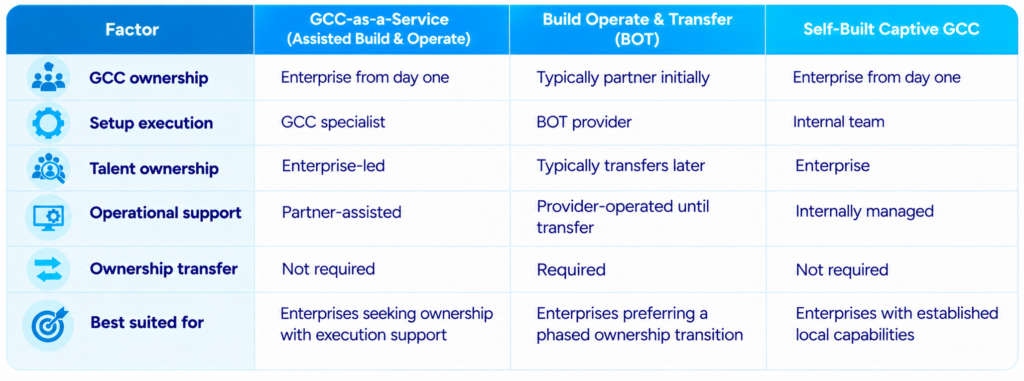
However, many enterprises are perplexed in choosing the perfect model for their center setup. Why is GCC-as-a-Service preferred over BOT?
For enterprises that already know they want a long-term, wholly owned GCC, Assisted Build & Operate can avoid the complexity of transferring employees, systems, and operations from a provider at a later stage. BOT remains relevant when an enterprise prefers the provider to own and operate the center initially.
The key distinction is simple: GCC-as-a-Service can combine enterprise ownership from day one with the operational support of an experienced setup partner.
Establishing a GCC involves more than hiring employees. Enterprises must align their business mandate, location, infrastructure, talent strategy, compliance, and operational governance.
Zinnov’s model addresses these challenges across three stages.
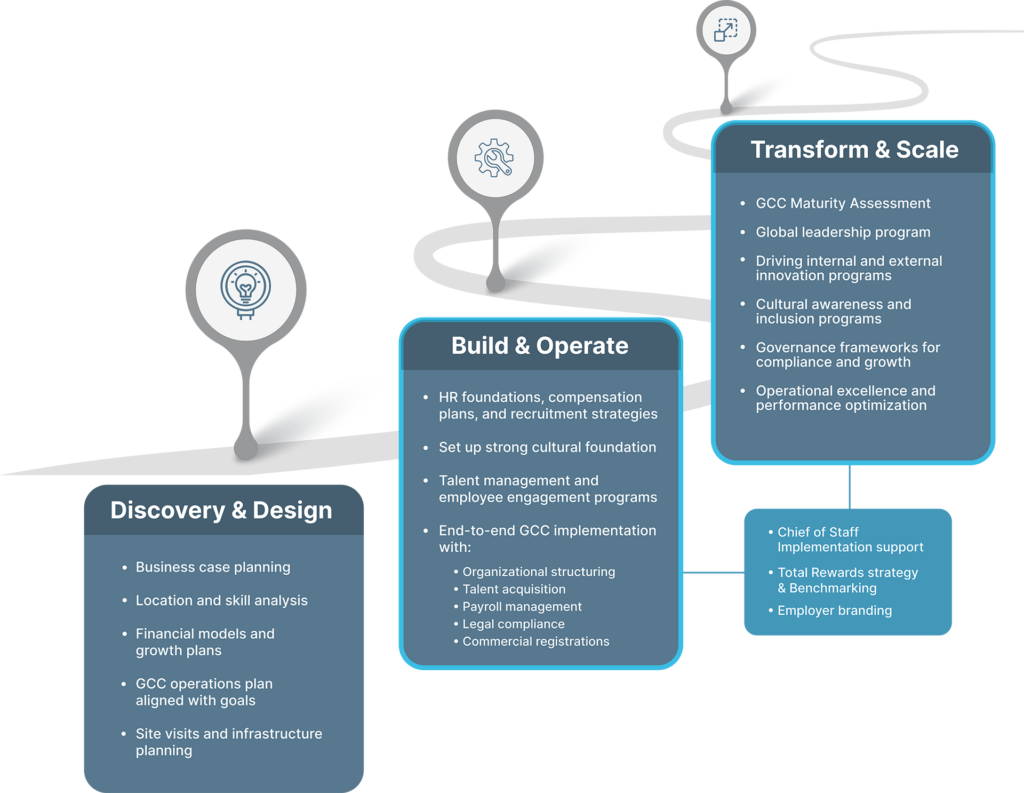
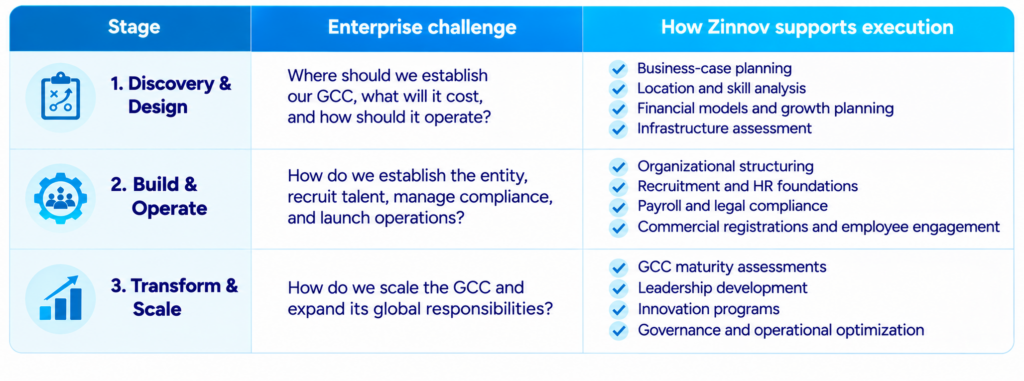
This integrated approach helps enterprises move from GCC strategy to operational execution and long-term capability development.
Zinnov’s GCC establishment and transformation experience provides a foundation for supporting enterprises across different industries, operating models, and growth stages
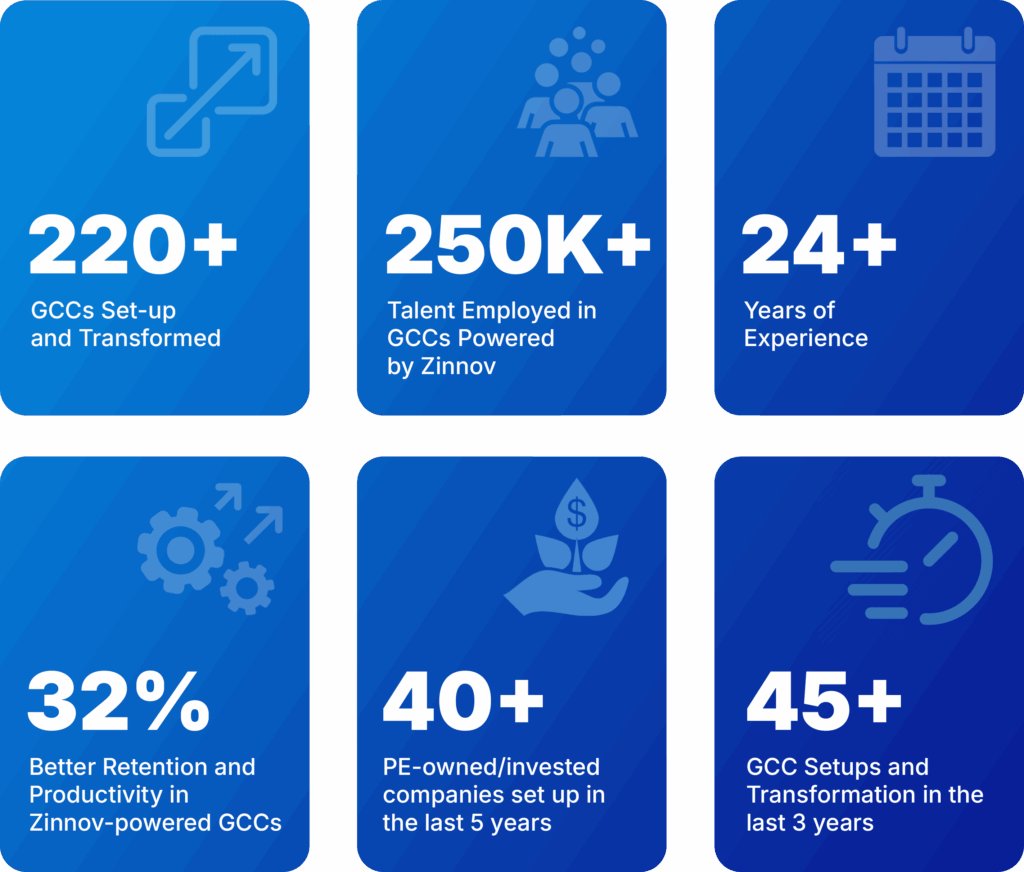
For US enterprises evaluating a GCC setup partner, execution experience matters more than advisory claims alone.
Wayfair: Accelerating a Bengaluru Technology Center
When US-headquartered Wayfair established its technology development center in Bengaluru, it needed to build a strong local engineering organization while navigating the complexities of entering a new market.
The center was designed to support Wayfair’s global technology ambitions, including product and engineering capabilities. The example illustrates how a specialist partner can help a global enterprise establish its India presence while allowing leadership to remain focused on core technology priorities.
Raksul: Establishing an India Technology Center
Japanese technology company Raksul established a Bengaluru center to strengthen its global technology capabilities.
The case demonstrates the value of local ecosystem expertise when an international company builds a technology presence in India.
Arrive: Building Engineering and AI Capabilities in Bengaluru
Arrive established a 20,000-square-foot Innovation Centre in Bengaluru to support engineering, product development, and AI capabilities.
This illustrates how an execution partner can help an enterprise bring together the foundational capabilities required to establish a technology and innovation center.
Storable: Establishing a Hyderabad GCC
US-headquartered Storable established a Global Capability Center in Hyderabad to strengthen its engineering and product development capabilities.
According to Inside Self-Storage, Storable partnered with Zinnov to facilitate the creation of its India GCC.
The example is particularly relevant to US technology companies evaluating India as a long-term product engineering destination.
MedExpert: Establishing a Healthcare GCC in Chennai
Healthcare technology company MedExpert selected Chennai for its first India Global Capability Center.
For healthcare enterprises, the example demonstrates the importance of combining domain-specific capability requirements with practical GCC establishment support.
Data Axle: Establishing and Scaling Its Pune Technology Center
US-headquartered Data Axle partnered with Zinnov to support the establishment of its Pune technology facility, strengthening its access to India’s technology talent ecosystem.
The success of a GCC depends not only on how quickly it launches, but also on how effectively it integrates with the global enterprise.
A capable GCC setup partner should demonstrate:
The right partner should help enterprises build a GCC that is designed for long-term value, not simply an offshore operation that meets its initial hiring target.
“A single function, whether IT, finance, or supply chain, can start a GCC without waiting for full organisational buy-in. We have seen Fortune 500 companies begin with less than 100 people and scale based on the success of that initial centre.”– Pari Natarajan- CEO & Co-founder- Zinnov, said on the Times of India.
A successful GCC is not simply an offshore extension. It is a strategic capability built to support global business priorities.
Build your GCC. Own your capabilities. Scale with confidence.



 THANK YOU
FOR YOUR RESPONSE

