





The first 50-100 employees of a Global Capability Center (GCC) do more than fill positions. They establish the center’s leadership, culture, technical capabilities, and credibility with global headquarters. The decisions made during this initial hiring phase can determine how successfully the GCC scales to its next 500 or 1,000 employees.
Key takeaways
Every GCC reaches a point when it stops being an idea on a presentation slide and starts becoming an institution.
That transition begins with the first people it hires. For companies setting up a GCC in India, the challenge is not simply recruiting 50 or 100 employees. It is assembling a founding team that can establish the quality bar, earn the confidence of headquarters, and build the capabilities required for future growth.
As Nitika Goel, Managing Partner and CMO at Zinnov, explains:
“They need to create the institution the next 900 people can join.”
So, how should enterprises approach their first 100 GCC hires?
Start with the leadership and technical foundation before expanding the workforce.
A successful GCC hiring strategy begins by identifying the people who will shape the organization, rather than simply filling the largest number of open positions.
The earliest hires should include the GCC site leader, functional leaders, product and architecture leaders, technical anchors, and individuals who can establish a strong organizational culture.
These roles matter disproportionately because they influence how subsequent employees are recruited, managed, and developed.
Consider a product engineering GCC. Hiring 80 developers before establishing strong product and architecture leadership may create delivery capacity. However, it does not necessarily create the ability to own a product, influence its roadmap, or make strategic technology decisions.
The difference is significant.
The first 20 employees can determine the quality of the next 500.
For enterprises establishing a GCC in India, the initial hiring priority should therefore be building the organizational spine: leaders and specialists who can establish direction, standards, and accountability.
A GCC should hire for the mandate it wants to own, not just the work it has on Day One.
Many organizations begin their GCC hiring plans by identifying immediate operational requirements: engineering capacity, technology support, analytics, or shared services.
While these capabilities are essential, they should not be the only consideration.
If an enterprise expects its India GCC to own a global platform, an AI charter, a product portfolio, or an enterprise-wide function within three years, some of the leadership and technical expertise required for that future responsibility must be established early.
Otherwise, the organization risks creating a center optimized for execution, only to spend several years redesigning its talent structure to support innovation and global ownership.
For example, an AI-focused GCC may initially require data engineers and machine learning specialists. But if its long-term mandate includes enterprise AI transformation, it may also need AI architecture leadership, product ownership, and governance capabilities from the beginning.
Hiring ahead of the mandate helps ensure the center can evolve without repeatedly rebuilding its organizational foundation.
The objective is not just to staff today’s GCC. It is to build the capabilities tomorrow’s GCC will need.
India’s GCC advantage extends beyond the size of its available talent pool.
It also comes from the concentration of experienced GCC professionals, technology specialists, startups, universities, industry networks, and technology partners.
For companies entering India for the first time, this ecosystem can be particularly valuable.
A newly established GCC may not immediately have the employer recognition of an established multinational. However, it can differentiate itself by offering meaningful global responsibilities, direct access to enterprise leadership, opportunities to build new capabilities, and ownership of strategically important products or functions.
These factors can be compelling for experienced professionals looking for roles with greater influence and accountability.
Companies should therefore consider the broader ecosystem as part of their GCC talent acquisition strategy, rather than treating hiring as a standalone recruitment exercise.
This also makes location strategy important. The right city or micro-hub should provide access not only to available employees, but also to the leadership, domain expertise, and adjacent capabilities required by the GCC’s mandate.
The strongest talent strategy connects the GCC’s purpose, its employer value proposition, and the ecosystem in which it operates.
A common mistake is treating the first 100 hires as a smaller version of the eventual 1,000-person organization.
This approach prioritizes headcount over institutional capability.
Three hiring decisions can limit a GCC’s long-term potential:
A more effective approach is to establish the leadership foundation, align hiring with the long-term mandate, and position the GCC as an opportunity to build and own capabilities of global significance.
The success of the first 100 hires should be measured by what they enable the GCC to achieve next, not simply by whether the hiring target was met.
Reaching 100 employees is an important operational milestone. However, headcount alone does not indicate whether the organization has built a sustainable foundation.
A more meaningful assessment asks three questions:
These measures help distinguish a center that is merely growing in size from one that is becoming more valuable to the enterprise.
As Nitika Goel emphasizes:
“The first 100 are not the beginning of scale. They are the design of the institution.”
Zinnov works with global enterprises across GCC strategy, setup, transformation, and scaling, including the talent and leadership decisions that shape a center’s long-term success.
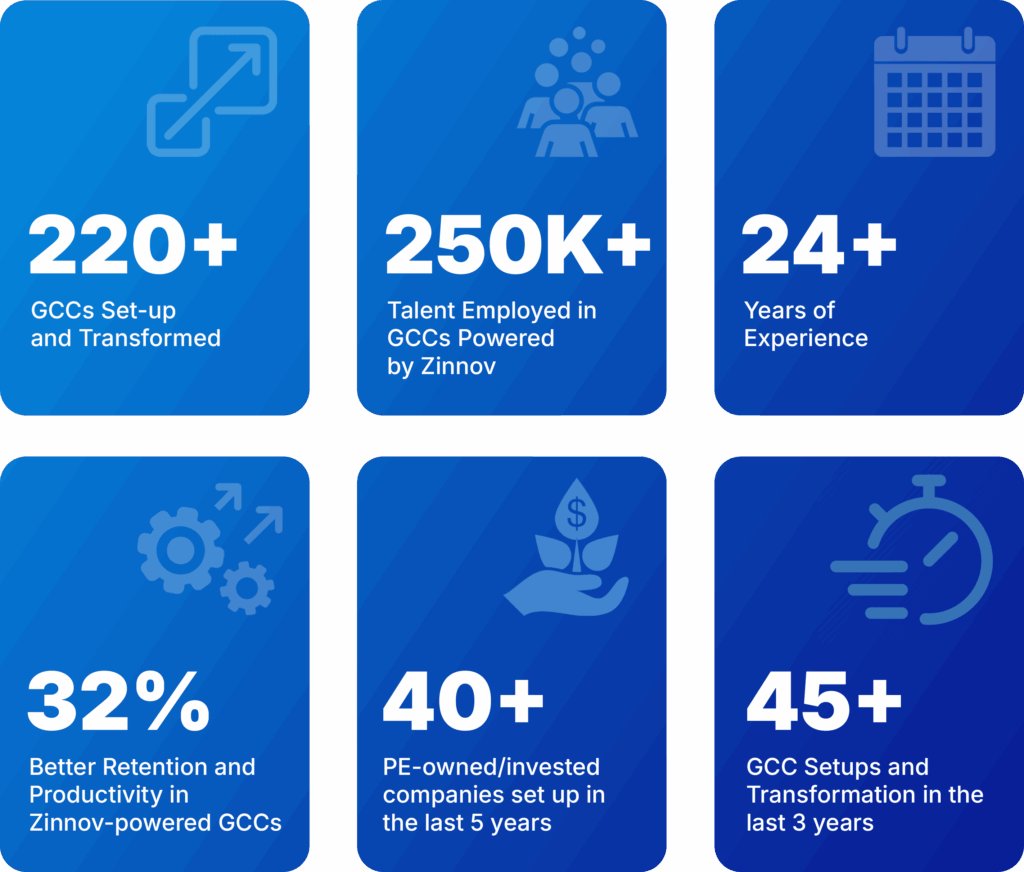
Its GCC setup approach connects early workforce planning with the center’s long-term enterprise mandate, helping companies build the organizational foundation required for sustainable growth.
For enterprises entering India, this means looking beyond recruitment targets to determine which leaders, technical capabilities, and talent ecosystems will enable the GCC to deliver strategic value.
Planning to set up a GCC in India? Build the right first 100.



 THANK YOU
FOR YOUR RESPONSE
