







Software is entering one of its most consequential transitions since Cloud Computing. For decades, differentiation centered on speed, scale, or usability – how efficiently products helped humans get things done. But the rise of Agentic AI is rewriting this equation entirely.
Agentic AI can interpret goals, reason across contexts, and act autonomously within workflows. In this new paradigm, products stop being tools that wait for instructions and instead become intelligent participants in business operations – capable of closing tickets, reconciling accounts, drafting code, or managing infrastructure with minimal human input.
This shift is creating both opportunity and urgency for business leaders. Building systems that operate autonomously demands new technical architectures, new business models aligned to outcomes, and faster innovation cycles. And while the transition feels early, the momentum is unmistakable – pushing companies of all size and shape into a race to define the future of intelligent, outcome-driven software.
This sets the stage for a rapidly evolving ecosystem – one where new archetypes are emerging to define the next era of enterprise intelligence.
As enterprises seek systems that deliver outcomes rather than just execute tasks, the software landscape is reorganizing into five clear categories- each capturing a distinct layer of the Agentic AI value chain.
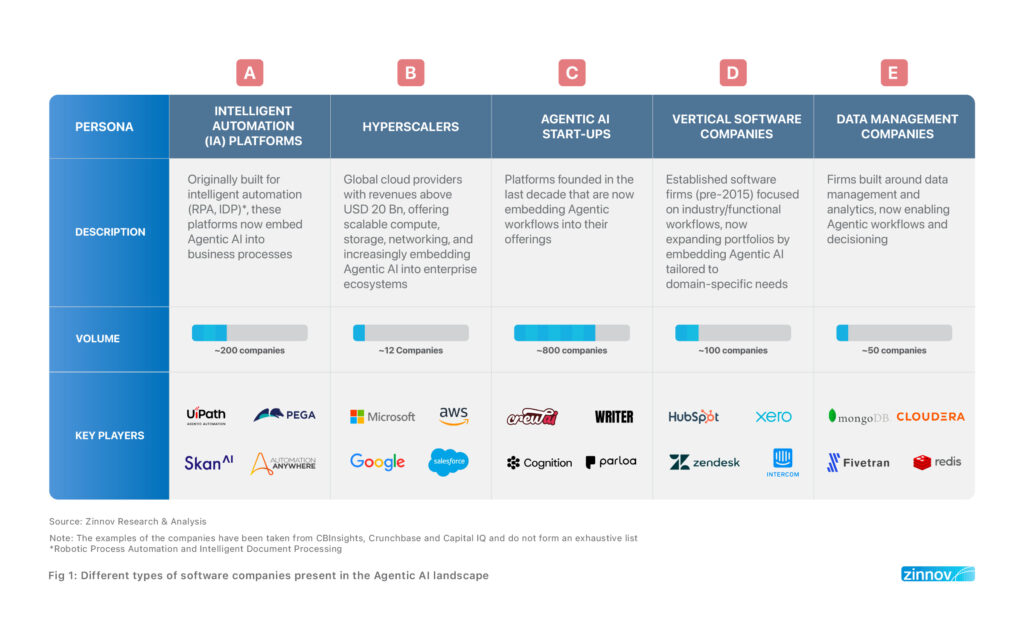
Together, these players span the full Agentic AI technology stack – Interface, Agent, Model, Intelligent Tooling, and Data & Infrastructure – all converging toward more autonomous enterprise solutions.
(Read our detailed Agentic AI POV here for a deep dive into the full technology architecture.)
Over the past 18 months, more than 50 Agentic AI acquisitions have been announced globally, a majority led by Software companies looking to embed agentic capabilities directly into their platforms
Notably, much of this activity is concentrated in the Agent layer, where innovation around multi-agent orchestration, contextual reasoning, and no-code builders is accelerating fastest.
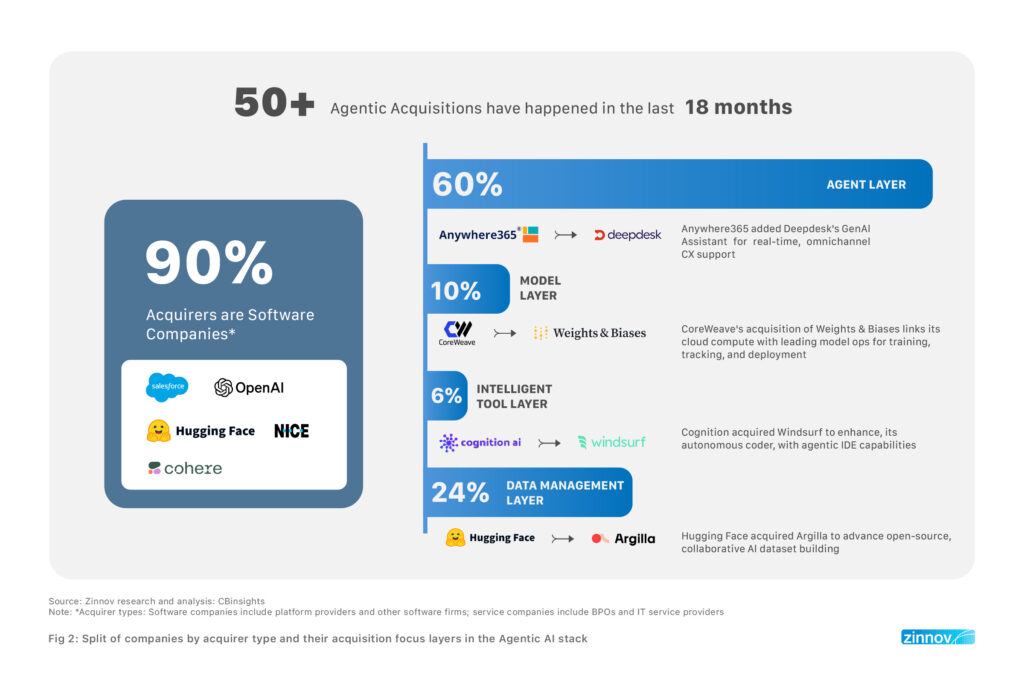
Nearly three-fourths of acquirers already possessed some Agentic capability, signaling a deepening of commitment rather than a first step. Deal patterns reveal:
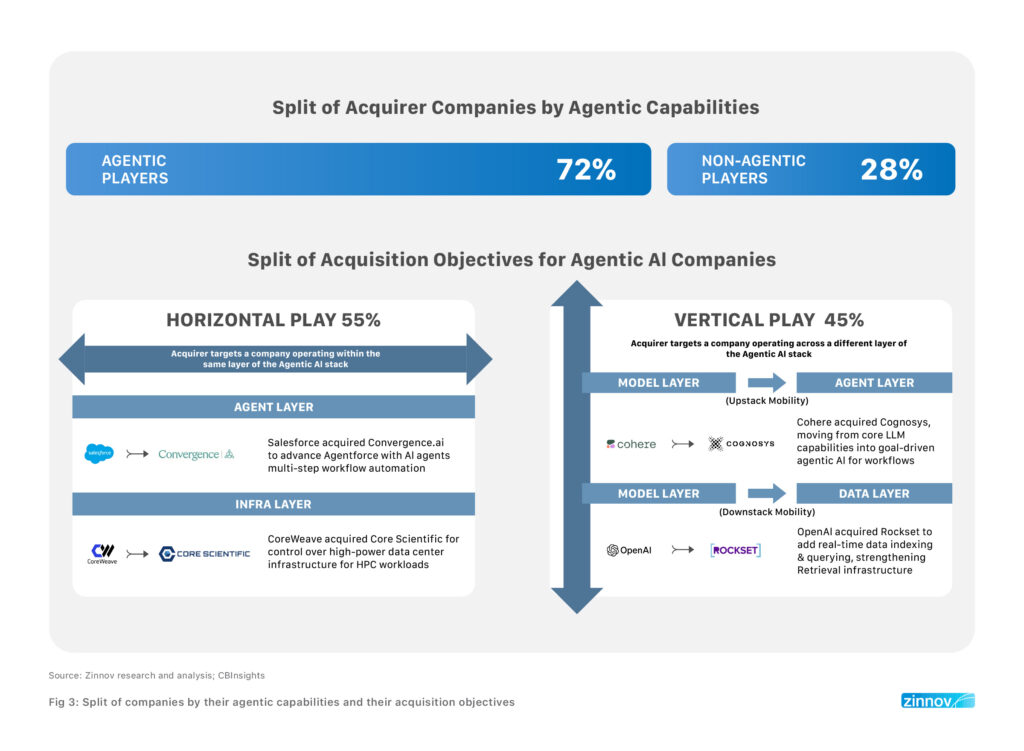
The takeaway is simple: Software firms have moved beyond waiting for Agentic AI to mature and are actively shaping it through investment, integration, and acquisition.
This leads to an important question: What exactly is driving this surge in Agentic M&A?
Behind every wave of consolidation lies a moment of clarity, when market leaders realize that building alone can’t keep up with the speed of innovation. That’s exactly where software companies find themselves today.
Zinnov’s analysis points to a set of structural drivers that are shaping this M&A momentum:
Agentic AI enables products to perform tasks typically handled by outsourced service teams – from customer onboarding to invoice management to support resolution. This unlocks:
Example: Zendesk’s acquisition of Ultimate.ai in 2024, a customer-support automation start-up, to embed multilingual, reasoning-based agentic capabilities directly into its helpdesk platform.
2. The Capability Gap Pressure
This pivot toward Agentic AI has widened the distance between vision and execution. Even mature platforms now recognize that their deterministic, rule-based systems cannot support the autonomy and self-learning customers now expect.
Each quarter without agentic capability risks lost relevance, as newer platforms set the standard for autonomy and self-learning workflows.
To bridge that gap, software companies are acquiring technologies that inject reasoning, memory, and orchestration directly into their existing stacks accelerating readiness without waiting for multi-year rebuilds.
Example: ServiceNow’s acquisition of Cuein in 2025 addressed a key capability gap by adding conversational data analysis to advance next-gen AI agents on its platform.
3. The Full-Stack Imperative
Leaders realize that controlling only one layer (data, workflow, or interface) isn’t enough. Full-stack coverage enables faster innovation, tighter integration, and more wallet share.
Example: UiPath’s acquisition of Peak.ai in 2025 highlights its shift from a core focus on automation and custom agent creation to incorporating verticalized Agentic capabilities, marking a step toward a more comprehensive stack.
4. The Talent Advantage
Agentic AI demands a kind of engineering talent that most software companies are trying their best to have access to. Expertise in multi-agent systems, reasoning logic, and autonomous architectures is scarce. Acquiring entire teams is the fastest path to capability infusion – battle-tested developers, architects, and product leaders who have already solved complex problems in autonomy and scaling.
Example: Google’s acquisition of Windsurf in 2025 was a pure acqui-hire, absorbing a team of researchers and engineers known for building advanced agentic coding framework.
5. The Ecosystem Consolidation Momentum
Control over integration points, developer ecosystems, and data pipelines will determine who dominates the enterprise Agentic layer.
To secure that position early, Software companies are acquiring complementary platforms that strengthen interoperability and lock in ecosystem leverage.
Example: CoreWeave’s acquisition of Weights & Biases in 2025 unified compute, model tracking, and orchestration into a single ecosystem, allowing developers to train and deploy agents seamlessly.
The Agentic wave is advancing faster than most product roadmaps can adapt. Software companies now face a fundamental choice: build slowly and risk irrelevance, or acquire rapidly to close capability gaps and shape the emerging ecosystem.
For software leaders, the opportunity is immediate: Act before the stack stabilizes, acquire before the standards settle, and shape the future before someone else does. Because in the Agentic era, speed isn’t a strategy, it’s survival.



 THANK YOU
FOR YOUR RESPONSE
THANK YOU
FOR YOUR RESPONSE

