





Most companies test their readiness for a Global Capability Center with a savings calculation. The companies that build lasting centers also test two other things: whether they are building the right center, and whether they are building it right.
Key takeaways
Most conversations about setting up a GCC in India start with one question: how much can the company save by moving work there? The answer matters, and it usually decides whether the business case gets approved. Nitika Goel, Managing Partner and CMO at Zinnov, puts savings in its place:
“Cost arbitrage is real, and it should absolutely be a part of the business case, but it’s only one signal.”
The other signals tell a company whether it is ready, and they are harder to calculate.
Zinnov breaks readiness into two tests, which Nitika Goel puts as a pair of questions:
“Are you building the GCC right, and are you building the right GCC?”
The order matters in practice. Building the right GCC comes first, because it settles what the center is for. Building the GCC right comes second, because location, leadership and governance only make sense once the purpose is clear. A company that reverses the order ends up with a well-run center doing the wrong job.
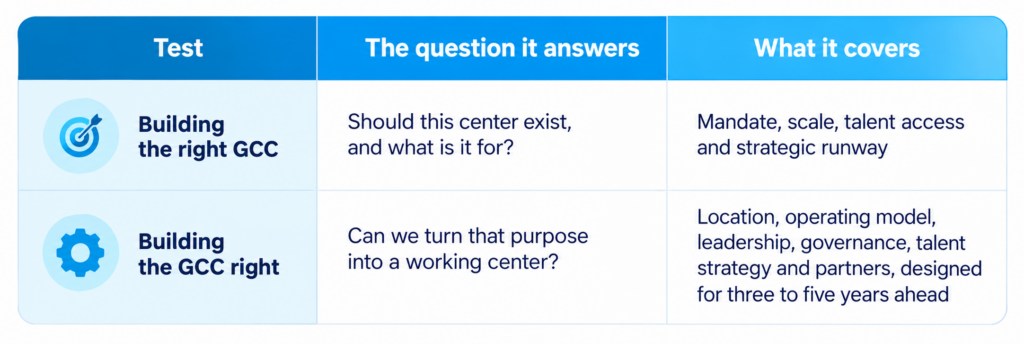
Zinnov uses four questions to decide whether a center should exist and what it should be built to do.
Is there a mandate India can own? Nitika Goel’s version of the question sets a high bar: “Do you have a meaningful mandate that India can own, not simply work that can be reallocated?” A mandate means accountability for an outcome, such as a product, a platform or a function. A list of tasks moving offshore does not meet that bar.
Is there enough scale to justify a dedicated center? A GCC carries fixed costs: an entity, leadership, facilities and compliance. The volume of work and the economic advantage have to be large enough to cover them. For some companies, the honest answer today is “not yet.” A partner-led arrangement can serve them until scale arrives.
Can India give the company talent it struggles to build elsewhere? This test asks whether India offers access to skills that are hard to hire at home, particularly in technology, engineering, data and AI. Access to cheaper versions of skills the company already has is a weaker basis for a center.
Is there runway for the center to grow? A ready company can see how the center will take on more complex work and global ownership over time. A center with no path beyond its first assignment will stay at its starting size and scope.
A company that answers all four with confidence knows what it is building. One that can answer only the second has a savings case and still has to find its reason to build.
Once the purpose is clear, the company has six design choices to make from day one. They fall into three pairs.
The first pair is where and how: the location and the operating model. The city decides the depth of talent the center can draw on. The operating model decides who owns the entity, talent and IP, and when.
The second pair is who leads and who decides: the leadership structure and governance. They settle whether the center head can set direction or only executes it, and which decisions can be made in India without going back to headquarters.
The third pair is who does the work: the talent strategy and the partner ecosystem. They determine how the first team is hired, which capabilities are built in-house and which come through partners.
Each of these is expensive to reverse once the center is running, which is why they need to be settled before launch.
A center designed only for its first year will be measured, staffed and governed for its first year. Nitika Goel’s warning:
“A GCC today built only on the cost equation can quickly become tomorrow’s constraint.”
Here is an illustration of how that happens.
A company sets up a center to take over testing and maintenance, chooses its location for the lowest cost of talent, and hires a center head to run delivery. It passed the scale test comfortably and never asked the other three questions. Three years later, headquarters wants the center to own a product.
The center has no mandate to build from. The city’s talent pool is thin in product engineering, the center head has no remit to set a roadmap, and every significant decision still goes back to headquarters. The center that saved money now has to be partly rebuilt before it can do more.
A company designing for three to five years ahead makes the same six choices with that future in view. It picks a location with depth in the capabilities the center will need, hires leadership that can grow into ownership, and sets up governance that can hand authority to India as the center matures.
A strong savings case is necessary and still leaves most of the readiness test open. Nitika Goel’s closing line sums up what Zinnov calls its signal on the question:
“Economics may justify the GCC, but mandate, talent, ownership and design will determine whether it creates enduring enterprise value.”
Zinnov has helped enterprises set up and transform more than 220 GCCs.
Its GCC-as-a-Service model works through both tests: defining what the center is for, then designing and launching it, covering location, entity setup, center head hiring and the first team. The enterprise owns the center from day one.



 THANK YOU
FOR YOUR RESPONSE
