





There is no single best city for setting up a Global Capability Center (GCC) in India. The right location is not necessarily the most affordable or the one with the largest talent pool.
It is the city, and increasingly the micro-hub within it, that best supports the GCC’s mandate, ecosystem needs, and long-term growth.
Key takeaways
When companies plan to set up a GCC in India, one of the first questions is often: Which city should we choose? Bengaluru or Hyderabad? Pune or Chennai? Which location offers the best talent at the lowest cost?
These are important considerations, but they do not necessarily lead to the right decision.
Nitika Goel, Managing Partner and CMO at Zinnov, challenges the assumption that there is one ideal location for every GCC:
“There is no best GCC city, and the most affordable city is often not the highest-value choice. The right location is the one that best fits the mandate you are building.”
The distinction matters. A city that works well for a large-scale operations center may not be the right choice for a product engineering, AI, or R&D GCC.
Zinnov evaluates GCC location decisions through three questions:
Together, these questions shift location selection from a cost comparison to a capability decision.
Three factors for choosing the right GCC location
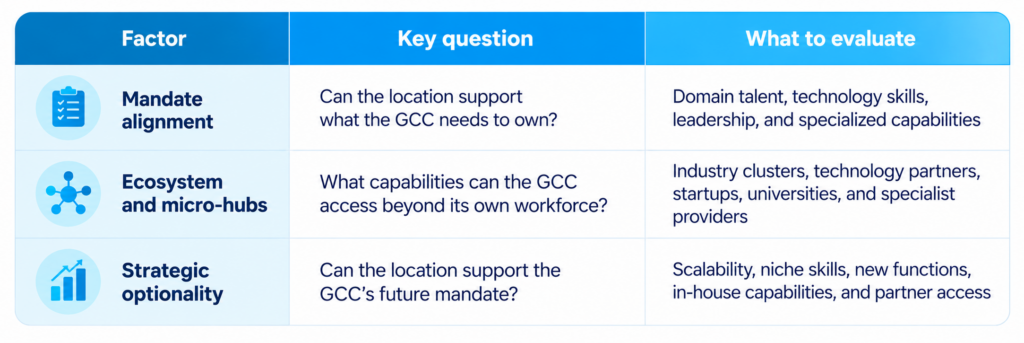
The first question is not simply whether a company can hire enough people in a city. It is whether the location provides the capabilities required for the GCC’s specific purpose.
Nitika Goel explains:
“The value of a GCC is increasingly defined by what it can own, not how large it becomes.”
A company establishing a product engineering GCC needs access to architects, engineering leaders, product talent, and specialized technology skills. A healthcare GCC may need professionals with domain expertise, data capabilities, and an understanding of regulated environments.
Both companies could consider the same cities, but their ideal locations may differ because their mandates differ.
This is why workforce availability alone is an incomplete measure of location attractiveness.
The better question is not how many people can be hired, but whether the location can help the GCC take ownership of higher-value work.
A location that supports today’s hiring needs but lacks the capabilities required for tomorrow’s mandate can limit the center’s growth.
A strong GCC location is more than a large talent market. It is an ecosystem of capabilities that the center can access without building everything internally.
Nitika Goel identifies technology partners, specialist providers, startups, universities, peer GCCs, and industry networks as important parts of that ecosystem.
“The best GCCs do not build every capability themselves. They orchestrate what they own and what they access through the ecosystem.”
For example, a GCC developing AI-powered products may benefit from proximity to AI talent, research institutions, cloud technology partners, and specialized startups.
These connections can help the center access expertise, develop capabilities, and respond to changing business requirements.
One mistake companies make is treating an entire city as a single talent market.
Bengaluru, Hyderabad, Pune, and other GCC destinations contain multiple employment clusters, each with different concentrations of industries, skills, employers, and supporting infrastructure.
Nitika Goel explains:
“The real question is not simply Bengaluru or Hyderabad. It is which subcluster within the city gives you access to the talent and ecosystem your mandate needs.”
Two locations within the same city can offer very different advantages.
A technology corridor with a strong concentration of product engineering companies may be better suited to one GCC mandate, while a cluster with established healthcare or financial services capabilities may be more relevant to another.
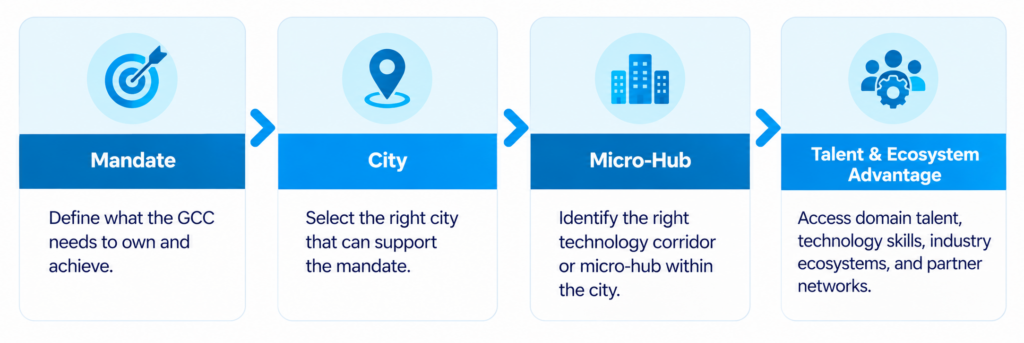
The decision is therefore not just which city to enter, but which micro-hub offers the strongest alignment with the GCC’s mandate.
A GCC’s mandate rarely remains unchanged. A center may begin with technology delivery or business operations and later expand into product ownership, AI, engineering, analytics, or enterprise-wide functions.
The third question is whether the chosen location provides the flexibility to support that evolution.
Nitika Goel calls this strategic optionality:
“Can you add new capabilities, tap niche skills, bring work in-house, or use partners as the mandate evolves?”
Consider a company setting up a GCC with an initial mandate focused on software development. Over the next three to five years, it may want the center to own product architecture, develop AI capabilities, or lead global platforms.
If the chosen location cannot provide the required leadership, specialized talent, or supporting ecosystem, expansion becomes more difficult.
A location selected purely for its initial cost advantage may therefore become a constraint as the center grows.
The right GCC location should support both what the center needs to deliver today and what the enterprise may want it to own tomorrow.
There is no universal winner. Bengaluru, Hyderabad, Pune, Chennai, Delhi NCR, and other Indian GCC destinations offer different combinations of technology talent, industry ecosystems, leadership availability, infrastructure, and operating costs.
The right choice depends on the capabilities the company intends to build.
For example, a company establishing an AI and product engineering GCC may prioritize access to specialized technical talent and innovation ecosystems. A company building a finance or enterprise operations GCC may place greater weight on functional expertise, operational scale, and industry-specific talent.
Comparing cities only on salary levels, real estate costs, or total workforce size can overlook these differences.
Cost-led vs. mandate-led GCC location selection
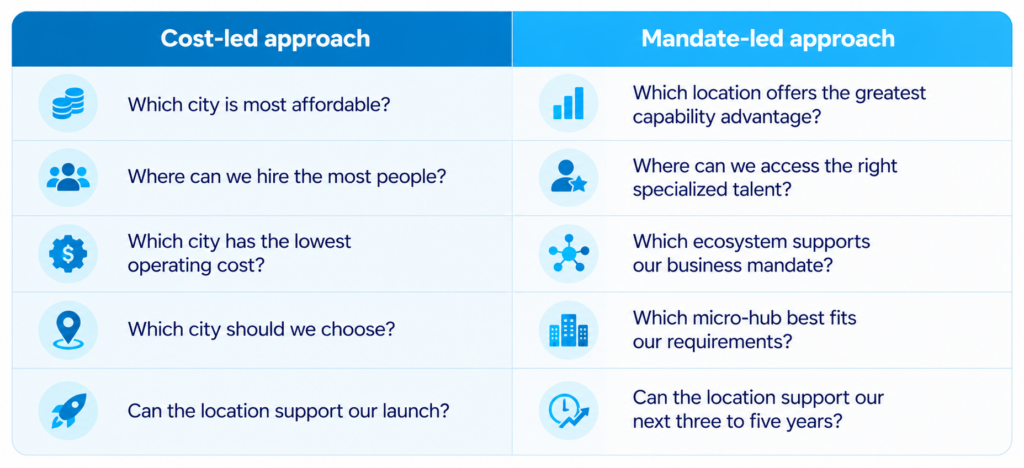
The goal is not to ignore cost. It is to evaluate cost alongside the capabilities and long-term enterprise value the location can deliver.
Traditionally, location decisions have focused heavily on operating expenses, workforce availability, and ease of setup. These factors remain important, but they do not fully capture what a modern GCC is expected to achieve.
As GCCs take on more complex responsibilities across engineering, AI, product development, and enterprise operations, their location must support capability ownership and long-term innovation.
Nitika Goel summarizes Zinnov’s perspective:
“Don’t choose a city for how many people you can hire. Choose the ecosystem and increasingly the micro-hub that gives you the greatest capability advantage.”
That changes how companies should evaluate potential GCC destinations.
The question is no longer simply where a center can operate efficiently. It is where the center can build capabilities that create a sustained advantage for the enterprise.
The right GCC city is the one that can support your mandate, connect your center to the right ecosystem, and provide the flexibility to evolve over time.
A company choosing a location should be able to answer three questions with confidence: Does the location have the talent and leadership our mandate requires? Can we access the right industry ecosystem and micro-hub? And can this location support the capabilities we may need in the future?
Nitika Goel’s closing observation captures the principle:
“That is what turns location from a cost decision into a value creation decision.”
Zinnov helps global enterprises evaluate GCC locations based on their business mandates, talent requirements, industry ecosystems, and long-term capability needs. Its GCC setup and execution approach connects location strategy with the broader decisions involved in building a center, including operating model design, leadership hiring, talent strategy, and launch execution.



 THANK YOU
FOR YOUR RESPONSE
