





AI-native GCCs are not considered a myth, but they are still rare. While almost every GCC in India has an AI story, Zinnov-nasscom data shows that only 5% have reached the stage characterized by AI-native operations. The ambition is widespread, but true AI-native maturity remains limited.
Asked whether AI-native GCCs are a myth, Nitika Goel, Managing Partner and CMO at Zinnov, says they exist and are rarer than the label suggests: “the term is being used far more loosely than reality warrants.” The gap between the label and the operating reality is where enterprises risk misjudging their own centers.
An AI-native GCC is a center where AI is embedded in the operating model itself. Zinnov looks for three markers.
By that test, adding tools does not change a center’s category. A GCC with thousands of Copilot seats and a busy AI center of excellence can still run on the same team structures, handoffs and approval chains it had in 2020.
The AI-native GCC therefore sits at the frontier of the ecosystem, well short of its median. For an enterprise assessing its own center, the base rate is the useful starting point. Most centers describing themselves as AI-native are, on this evidence, still adding AI to a model that predates it.
The difference lies in how far the operating model has been redesigned around AI.
Exhibit 1. Three levels of AI maturity in a GCC
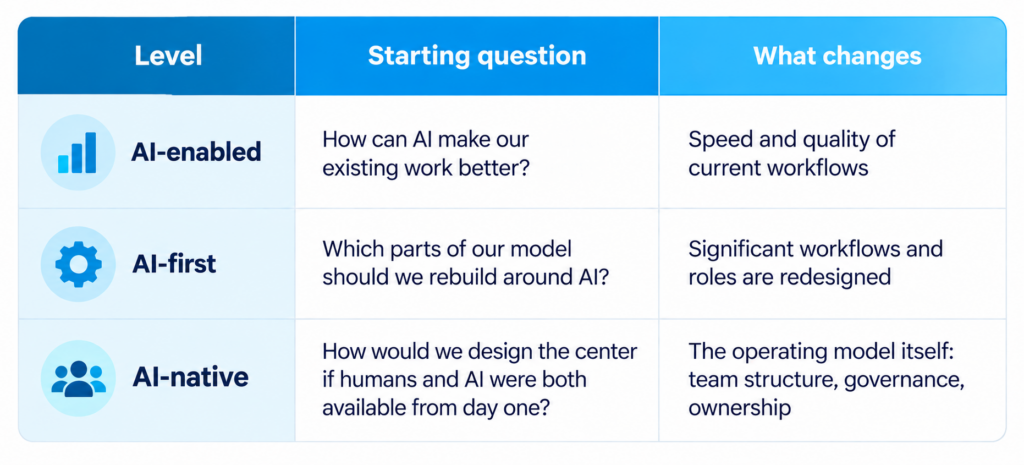
Nitika Goel frames the AI-native question this way:
“If humans and AI were both available from day one, how would we design a center around it all?”
An engineering team shows the difference. Take an illustrative example.
Under the traditional path, a GCC took about a decade to climb from delivery center to portfolio hub.
That compresses the decision. An enterprise setting up a center today chooses whether to design an AI-native operating model at launch. Waiting means retrofitting one later, and a retrofit is the harder path.
It can, and the route runs through redesign. An established center has to rethink which work agents carry, how teams are sized and where governance sits, while keeping existing delivery commitments running. That is harder than designing from scratch. Established centers also hold advantages new ones lack: deep domain knowledge, institutional trust with headquarters and data that took years to accumulate. Those advantages are what an AI-native operating model needs to produce results.
The center exists, at the frontier of India’s ecosystem. Nitika Goel locates the myth elsewhere:
“The myth is believing that adding AI to a traditional GCC automatically makes it one.”
Her closing line gives leaders the test to apply to their own center:
“AI native is not a technology label. It is an operating model choice.”
Zinnov has helped enterprises set up and transform more than 220 GCCs. Its GCC-as-a-Service model helps companies design new centers around AI from day one, and its transformation practice helps established centers redesign their operating models.



 THANK YOU
FOR YOUR RESPONSE
THANK YOU
FOR YOUR RESPONSE
