







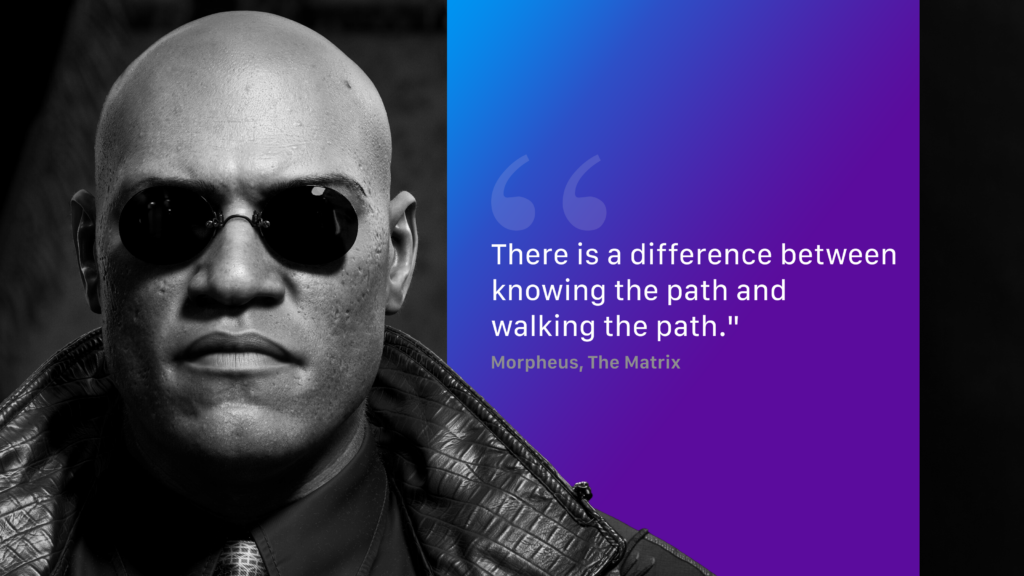
That’s the GCC-AI story right now. Every center knows the path. The strategy decks are sharp. The pilot portfolios are growing. The boardroom conviction is real. But walking the path, getting AI from the slide into production, from the demo into the workflow, from the experiment into the operating model, that’s where the story gets honest.
Across our engagements, 92% of GCCs in India are now piloting or scaling AI use cases. Over 70% of their leaders tell us they have no structured way to measure whether any of it is delivering value.
Those numbers alone would make for an interesting adoption story. But the real story is deeper. It’s about what AI is doing to the foundations the GCC model was built on.
For twenty years, GCCs have been built on a single bet: that the ability to execute is the bottleneck. Five hundred engineers who can build it, forty to sixty percent cheaper than headquarters. The entire model, hiring, KPIs, the relationship with the parent company, was architected around delivering capability at volume.
AI is breaking that bet.
Ivan Zhao, Notion’s CEO, framed it well. Human value falls into three buckets: capability (what you can do), judgment (what you should build), and agency (whether you can will it into the world). AI has flooded the first bucket. Coding, the scarcest capability in technology three years ago, is becoming abundant. The bottleneck has moved to judgment. Taste. Context. The ability to make the right call when the answer isn’t obvious.
Most GCCs were built entirely around Bucket 1. That was the right bet for twenty years. It isn’t the right bet for the next five.
Jensen Huang put the choice that follows from this simply: AI only destroys jobs if the world runs out of ideas. Productivity without ambition equals headcount cuts. Productivity with ambition equals growth. If your GCC teams just became meaningfully more productive, the question is whether you redeploy that capacity into roadmap backlog, customer experience gaps, and new markets, or harvest it as savings and quietly stop building.
That choice, made explicitly or by default, will determine what the GCC becomes over the next three years.
The GCCs making real progress with AI share a design principle that most centers haven’t adopted yet. They didn’t install the steam engine in the water mill factory. They redesigned the factory around the new energy source.
A global financial services company’s India GCC didn’t begin its AI journey by hiring data scientists or standing up a Center of Excellence. They sat with their operations team, mapped every decision point in a core workflow, identified what required human judgment and what didn’t, redesigned the handoffs, and built the AI to fit the new process. The result was a production system processing real work, not a pilot waiting for the next quarterly review.
A global consumer goods company took the same instinct in a different direction. Instead of scattering AI pilots across ten departments, they picked one domain, marketing, and went deep, applying AI across insight generation, content creation, and product development as one connected system where each application fed the next. The compounding was visible within months.
These centers aren’t just adding AI tools. They’re transferring decision rights. Moving from capability centers to judgment centers, where India owns product decisions, challenges architectural choices, and brings cross-market context that headquarters doesn’t have.
What no one talks about: most GCCs default to bolt-on AI, copilots layered on existing processes, an “AI Center of Excellence” on the org chart, because embedded AI requires someone to make a call about the future shape of the operation. The companies making the shift break roles into tasks (automate, augment, or upskill) and build a skills graph where people become the unit of planning. That redesign changes everything downstream. In most GCCs, the conversation that triggers it hasn’t happened yet.
Here’s the finding that should unsettle every GCC leadership team considering this shift. When we talk to leaders, they report limited AI adoption and low skills maturity. When we talk to their employees separately, the picture is different, higher proficiency, more frequent use, more comfort with AI tools than leadership realizes.
We see this often enough that it deserves a name. Call it the adoption visibility gap. Most GCCs measure breadth, how many teams have access. Almost none measure depth, how deeply AI is woven into actual work. The depth is where the return lives.
What no one talks about: your people may have figured out AI before you did. Every investment decision, every scaling plan is being set against a picture that understates what’s already happening on the ground. The GCCs that close this gap instrument adoption at the workflow level, they track what people do with AI, not just whether they have the tools. That visibility changes the entire conversation about what to fund, what to scale, and what to stop.
Once you can see what’s happening on the ground, a consistent set of gaps comes into focus. They show up across industries, company sizes, and GCC maturity levels.
The handoff gap. In most GCCs, nobody owns the space between a successful pilot and a production deployment. Engineering builds the proof of concept. The business sponsor approved the budget but didn’t commit to changing how the function operates. The GCCs that ship to production assign a business owner to every AI initiative expected to go live. That single decision changes more trajectories than any model improvement.
The data gap. Two-thirds of GCC leaders we work with cite fragmented data as their primary barrier. Most enterprise data was built for reporting, dashboards, summaries, batch processing. AI needs data that is clean, governed, continuously refreshed, and structured for machines. The GCCs scaling fastest made an early, unglamorous decision: data infrastructure before models. The ones still stuck built models on curated sandbox data and discovered, expensively, that production data is a different world
The governance gap. Air Canada’s chatbot invented a refund policy that didn’t exist. A customer relied on it, booked the flight, applied for the discount. Air Canada argued it couldn’t be held liable for what its chatbot said. The tribunal rejected that outright. At a major technology company, engineers pasted proprietary source code into an LLM, three leaks in three weeks. They weren’t acting in bad faith. They had no policy telling them what could and couldn’t go into an AI tool. Enterprise governance was built for deterministic systems. AI is probabilistic. Most compliance teams haven’t caught up.
The talent gap. The shortage isn’t data scientists. It’s people who can connect a model to a business outcome, domain experts with AI fluency, business leaders who can redesign processes rather than layer AI on top. The most effective GCCs build fusion teams where the AI engineer brings the engine, and the domain expert brings the map.
The measurement gap. If the AI metrics in your review are headcount loaded, utilization rates, and pilots launched, you’re tracking activity. The metrics that reveal compounding: cycle time reduction, models in production, experiment velocity, error rates, customer experience movement.
What no one talks about: these five gaps are connected. The visibility gap means leadership underestimates what’s happening. The handoff gap means what is happening can’t reach production. The data gap means production isn’t ready even when the organization is. The governance gap means risk accumulates ungoverned. The talent and measurement gaps mean the center can’t prove value even when it’s creating it. They compound together. The GCCs that treat them as separate workstreams find that progress in one area stalls because of unresolved gaps in another.
The GCCs that address these gaps together don’t just solve an adoption problem. They become a different kind of center. They stop delivering capability and start delivering judgment. They stop supporting headquarters and start shaping decisions. They stop being measured on people loaded and start being measured on outcomes owned.
That transition, from Bucket 1 to Bucket 2, is the real AI transformation in GCCs. Not the copilots. Not the pilots. Not the slide deck. The organizational shift from a center that executes to a center that decides.
What no one talks about: the talent retention question in AI comes down to credibility. The best engineers can tell the difference between an organization that ships and one that talks about shipping. Twenty pilots with no path to production is the loudest signal a GCC can send. The people you most need to keep are the ones who read that signal first. The GCCs retaining their strongest AI talent are the ones where production deployments are visible and where the center’s mandate is genuinely expanding, not just its headcount.
If you’re leading a GCC, you already know AI matters. The question is what your center is becoming because of it.
Are you redesigning the factory around the new energy source, or installing steam engines in the water mill? Are you transferring decision rights to India, or adding AI tools to the same capability at volume model? Are you measuring judgment and outcomes, or still counting heads and pilots?
And the most uncomfortable question: have your people already started the shift without you? The adoption visibility gap tells us your organization may be further along than your dashboards suggest. Or further behind than your strategy deck claims. Either way, closing that gap, between the AI on the slide and the AI in production, between the capability you’re buying and the judgment you could be building, is where the real work starts.
This is the 6th piece in our What No One Tells You series on Global Capability Centers (GCCs). If you’re new here, the earlier articles cover ground worth reading first:



 THANK YOU
FOR YOUR RESPONSE
THANK YOU
FOR YOUR RESPONSE

