




BACK TO GCCs Unfiltered
ZINNOV PODCAST | GCCs Unfiltered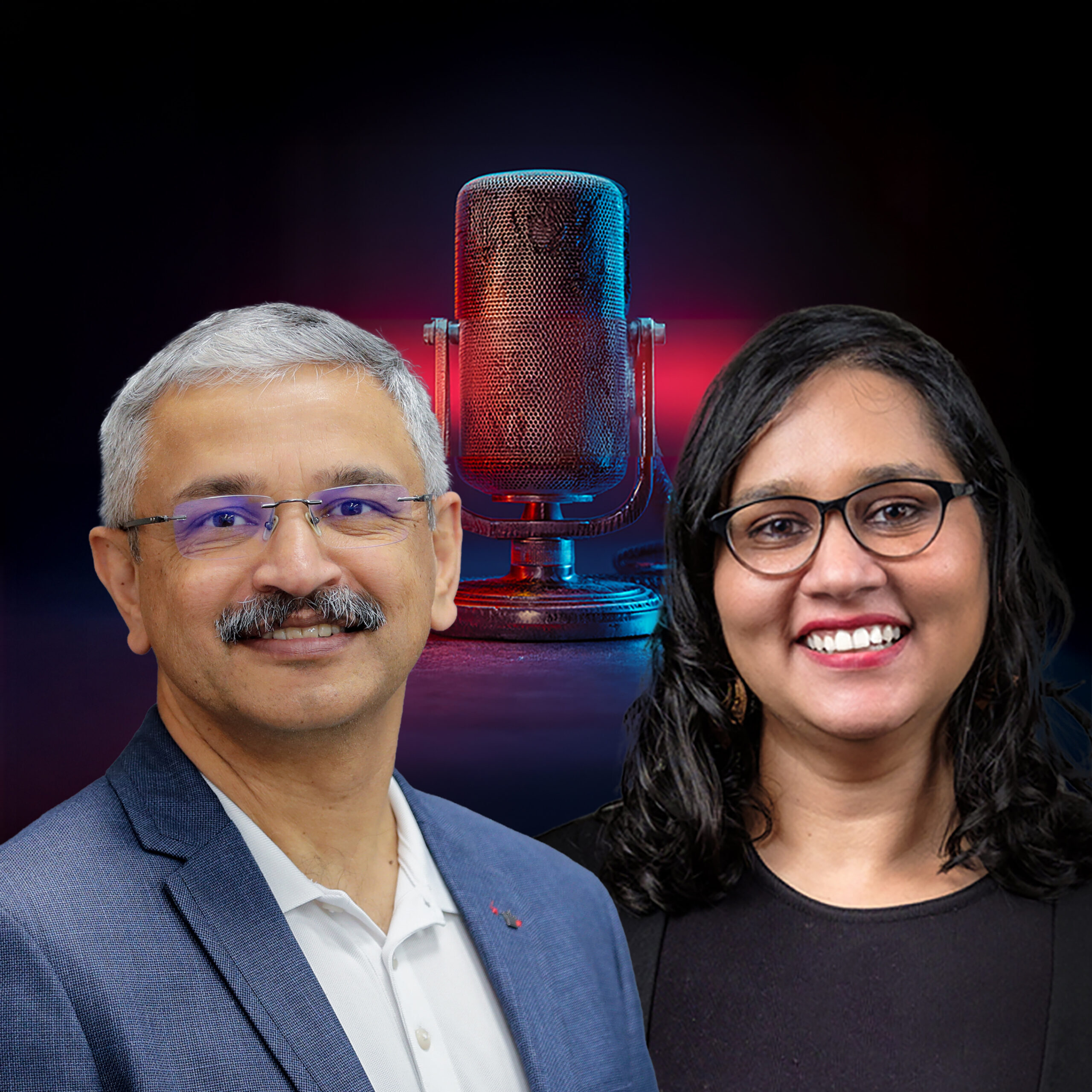



The future of Global Capability Centers (GCCs) is the question at the center of this episode of GCCs Unfiltered.
Nitika Goel, CMO and Managing Partner at Zinnov, sits down with Jitendra Kumar Pandey, India Country Head and Vice President of R&D at BMC Helix, for a conversation with no room for diplomacy. Jitendra Pandey has spent more than 30 years in enterprise software across the IBM, Software AG, and WebMethods eras. He now runs BMC’s largest R&D hub anywhere in the world, based in Bengaluru.
His central claim is blunt. Global Capability Centers (GCCs) in their current form will not last. Execution, delivery, and cost have become table stakes. The GCCs that matter next will look more like software factories, and customer value becomes the scoreboard. This episode maps what that shift demands of GCC leaders across AI maturity, trust, systems thinking, and measurable outcomes.
In this episode, BMC Helix’s Jitendra Pandey argues that Global Capability Centers will evolve into software factories that compete on domain expertise and customer value while software development itself becomes commoditized. He explains why cost has left the GCC conversation, why AI is now assumed rather than announced, why trust is earned one interaction at a time, and how BMC Helix measures success by customer return on investment.
Tune in now.
PODCAST TRANSCRIPT
Nitika Goel: Hi, everyone, and welcome to another episode of GCCs Unfiltered. I’m your host, Nitika Goel, CMO and managing partner at Zinnov. You know, we started this series because we felt that the GCC conversation had become a little too polished, too full of numbers and headlines and not enough of the real stuff, the pivots, the trade-offs, the moments that actually shaped how these centers were built and are continuing to be built.
Today’s conversation sits right at that intersection. My guest has been in enterprise software for over 30 years. He has lived through the IBM era, the Software AG, WebMethods era, and now leads R&D for a company that has just become independent, BMC Helix, while simultaneously running one of the most critical country operations right here in Bengaluru.
Nitika Goel: I’m joined by Jitendra Kumar Pandey, India country head and vice president of R&D at BMC Helix. And I’ll say this upfront, Jitendra and Zinnov go way back, almost 20 years to his WebMethods days. So this is going to be one of those conversations where there is absolutely no room for diplomacy. Lovely, lovely, lovely to have you here, Jitendra.
Jitendra: Thank you very much.
Nitika Goel: Back into the third office of Zinnov, probably one you’ve seen in many CXO forums, but- Yes … you’ve probably seen our first office as well.
Jitendra: I’ve seen the first office in Koramangala as well, where people were sitting behind the cardboard boxes and there were, like, five people, maybe six people, including Pari at that time.
Nitika Goel: Love it.
Jitendra: But, yes, long time.
Nitika Goel: So I thank you again for being here and truly appreciate and value the fact that you have been a customer and friend of the organization for so long.
Jitendra: Thank you very much for inviting me.
Nitika Goel: No, I’m glad. So we’re gonna get into BMC Helix, right? I obviously do know a little bit about your organization.
You’ve split off into a newer entity more recently. Would love to understand what BMC Helix does and a little bit about your organization in 30 seconds and how you are changing the world of technologies.
Jitendra: If you just have to remember in two words or two sentences, it’s mostly about AI-powered service ops organization.
We are experts in, uh, service ops, and everything happens through AI in BMC Helix. That includes traditionally what we know as ITSM, the service management part, what we know as operations management. It also includes, uh, um, all of the workflows that we do. But at the end of the day, we add value to any digital services customers are using through AI, and that’s what our expertise is in.
Jitendra: Our center in India, uh, is the largest hub anywhere in the world for BMC, so we take pride in adding most value, uh, for our customers from this center.
Nitika Goel: You mentioned that you are AI-powered, right? So I’m gonna bring that nuance in, and I know a lot of people talk about AI and use it very… Most of the AI that they talk about is the productivity uplift.
When you talk about AI-powered, uh, what are some of the nuances and differences that you see coming into play?
Jitendra: See, if you look at it traditionally, a lot of these areas included decision support systems based on rules. If this happens, then do that, and all of that, right? And a lot of institutional knowledge was built into these kinds of platforms.
With AI, that is changing. AI not only will reason with you, but it also augments your thinking in that case. So everything that we did traditionally, the still value, the same value has to be added, but it’s in a different way and take help from AI, do it faster, do it sooner, but also reason with it and rethink the way you did it in the past.
That’s predominantly what AI-driven thing is. Service ops remain the same in the core competency.
Nitika Goel: Like you talked about using AI effectively, in some cases, and I mean we were discussing this, some people thinking, think that Copilot is the use of AI, right? Is truly the meaningful use of AI. So the maturity in terms of what is possible or the art of possible with AI is very, very different in how organizations are adopting it, how leaders are thinking through the problem.
In that case, how do you think GCC leaders, and specifically your cohort of leaders, should be thinking of AI differently?
Jitendra: So AI-led software, AI-led value addition has become very common- commodity … thing. It’s a commodity for everybody, and everybody also has a different meaning to it. You mentioned some people think that they are advancing in AI because they’re using Copilot in Microsoft Office, not even otherwise.
Some people think that they are using AI to deliver customer value, but some people also think that they are actually at a maturity level where they are adding some measurable, uh, value to the customer. It’s about the customer value that they’re adding to it. I’ll give you an example. Uh, in our conversations sometime back, we don’t worry about how do you use AI, because that’s what has been the discussion so far, that how can I use AI in my project?
The discussions have moved from how can I use AI in my project to how do I deliver value to the customer? No AI is ever mentioned because that’s understood in most of the cases. Things like how can you increase your NPS? How can you use your, increase your CSAT, uh, from a customer satisfaction point of view?
Jitendra: Using AI is something that is underlying, but it’s all about delivering the customer value.
Nitika Goel: So I want to come back more specifically, right? When people are talking about AI, they throw a lot of metrics. They talk about a lot of efficiency metrics. And of those metrics, especially because you’re looking at customer value being that core metric, what do you think of, uh, vanity metrics and what do you truly think are value metrics?
Jitendra: Everybody is relentlessly pursuing the productivity metrics. The discussion is about how can we increase productivity, or has the productivity increased? Uh, you’ve heard about 10X software developers, and it’s assumed that productivity of those developers has increased 10 times. But I think, and it’s a little controversial, but I think that the metrics that we are following today will not be useful tomorrow because it will be given that this is something that is happening.
So, measuring it right now gives you a satisfaction, but that may not really be useful. The value metrics that probably actually matter for everybody would be things like did you add to the bottom line of a customer or not? It depends which kind of a company you are in, and you can choose your metrics between top line and bottom line, but did you add something to the bottom line of the company, uh, or the customer or not?
Jitendra: Did you add value in terms of what success metrics that customer has themself? Did you make an impact on those success metrics or not? So the metrics that you measure yourself and the way customers measure you is blurring basically. If a customer thinks that they want exceed in some areas, you would rather provide value in those areas instead of measuring your own things in the past.
Nitika Goel: You talked about the convergence of the customer’s KPIs are actually the organization’s KPIs, which in turn become the GCC’s KPIs, for it to be truly meaningful in terms of leapfrogging to outcomes. In that sense, many of the current GCCs, and I would call… I know a lot of us say that they’re India centers of the global organization, but I call it GCC only because it’s a cohort or a type of company that has some common, shared, or lived experiences.
In that construct, where do you think the operating model here needs some reinvention?
Jitendra: The value that, uh, GCCs need in those cases, and, and your definition of GCC in that case, is something that we measured success for ourselves in the last 25, 30 years is becoming a table stake first. Like, execution is becoming a table stake, delivery is becoming a table stake, cost nobody even talks about it.
In some cases, the cost might actually be more than hiring anywhere else in that case. The discussions have moved from those traditional metrics to an area where you talk about leadership. Nobody in the GCC itself is saying you do, you execute better, you deliver better, you deliver faster. These are all understood.
Jitendra: But what we are being looked at right now is to provide leadership for the organization, but also for the rest of the community in our area. So how do you really go up the value chain in terms of leadership and providing leadership in that area? I don’t know if there is a metric that you can define in that area because it’s a complex metric of various things.
It’s, it’s about thought leadership, it’s about excelling in that area, but it’s also about adding to the bottom line in those areas. But those are the complex metrics, uh, that have come in, uh, instead of those traditional ones.
Nitika Goel: I think we were talking about it just off-camera where you said, like, some of the mavericks and the most creative thinkers of our generation, 10% of it was the audacity of the idea, but 90% was perseverance and persistence.
Nitika Goel: And the sweat, right? Just the pure resilience and effort to get that job and vision done. So right now we have the numbers, everybody talks about GCCs, usually in scale, sometimes in terms of their innovation quotient. If a GCC today, in the context of what you just described, where software is commoditized, your engineering prowess is commoditized.
Nitika Goel: In that construct, what is the kind of reinvention needed? What is the kind of resilience that is needed? And what is the kind of relevance that we need to sort of start measuring for?
Jitendra: Yeah. So I’m gonna say something controversial, obviously.
Nitika Goel: Absolutely. We like that.
Jitendra: Uh, and the reason why I said it’s a little controversial is because the way we know GCCs today, my opinion is that that won’t exist tomorrow.
Jitendra: The way we talked about our success in terms of traditional metrics, uh, versus the forthcoming metrics, I think those won’t really matter because every software company, if you look at it, and I am talking about software, but that same thing is applicable to other industries also. Every company has their own GCC where they do a lot of this innovative work today, where they do software development, whether they, uh, provide value to the customer from that point of view.
Now, like you said, that is becoming commoditized, and probably hardware has gone through this many, many years back. But is, uh, what I’m talking about, this is, this is a pure prediction for the future that GCCs the way we know today will stop existing, will cease to exist. What might happen is that GCCs will become probably software factories.
Jitendra: Mm-hmm. And the, the reason I said factory is because there is less of a context of the software they are developing, but they are more about operations. So GCCs will probably become just the factories, and maybe there is just one GCC that is needed for all the software companies that we have. If you are into databases, you get into databases.
You, you add value from the domain knowledge that you have. If you are into, um, service ops, you get into service ops area for that domain knowledge. But somebody else will write the software for you, just like it happens in the hardware industry, and we talked about it, right? That- Who manufactures the chip is less important, but what is that chip about and how it is an innovative chip when…
Jitendra: I mean, you will look at it if, uh, if you look at it the Apple system, M1 to M2, M2 to M3, and all the way up to M5, there’s a lot of innovation happening in that chip. But who manufactures the chip is not important, and I think the same thing will happen in the software industry as well.
Nitika Goel: That’s lovely.
Nitika Goel: When you were just talking about it, another edit thought is like we’ll have two operating systems like the Android and the iOS operating system Yeah. And then everybody will be building agents and apps on top of that.
Jitendra: Possibly. That’s, that’s what we have, uh, come across, right? I mean, which third operating system do we know today?
Nitika Goel: That’s true. Does it?
Jitendra: Yeah.
Nitika Goel: One thing I definitely wanna talk about, uh, also is the fact of how do you make the time or create a mental prioritization framework to get to the right outcomes. I’ll tell you why. Lots of times when we connect with GCC leaders, et cetera, they are reacting, not necessarily responding to the change because there’s so much noise about AI and how things are changing, new GCCs coming in every single day, but they’re at a higher maturity.
Nitika Goel: There’s a volley of information, FOMO being created in the ecosystem in terms of what needs to be done, and that is also being heard by leaders globally who say, “Okay, listen, this company has had an X amount of productivity uplift. Why aren’t you doing it?” So immediately everybody just jumps onto the bandwagon, picks up what they need to, and then goes on.
Nitika Goel: For an organization or a company or a GCC based here, how should leaders think of short-term transformation versus long-term performance?
[00:14:53] Jitendra: AI is everywhere, and it is providing the speed as well as agility. In speed and scale, which we worried about, you remember when we started GCCs 20 years back or 25 years back. One of the big metrics that we used for ourselves was how do you scale this?
[00:15:12] Jitendra: Yes, you build something very nice, but how do you scale this now? Now, from a technical point of view, that scaling has become easy. It, the speed and scale has become very, very easy, so that’s some- that AI is able to handle it. What we still need to provide from a value point of view as far as the companies are concerned, and that’s not necessarily only applicable to GCCs, but GCCs also, is providing the human element, and we talked about the human element earlier today, uh, which is about providing context, providing judgment, uh, having accountability for those things, having relationship, right?
Jitendra: So those kinds of things, uh, are still needed, but the GCCs also have to prepare in terms of, um, asking the right question, where they are moving, what value customers are looking for, and how do they really develop software if they are in the software industry in that area that they can add value to their customer.
AI has all the answers, but what’s the right question? That still leaders have to provide.
Nitika Goel: Now let me come back and shift in terms of when you say leaders to provide. You’ve obviously been through many organizations at different scales. You’ve joined an organization which was going through a tremendous amount of transformation just by the share of the spinoff.
You’re also private equity owned, which is not easy. Ruthlessness on metrics is a given fact if you’re a PE-owned company. You talked about speed and agility being driven by technology. How do you build trust at scale?
Jitendra: Yeah, that’s one thing AI cannot help right now. That is something that leaders and everybody has to do it on their own.
So for me, trust is exactly like a credit score. You build it over a period of time, and it’s also very easy to erode that trust. Honestly, I, I don’t think building trust at scale is a concept that I agree with. I think the concept that I understand is building trust at every single level. Building trust at individual interaction points within the organization as well as outside the organization, whether it’s with customers, whether it is with your, uh, partners.
Nitika Goel: I’d even draw a parallel to marketing, right? Your customer builds a relationship with the brand when every single interaction point is consistent, it’s cohesive- Yeah … and it talks about whole tour. And that’s what you’re also saying. It’s every single point of interaction that really becomes a trust point, right?
Jitendra: That’s, that’s what I believe, because some of these, uh, metrics like developing trust, having a good relationship with your customers, you can’t industrialize these kinds of things. It has to be every single interaction one step at a time. That, that is something that I believe.
Nitika Goel: I’ll give you some of the examples of what we hear with GCCs.
A big thing is they have a lot of the work here, but there is obviously a trust deficit in some cases because productivity is not measured in other locations, but very often it is measured within the India center because there is a high density of people, and they’re also different functions, right? So that’s one thing.
Nitika Goel: The second is when more advanced functions like product management, et cetera, there is a belief that it needs to be co-located with the customer. Whereas you also talked about a nuance that everything that you do needs to add value to customer, right? In some cases, that almost seems like a dichotomy in the operating system in itself.
So how does that come to bear, and how are GCCs and, you know, some best-in-class GCCs working through that?
Jitendra: You remember when we talked about that customers are elsewhere, product companies have to be co-located, that you mentioned? At that time, we were predominantly talking about North America, and we’ve… we didn’t have the kind of things that we have today in terms of communication, right?
Jitendra: We… Every single call is on video. There is no lag. I remember 25 years back, actually 26 years back, when I was working at Oracle, we had one 64 Kbps leased line, and that was it. At that time, we didn’t have email access connected to our computer. Somebody would go to a different place, download emails in a- Oh, no
Jitendra: floppy disk, and then everybody gets to read those kind of things. The technology has created a level playing field. You know immediately right now what’s happening. You talk to customers on a day-to-day basis. Whether you are talking on a forward-looking engagement or you’re just fixing a bug for a customer, you talk to a customer every single time.
Customers and developers are connected to each other on WhatsApp. They, they’re even exchanging notes with each other on WhatsApp that way. So that kind of thing happens, and there is telemetry in the product, and you know the uses of the product, everything happening, and so that has created a level playing field.
But also the customer base has shifted. It’s no longer North America heavy. It is everywhere. I mean, if you look at it for most of the enterprise software companies, government is the biggest customer, and you’re serving the government. In fact, a lot of companies have created a separate subsidiary for government itself.
It’s no longer only big companies headquartered in North America, but it’s government sector, it’s, uh, Middle East that has come up in a big way. Uh, Europe, in a big way. Um, Asia Pacific has a lot of big customers. In fact, a lot of big customers have their development centers and their, uh, decision-making centers in Asia Pacific.
Jitendra: So sure, the company could be a North American company, but the customer that you’re talking about, quote and unquote, is actually sitting in the office next door to you. Yes.
Nitika Goel: Uh, that’s such an interesting thing because I recently was speaking to a GCC leader and they said their suppliers are sitting here, their developers are sitting here, their customers are sitting here.
So it’s just-
Jitendra: Correct. But the company might have been registered in North America, but does that mean that the customer is elsewhere? I don’t think so.
Nitika Goel: But are GCC leaders playing that role of that ecosystem enablement and unlock at the scale that we could potentially be doing accordingly? That
Jitendra: is an absolute good question because I think the success for GCC today is an ecosystem play, and companies like, uh, a consultant like Zinnov is actually enabling that everywhere.
Nobody is an expert in everything. A company or one part of that whole GCC ecosystem is an expert, but together we can be. So the way we learn from each other, the way we learn from best practices from each other, and the way we rely on each other for some of these common problems will actually be the differentiating factor, and I think we are in a very good place, uh, in geographies like India, where there is a high concentration of this, and there’s an opportunity to talk to each other there.
Nitika Goel: So one of the things we talked about is leadership intervention, right? And I think we alluded to it, but I’m gonna ask a more specific question on it, and it’s the great point that you brought in. Where should leaders intervene versus allow systems to learn and evolve? Like you said, say, we are bringing in an ecosystem play.
Now, certain things are just coming into bear. It’s happened organically. It’s not… But where should leaders really intervene?
Jitendra: The way leaders can probably intervene today is mostly in terms of, uh, increasing the risk-taking ability of people. Just because things were done yesterday and you’ve been extremely successful until today, doesn’t necessarily mean that…
I mean, you- you’ve- you’ve heard about that book about Who Moved My Cheese, right?
Nitika Goel: It is. I, I love the book.
Jitendra: So those kinds of things, those are very, very relevant, for sure. The way leaders can actually, uh, increase awareness of the people, they can challenge people. In fact, I just wrote, uh, some time back an article about how do you really manage high performance?
We don’t… Everybody talks about in traditional metrics on managing performance, how do you manage low performance, and you know what to do about it and all. But with the advent of AI and other things, there will only be high performers that will be left. Now, how do you manage those high performers? Nobody has thought about it, anything.
Jitendra: So leaders’ ability to think in those directions and also train the following, uh, in the company to actually handle those will become a differentiating factor for a lot of people.
Nitika Goel: So I’m gonna get into more specific nuance on that. Okay. Right? Because obviously you like high-performing teams. You’re also changing your entire organization to be deeply customer-focused.
Top line, bottom line, depending on where you need to land, right, as an organization. If there was a leader who’s thinking of this from the ground up, right, and whatever baggage they have, how would he or she think of this? Like, how would they create that structure? What would they do to build it for truly high-performing output?
I’m a consultant. I will ask you for a framework. I cannot. It’s our DNA.
Jitendra: Yeah, I think my, uh, I would have given it away. Honest feeling is that, uh, the leaders have to start believing in it first. They’re not really doing it for the sake of doing it. They’re not doing it because somebody has given them this mandate.
They first have to be believe… They, they first have to believe in that area. The fabric has to be right. Skill can be taught, but the fabric has to be right. So first we need to really have the right kind of, uh, uh, people in that area. But the way they need to start from scratch is thinking that, you know, sure they are, they are good people and they have been brought in that place, but that’s not the only thing that is, the organization has.
You would never have heard of a successful leader but a failed team, but the converse is very true. It always happens sometimes. So what you need to do is challenge the people, give them a, a rope, but also tell them, give them feedback where there are blind spots. There are a lot of… There’s, there’s a lot of value in giving feedback right now, and there’s pretty much it’s institutionalized metrics that, okay, you need to keep giving feedback.
Jitendra: My personal opinion is that feedback all the time doesn’t help. It helps immensely when there is a blind spot for the other person, and if you give feedback at the right place, that, that something happens. You need to be able to lead through leaders, and you need to have a metric where instead of how much of the company’s target that you delivered, but also how many leaders have you created?
Jitendra: Did you create a scalable structure or not? Is something that is gonna be important going forward because unless you do leadership at scale, uh, it’s gonna be less impactful.
Nitika Goel: The other thing I really wanted to talk about- When you sort of describe this, it makes me think of a systems thinking rather than like a point-in-time thinking.
I know when we were discussing on the side, when people think systems thinking, they think of it as a platformization of the product or the services or the solution, which makes it obviously easy to plug and play, where there are certain guardrails. But every single person is thinking of the end outcome and not acting as a blocker, right?
Nitika Goel: It’ll be really good to understand how you believe a system-led thinking can be established. Or do you think it’s already there in many GCCs, or does it need to be built from now?
Jitendra: 20 years back, the situation was different. Now the situation is different. Now most of the GCCs that are starting would have probably the systems thinking because the mandate is different.
The mandate for them is to add value to the overall business, right? So they, they are structured from the very beginning to think in that direction itself. But systems thinking is something that has to be developed within that organization. It doesn’t come naturally because if you are looking at any GCC, individuals, individual teams, individual departments, individual managers, leaders, whatever you call it, they are still focused on what would make them successful, and it’s very easy to ignore the fact that how are they contributing to the overall, uh, business of the company?
Jitendra: One department’s success in itself might actually be hindering the overall success for the company in that case, although we call it success. So at some point in time, you have to take a step back. You have to make sure that, yes, I’m gonna compromise on that particular aspect because together we succeed.
It’s not only that I succeed, and I don’t care about you as a different department. So that systems thinking is extremely important. You know, I think our job is not necessarily to only rely on heroes, but make sure that we give ability for the entire organization to play heroes all the time, and there are situational heroes that definitely will work, and that, that happens, uh, all the time.
Nitika Goel: If you were a movie script writer, you would have made it very hard for the director with so many heroes. No, but a very important thing, I think you bring in something very profound, right? On a more serious note, where you say it’s not about a few heroes, but really to make a system of heroes, if you will.
In that case, um, how do you build it functionally, right? Do you link it to OKRs, for example? How do you… Do you create shared metrics? Do you– How do you create it at scale? It’s very hard. It’s not a motherhood and apple pie statement that if I’m measuring a person’s salary on, you know, how well you do your task, but at the same time saying, “But you must think of the task in the greater good,” it’s not gonna happen organically.
Nitika Goel: How do you build that- Into a system so that they’re thinking of the larger organization, not behaving like a cog, and also being able to deliver to the outcomes that they’re mandated to.
Jitendra: Two ways it has worked in the past, for me at least, that you set the goals at a broader level. You set a goal at a higher level saying, “This is what is needed for our organization to be successful.”
Whatever that goal is at the top of the organization, and every organization has their niche what we wanna do. Every organization wants to succeed, but what success means for the organization is at a top-level goal. But like you said, it doesn’t necessarily come very easily to everybody, and that’s where the leader’s role becomes extremely, extremely important to not only translate how your department, your function’s goal will contribute to the overall goal, but relentlessly, uh, make sure that this communication goes downwards.
Jitendra: That’s when the leader’s, uh, role becomes extremely important. There will still be goals for different departments, but linking those goals together and looking at it in overall pictures that, okay, are, are all my functions working in a way that I can still achieve the overall goal? That’s when it becomes extremely critical for the leaders to translate that.
Nitika Goel: So BMC, of course, is doing very, very interesting things in AI, and, uh, we’ve talked about all of this. If there are specific anecdotes or examples where from an organizational context that you believe sort of lend to this either systems thinking or AI narrative, which is just baked in early on, that you would like to share with us.
Jitendra: AI is everywhere. Okay. Yes. I, I don’t think we talk about AI in any of those things. I think it’s pretty much understood that something is being done, it must be done through AI. But has AI. It has AI in it. Yeah. The ubiquity of AI these days. Uh, instead of, instead of talking about how can we use AI in our own areas, I think we have gone beyond that and we have started thinking about how do you really deliver measurable impact to the customers, to the, to the, the value stakeholders in this case?
It is understood that it’ll happen through AI, like NPS, for example. How do you really increase NPS in your area through the product roadmap? At some point in time, you are also able to predict that this is your roadmap, and it’s gonna have this kind of an impact on your NPS, which is very… was a lagging indicator in the past, not a leading indicator.
Jitendra: Now, at our organization, we are working a lot in terms of efficiency, but at the end of the day, customer is always at the forefront. If the customer doesn’t benefit from all of the things that we are doing, then it becomes meaningless. Yes, we are doing it for the sake of having an AI in the product or in the functions, but at the end of the day, the value has to be delivered to the customers, and that’s how we look at it, all the metrics.
Nitika Goel: So do you have a specific example of how you have delivered value to the customer? From your team here
Jitendra: We actually measure the return on investment the way customers are doing with our products. The way they have increased their return on investment is something that is extremely important for us to measure right now.
We are in the software industry. How much time and money the customer spends on upgrading the product? How much time and money the customer spends on the first onboarding of their own first customers? Uh, how long does it take for them to bring in a new, uh, subsidiary? Is all the bigger metrics of return on investment, and we measure upgrade time, we measure how many defects we created that the customer had to delay their projects on.
Jitendra: How much time are they taking on onboarding of those things? They are all becoming at a division level, but they are all contributing to return on investment for the customer.
Nitika Goel: Are there specific initiatives or programs that you run within BMC today or under your leadership as well that you would like to specially call out and that lends to any of the narratives that we talked about, right?
Either in the systems thinking, leadership thinking, or even like you said, measuring certain customers and goals that you think that would be- Yeah … good to call out.
Jitendra: We have a very interesting program which we, um, for the lack of a better word, it’s a drink your own champagne program. Oh, love
Nitika Goel: it. Not Kool-Aid, but you’re drinking the champagne. Love it. Yeah. Love it. Yes.
Jitendra: So, uh, like you mentioned, we have a customer center there, but that customer center works more than just the customer center. Our own IT is our first customer. Then it becomes our own SREs, those, the people who are handling our cloud software, is the second customer. Actually, the third customer who’s paying is, uh, the, the customer who’s paying money is a third customer.
Third customer.
Nitika Goel: Got it.
Jitendra: So we make sure that our own IT is successful first, then our teams that are managing our cloud software are successful, and then only when, uh, it is done, then we give it to our customers. So it’s kind of a pre-baked at the time when it goes to our customers. And the customer experience center that you mentioned about, we also have, uh, a network operation center there, which we call a command center right now, where the entire company’s IT is managed by just two people sitting there and probably doing something at some point in time, but it’s pretty much an autonomous, uh, way it does there.
And we take pride in making sure that we ourselves are successful in that area before we actually take money from the customer.
Nitika Goel: Before we let you go, for sure, we have to do something called the rapid fire. Okay. Okay? I am, like, a big fan of all things Bollywood, and Karan Johar was the inspiration I may have to confess, but, uh, hopefully- So you have a
Jitendra: gift hamper as well somewhere?
Nitika Goel: We will definitely send you the gift hamper. We want to keep it light. I have my rapid fire set of questions. There were some stayed ones, but now we should ask you some out of syllabus questions as well, right? So, um, what is the most contrarian opinion you have about the GCC model?
Jitendra: I think the contrarian opinion, uh, would be around that GCCs will last forever.
It’s not gonna happen. I don’t think… I think it’ll happen. GCCs will go away sooner than anybody can expect at the moment. Everybody thinks that GCCs are going up the maturity curve. And at some point in time, instead of a delivery center, instead of a, a project center, they’ll become an innovation hub.
Jitendra: Not gonna happen. Probably a half-hearted target, because at the end of the day, like we mentioned before, it’s about the customer value that you deliver. Innovation is a part of it, but everybody thinks that they are an innovation hub, maybe not.
Nitika Goel: And now I’m gonna also ask you, what is the one hard truth about GCC leaders nobody wants to admit?
Jitendra: The role of a GCC leader is less relevant for the GCC in itself, but it has become a part of a bigger ecosystem. Yes, you have a leadership responsibility for the GCC given, but you are expected to play a bigger role in the entire organization than just the GCC.
Nitika Goel: If you had to build a GCC today from scratch, what would you do differently and right off the bat?
Jitendra: The way I built GCC in the past was hire for skill sets, hire for functions, hire for scale. A lot of those things are all given. Scale is all given. Speed is all given. Um, the way I would do that today is probably an irreversible mandate for the product area, but also having an impact and direct connection to the customers.
Nitika Goel: If somebody had to write a book about you, what would the title of that book be?
Jitendra: It, it could be borrowed from a famous, uh, movie, but In Pursuit of Happiness.
Nitika Goel: Love it. The other question that I wanted to ask you is, I know because we were having the conversation, you are a builder and a continuous learner.
So how does your learning philosophy evolve? Like, what is your learning philosophy first?
Jitendra: Yeah, it’s an omnidirectional learning philosophy. Anything that, um- I find it interesting. I try to learn in those areas. And we were talking about the brick-fired pizza oven that I just made, but it happens in all areas.
Uh, whether it is about painting the house or about cleaning the toilet or about doing the marble polishing. In fact, I do my marble polishing on my own. Oh my
Nitika Goel: God.
Jitendra: So it’s, it’s all about, um, just being inquisitive about, about that area and deriving this confidence that, sure, you can do it. Why not?
Nitika Goel: I love it.
Jitendra: I think that’s, that’s a, that’s the biggest part of it.
Nitika Goel: So I think for those of you who do not know, what Jitendra is also saying nicely is he has hand-built a brick oven in his backyard or side yard where he can make pizzas at scale. So it’s not an open invite just yet, but if he does a table dining thing, it is something that we will definitely send out to this community and you shall partake.
Nitika Goel: So but that is crazy. I’m looking forward to it.
Nitika Goel: It’s crazy. He’s even picked out the bricks and done everything on his own. So what gives you your little uplift of joy and happiness every day?
Jitendra: I’m so lucky to have nice people around me, uh, good opportunities, and, uh, ability to make a difference that I can, in my way, I can do that.
Jitendra: That is an extremely overwhelming and powerful feeling. That, that is one thing that makes me happy.
Nitika Goel: That’s lovely. Gratitude essentially as well, right?
Jitendra: Let’s call it that.
Nitika Goel: So love it, love it. And what does unfiltered success look for, uh, look, uh, like in BMC Helix over the next three years?
Jitendra: I think we are already at a leadership position. If you look at it, um, Forrester’s, uh, assessment of our, uh, service management area, we are the leaders of the leaders. We not only wanna keep that leadership position, but we wanna strengthen it. But strengthen it, the leadership position, not only in a way that benefits BMC, but our customers benefit from it.
Jitendra: Our customers also feel that they are the leaders in their own area because of us, is something that we aspire and we look forward to.
Nitika Goel: What is your guilty pleasure?
Jitendra: Single malt scotch at the end of the day.
Nitika Goel: Lovely. Thank you, Jitendra, for being with us today. It has truly been a revelatory conversation.
Nitika Goel: I’ve learned a lot from you, and it’s been a proverbial master class for me.
Jitendra: Thank you very much for inviting me as well.
Nitika Goel: Thank you. Thank you.
Mohan Rao on how Samsung’s Bangalore R&D center went from delivering to spec to 14,000 patents, and why he’s now redesigning every process in it for AI.
Theom’s Navindra Yadav and Ravi Sankuratri discuss enterprise AI security, data governance, building an AI-native company, and their GCC journey in Hyderabad.
Don’t miss any of our future episodes!
Also subscribe to the Zinnov Podcast on these platforms





Mohan Rao on how Samsung’s Bangalore R&D center went from delivering to spec to 14,000 patents, and why he’s now redesigning every process in it for AI.
Theom’s Navindra Yadav and Ravi Sankuratri discuss enterprise AI security, data governance, building an AI-native company, and their GCC journey in Hyderabad.
 THANK YOU
FOR YOUR RESPONSE
THANK YOU
FOR YOUR RESPONSE
