




BACK TO GCCs Unfiltered
ZINNOV PODCAST | GCCs Unfiltered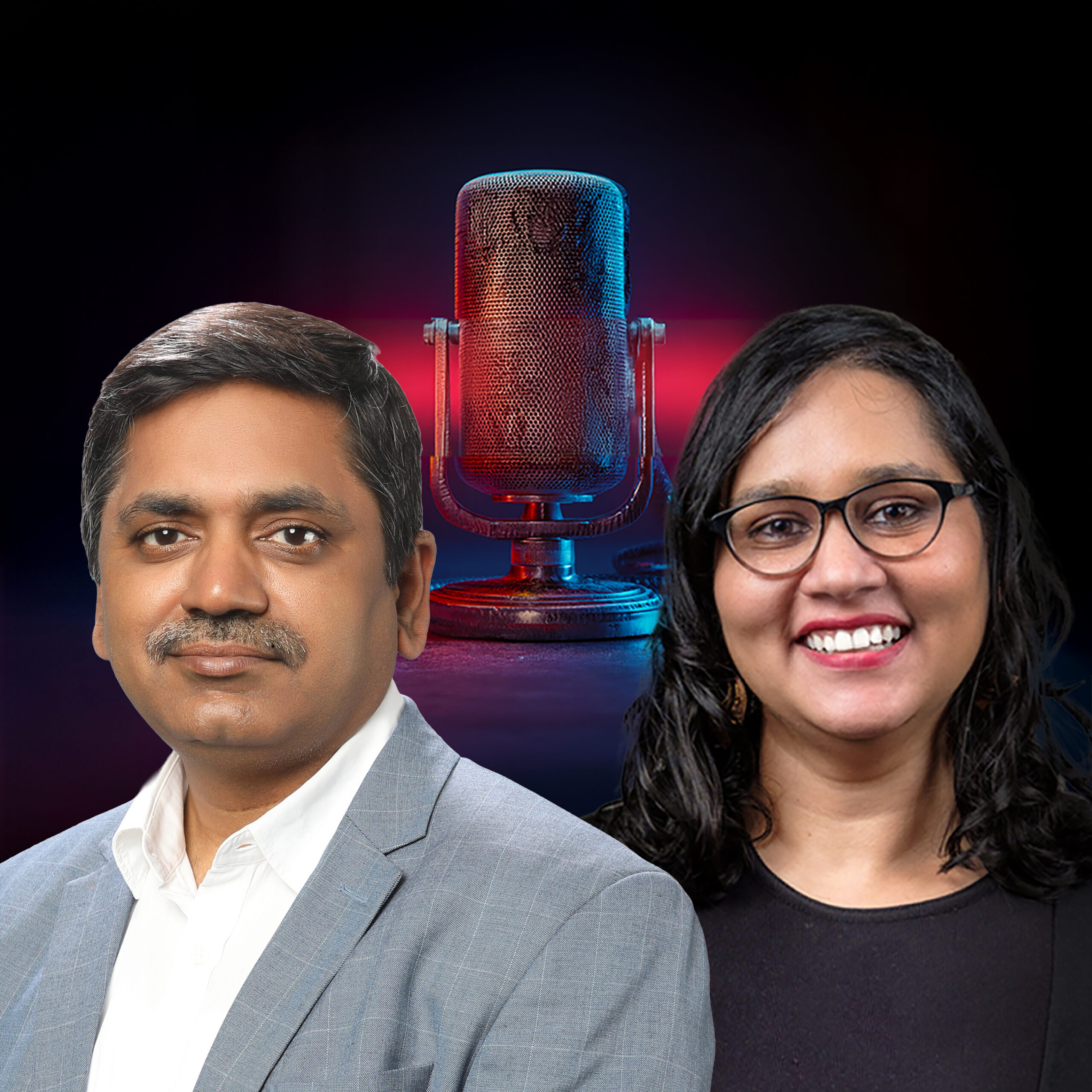



Operating at scale when industry fundamentals are shifting.
Walmart, one of the world’s largest retailers, with 10,000 stores, operates under constraints most don’t. Speed creates risk. Scale creates complexity. Technology is reshaping competitive advantage.
In this episode of GCCs Unfiltered, Nitika Goel, Managing Partner & CMO, Zinnov, sits down with Balu Chaturvedula, SVP & Country Head, Walmart Global Tech, the leader managing this scale, on what it takes to move an organization of this size when fundamentals are changing.
A few patterns emerged during the conversation:
Culture determines whether you move or get stuck.
Most organizations have the technical capability to transform. What blocks them is whether people believe they can contribute, and whether their work feels relevant as everything changes. Without that, even the best strategy becomes a liability.
Speed, scale, and trust work as a system.
You can optimize for two, but the third matters more than you think. The fastest organizations aren’t pushing speed alone; they know where trust must hold, and where to move faster.
Purpose becomes the decision-making framework.
At scale, especially with AI reshaping roles, clarity on why matters more than clarity on how. It separates pragmatic decisions from reactive ones.
Capabilities vs. features change how you operate.
Building once for the entire organization requires different architecture, governance, and leadership. Most don’t make this shift. Those who do move at a different pace.
Global centers are either core or peripheral.
This is no longer about location. It’s about whether you drive business outcomes. That shift is already underway.
This is what determines which organizations stay competitive, and which don’t.
Tune in now.
PODCAST TRANSCRIPT
Nitika: Welcome to GCCs Unfiltered, where we talk about the things no one does in the GCC ecosystem. No slides, no fluff—just real conversations with leaders in the thick of it. I’m Nitika Goel, your host, the CMO and Managing Partner.
My guest today is Balu Chaturvedula, SVP and Country Head of Walmart Global Tech in India.
For our listeners, Walmart is one of the world’s largest retailers, with over $600 billion in revenue and more than 10,000 stores across 19 countries. That kind of scale needs serious technology behind it, and Walmart Global Tech in India is one of the key centers building just that—and Balu leads it.
He has been with Walmart for over a decade, joined as a Senior Director, and built his way up. Before Walmart, Balu worked at Yahoo, Motorola, and HP—30 years of building technology at scale. Everyone I’ve spoken to about Balu says the same thing: it’s not the résumé that stands out, it’s the person.
Welcome to GCCs Unfiltered. It’s truly an honor and privilege. Thank you for being here today.
Balu: Thank you very much.
Nitika: Walmart has been synonymous with retail at scale, yet today it is increasingly viewed as a technology-forward organization. Looking back, what do you think was the inflection point where Walmart stopped being just a retail company and became a technology company shaping how business operates?
Balu: It all starts with the purpose of saving money so people can live better. We’ve ingrained that mission into our DNA—a timeless philosophy given by our founder, Sam Walton.
From there, we made the story bigger and brought it into technology. There are three pivotal points in our digital transformation journey.
The first is building the foundation—moving from legacy systems to cloud-native architecture and modernizing technology.
The second is transitioning to building capabilities instead of just features—creating solutions that work across markets.
The third, and most exciting phase, is accelerating with AI. One of Walmart’s core assets is the data we work with. Our customers trust us, and we use that data responsibly. That will be our key differentiator as we accelerate forward.
Nitika: You operate at extraordinary scale. Does A/B testing even exist? One mistake impacts millions. How do you build once, do it right, and still innovate?
Balu: When speed meets scale, Walmart stands out. Experimentation is absolutely on. But at this scale, you don’t have many chances to make mistakes.
Let me give you an example. We had a homegrown warehouse management system. We decided to move to a cloud-native system.
Initially, we made assumptions and built a solution, but it didn’t work. We went back, studied operations deeply, recorded processes, measured everything, and broke it down into smaller modules.
We rebuilt capabilities step by step—receiving, scanning, and atomic operations. Today, about 80% of the U.S. network runs on this cloud-native system. It’s one of the biggest successes for Walmart.
Nitika: How do you make this repeatable for others?
Balu: Start with purpose. Then understand the problem and the persona you’re solving for—customer, member, partner, or seller.
Combine personas with domain knowledge and a purpose-driven mindset, and it scales beautifully.
Nitika: Can you walk us through one part of the value chain?
Balu: We touch almost every part of retail. But the catalog is especially close to my heart.
If retail is a supercomputer, the catalog is the operating system. It revolves around two core elements: product and offer.
Everything maps to an item—you forecast it, procure it, receive it, ship it, sell it, and return it.
The challenge is data quality at scale. We process around 850 million data points daily. Manual judgment doesn’t scale.
So we use AI and LLMs to solve most of the problem and only escalate complex cases to humans. This increases the value of human judgment significantly.
Nitika: With so many problems, how do you decide what to solve?
Balu: It starts with goal setting. Retail is built on four pillars: assortment, price, convenience, and trust.
We identify where we want to create value, define goals, and distribute the problem. There’s no magic—it’s disciplined execution.
Nitika: How do you decide what to build versus buy?
Balu: Focus on what is strategic. Build what is core; partner where needed.
For example, we don’t build foundational LLMs. We leverage them to create retail experiences. Our work with OpenAI on agent commerce is a good example.
Nitika: What technology shifts will reshape commerce?
Balu: Data intelligence and agent-driven commerce. The future is agent e-commerce, and we’ve already started building toward it.
Nitika: How are you transforming your workforce for AI?
Balu: You must embrace change early. Culture is a flywheel—culture, talent, and innovation.
We start with leadership and then scale across all roles. Reskilling is critical. Change happens in phases: resist, deny, accept, commit. You need to move people toward commitment.
Nitika: How do you handle resistance?
Balu: Resistance comes from fear—fear of becoming irrelevant. You must create psychological safety and show people their value.
We focus on reducing cognitive load so people can do their best work.
Nitika: How did you align with Walmart’s culture?
Balu: I see it as a three-step journey: enable, empower, and elevate.
Enable through experiential learning—store visits, supply chain exposure.
Empower by giving autonomy and encouraging risk-taking.
Elevate happens naturally when the first two are done right.
Nitika: Where do you see GCCs in the future?
Balu: We are already on that journey. GCCs are becoming more global and integrated.
Technology will remove geographical boundaries. The name may change, but the value will continue to grow.
Mohan Rao on how Samsung’s Bangalore R&D center went from delivering to spec to 14,000 patents, and why he’s now redesigning every process in it for AI.
Theom’s Navindra Yadav and Ravi Sankuratri discuss enterprise AI security, data governance, building an AI-native company, and their GCC journey in Hyderabad.
Don’t miss any of our future episodes!
Also subscribe to the Zinnov Podcast on these platforms





Mohan Rao on how Samsung’s Bangalore R&D center went from delivering to spec to 14,000 patents, and why he’s now redesigning every process in it for AI.
Theom’s Navindra Yadav and Ravi Sankuratri discuss enterprise AI security, data governance, building an AI-native company, and their GCC journey in Hyderabad.
 THANK YOU
FOR YOUR RESPONSE
THANK YOU
FOR YOUR RESPONSE
