The automotive industry is undergoing a fundamental shift as vehicles move from hardware-bound engineering systems to intelligent, software-defined vehicles and software-led platforms. Customer expectations for seamless digital experiences, real-time updates, and continuous performance improvements are redefining how OEMs design, build, and operate mobility. Legacy ecosystems struggle to keep pace with this rate of change, and that gap increasingly shapes competitive outcomes.
Why Software-defined Vehicles Matter Now
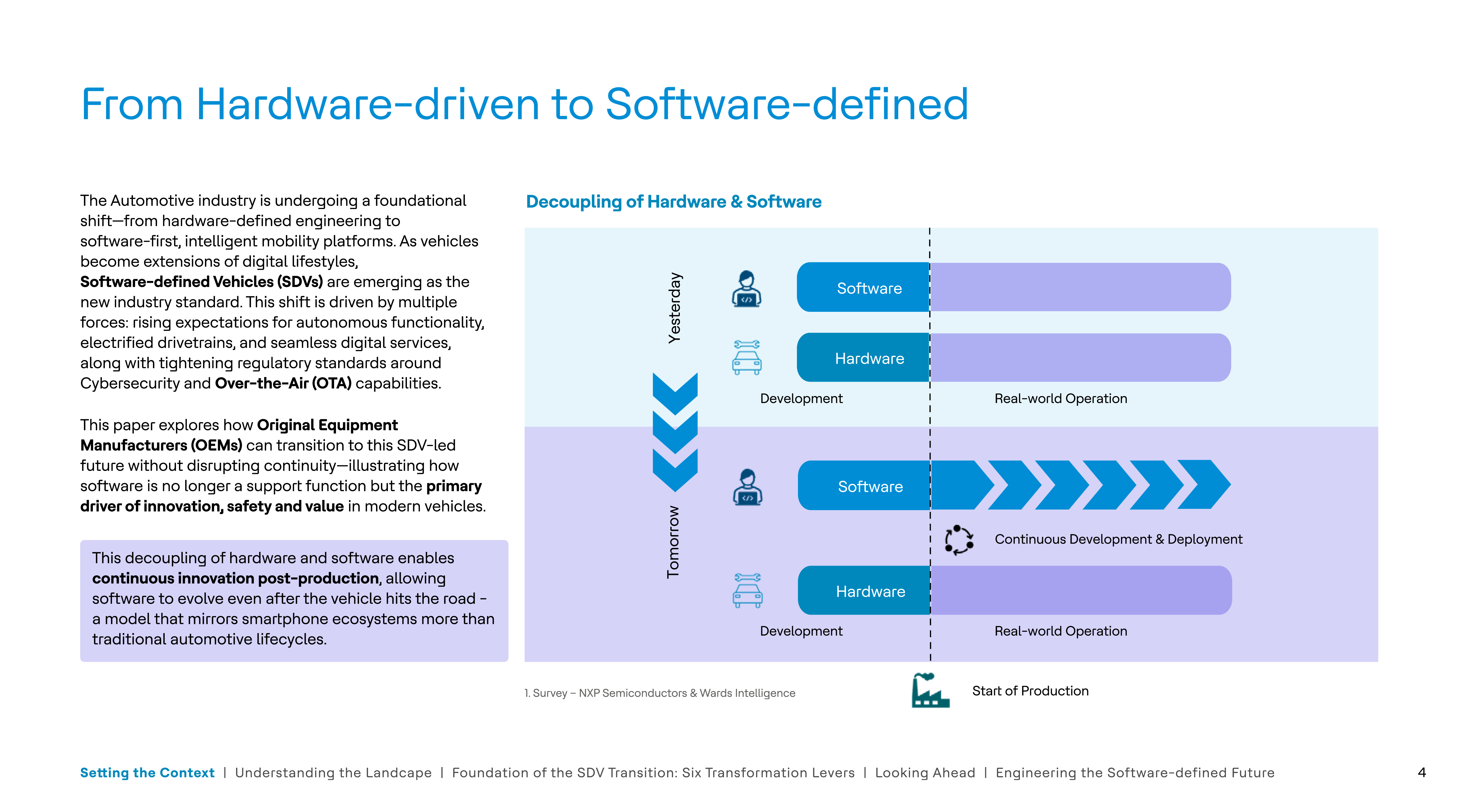
As software assumes a central role in defining innovation, safety, and value, OEMs face a critical challenge. They must transition to Software-defined Vehicles while maintaining continuity across existing platforms, programs, and operations. Decoupling hardware and software has emerged as a key enabler, allowing development to extend beyond production and enabling vehicles to evolve throughout their lifecycle.
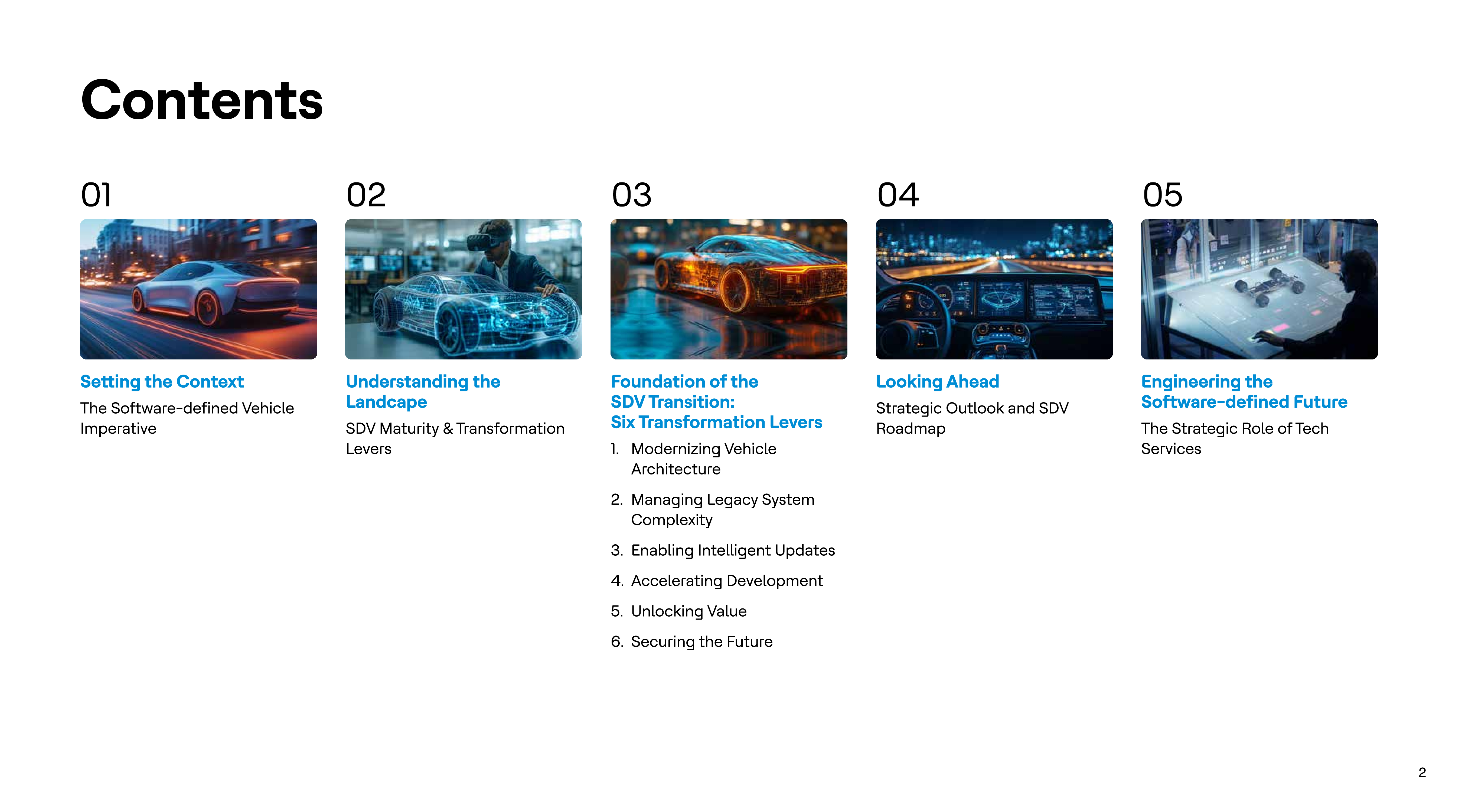
What This Whitepaper Covers
- A practical view of how OEMs can move toward a Software-defined Vehicle model while maintaining operational continuity, by separating software lifecycles from hardware constraints and enabling continuous post-production innovation.
- An exploration of evolving vehicle architectures, including zonal and centralized compute models, and their role in supporting scalable software platforms that adapt over time.
- A clear breakdown of the SDV maturity journey, outlining the stages OEMs progress through and the capabilities required to evolve from software-enabled systems to adaptable vehicle platforms.
- An in-depth look at the six transformation levers shaping SDV readiness, spanning architecture modernization, legacy system abstraction, OTA enablement, virtual validation, data monetization, and cybersecurity integration.
- An examination of continuous OTA-driven updates and their role in delivering new functionality, performance improvements, and security enhancements throughout the vehicle lifecycle.
- Insights into how connected vehicle data enables predictive services, in-vehicle commerce, and emerging monetization opportunities across the ecosystem.
- A focused view on the expanding cybersecurity landscape and why integrated, end-to-end protection has become essential as connectivity scales.
Together, these perspectives present a practical view of the SDV transition and the structural changes required to support it. Developed in collaboration with HCLTech, this whitepaper combines strategic insight with engineering perspective to guide OEMs through the shift to software-led mobility.
Download the full whitepaper to explore how Software-defined Vehicles can enable continuous innovation, resilience, and long-term value creation.
With deep expertise across Engineering R&D, digital technologies, and software-led platforms, Zinnov supports global mobility and automotive leaders across every stage of transformation. Connect with our experts at













 THANK YOU
FOR YOUR RESPONSE
THANK YOU
FOR YOUR RESPONSE

