







Two GCC in India open the same year. Same kind of office, same hiring sprint, same town-hall slide about moving up the value chain. 3 years on, one of them is running a global product line and its head sits in the room when the company sets strategy. The other is bigger than it ever planned to be and still emailing headquarters for sign-off to hire a senior leader.
Look back at Year 1 and almost nothing explains the gap. Same budget, same city, same caliber of people. What actually split them was a handful of decisions made in the first 6 months, before either center had filled a floor. None of those decisions was written down as strategy. They lived in a mandate note, a hiring plan, a governance chart, a lease. By Year 3 they had hardened into the thing each center had become.
That is the part the India setup conversation keeps skipping. The country has long since cleared every bar that used to matter, and India GCCs has only grown.
“Setting up in India is no longer the question. Setting up right is.”
Pari Natarajan, CEO, Zinnov
For years the India pitch was cost and scale, and it worked. An engineer who runs USD 185,000 a year in the US still costs about a third of that here, and plenty of companies came for exactly that math.
Cost stopped being the whole story once the India GCC market grew. India now has a large installed GCC workforce, one of the deepest pools of AI and Machine Learning (ML) talent anywhere, leaders who have already run global operations, and a thick ecosystem of start-ups, universities, and specialist partners a new center can lean on from day one.
Where the deep talent pools are · click a country
Only a few markets have the depth to support large-scale GCC mandates. Click a highlighted country to see its talent depth and cost.
What makes that depth count is durability. In a thin market, salaries spike the moment you scale and the saving you came for quietly disappears. India holds its price as you grow, which is why the unit economics still work at a few thousand people.
Talent cost · average annual, USD
India pairs the cost advantage with workforce depth, so unit economics stay stable as teams grow.
So the real question has shifted.
It used to be whether you could build something serious in India. Now it is what kind of center you build, because the country will happily let you get it wrong.
You can hire brilliant people and give them no authority. You can build an AI team and keep every roadmap call at headquarters. India hands you the option to build a center with real influence. Whether you take it is a design choice, and you make most of it early.
Most centers do not stall because of one bad call. They stall because a run of sensible ones stack into a ceiling.
Headquarters keeps the roadmap because the center is new and unproven. Hiring ramps fast because a full floor looks like progress. The first mandate stays narrow because narrow feels safe. Governance gets parked while the model is still forming. The lease gets signed on a confident growth chart. Partnerships get pushed off because building in-house feels more in control.
Every one of those is easy to defend in the meeting where it is made. The trouble is what they add up to. By the time someone says the GCC should move up the value chain, the center already carries a delivery identity, an execution-heavy team, thin local authority, and a set of fixed assumptions that are now expensive to unwind. None of it looked like a mistake at the time, which is exactly why it slipped through.
“HQ kept the decisions, India inherited the execution, and the distance between them got wider over time.”
Nilesh Thakker, President, Zinnov
Six choices, made before the first local hire, set the ceiling, and they are linked rather than separate.
Start with what India will own, not what work can be moved there. A support mandate means the center executes work defined elsewhere, with the roadmap and the major calls staying at headquarters; that is fine if you want a cost-led delivery center, but it sets the expectation early that India executes and HQ decides. A capability mandate gives the center a function, platform, product area, or business outcome to own, with room to decide how the work gets done, which makes senior hiring easier to justify and gives governance a reason to be delegated. This is the first decision that sets the ceiling. A center given nothing important to own will struggle to become important later, and no one should be surprised when it does.
A broad launch looks impressive: several functions move at once, hiring ramps, multiple stakeholders get teams, the center is busy from day one. Busy is easy to mistake for essential. A center doing small pieces of many things grows large without becoming necessary, while one that goes deep in a single meaningful area builds proof faster and gives headquarters a working model of what India can own, how decisions can move, and the kind of leader the center can attract. Multi-function is fine, and most mature GCCs are. The trap is going broad before the center has a single thing it’s clearly known for.
Governance is where the “strategic” label gets tested. A company can call the center strategic, but if every meaningful decision routes back to headquarters, the operating model says otherwise. The questions are concrete: can the India leader approve critical hires, choose vendors, move budgets, and set delivery priorities inside the mandate without waiting on HQ for each one? When the answer is no, the center is an execution layer wearing an ownership title. This is one of the most common ways momentum dies. Headquarters wants a proactive India center but keeps the authority model of an offshore team, so the center is asked to behave like a business owner while being managed like a delivery unit. The test: if India is accountable for the result, does India have the authority to affect it
Hiring is the easiest thing to measure in a new center and the easiest place to mistake motion for progress. A scale-first ramp moves headcount fast, but if scope is still shifting and the leadership bench is thin, it builds management debt: role bars drift, comp gets set under pressure, and the first hundred hires fix the reputation and the culture before the model is stable. A capability-first build puts the leadership spine in first, hiring people who can set the bar, manage complexity, earn headquarters’ trust, and pull in the next layer of talent. That matters more when the center is meant to own AI, product, cybersecurity, data, or finance transformation, all of which need judgment rather than volume. The question worth asking isn’t how many you can hire this year; it’s who will make the center better as it grows.
A big office commitment makes a new center look serious and can lock it into assumptions made too early. Commercial leases in India typically run 7 to 10 years, and real estate, infrastructure, and vendor commitments usually rest on early projections about growth, functions, and how many people sit in one place. Some of those projections will move. A lease signed against an aggressive hiring plan looks efficient at launch and becomes a constraint if the mandate shifts, hybrid patterns change, or the mix moves toward senior roles. The point isn’t to avoid commitment, since a center can’t run on temporary thinking; it’s to separate the commitments that signal seriousness from the ones that create rigidity. A center built to evolve needs a footprint that can evolve with it.
India’s advantage isn’t only the people inside the office. Around the center sit start-ups, universities, AI specialists, cloud and service partners, and peer GCC leaders, and many companies underuse all of it, running the center as a closed unit that solves every capability gap internally. That feels controlled and tends to be slow. For AI, product, data, cybersecurity, and transformation work, the market around the center is part of the capability: it helps test ideas, reach specialist skills, and build pipelines faster than going alone. Owning the core doesn’t mean building everything. The question is which capabilities have to live inside the center, and which can be accelerated through the ecosystem.
Early design mistakes rarely announce themselves. An unclear mandate reads as flexibility. Routing decisions through headquarters reads as control. Fast hiring reads as momentum. A big lease reads as confidence. The bill arrives later. By Year 3 the center can be large but dependent, reliable but powerless, full of good people but short on the senior leaders who set direction.
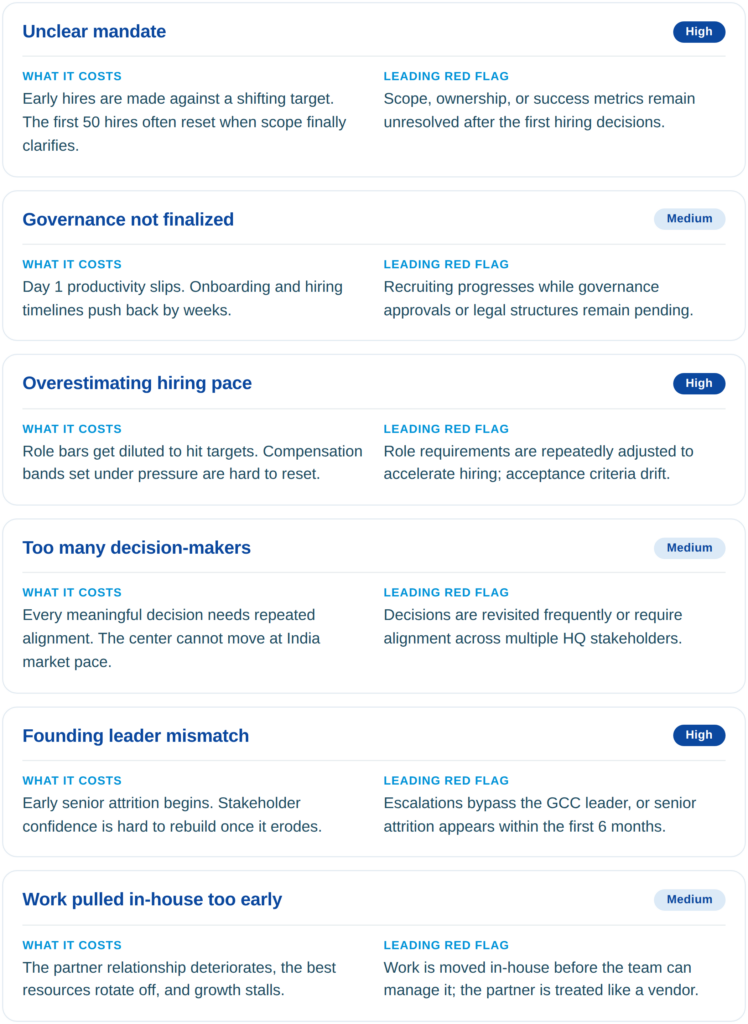
That is why underperformance gets misread. The company stares at the year-three symptoms, attrition, slow decisions, frustrated stakeholders, and treats them as today’s problems, when most of them lead straight back to choices made at setup. The tells are usually visible long before: scope still unsettled after hiring starts, governance pending while recruiting races ahead, role bars loosened to hit numbers, escalations going around the India leader, work pulled in-house before the team can hold it. They look like small operational hiccups. They are the operating model showing its shape.
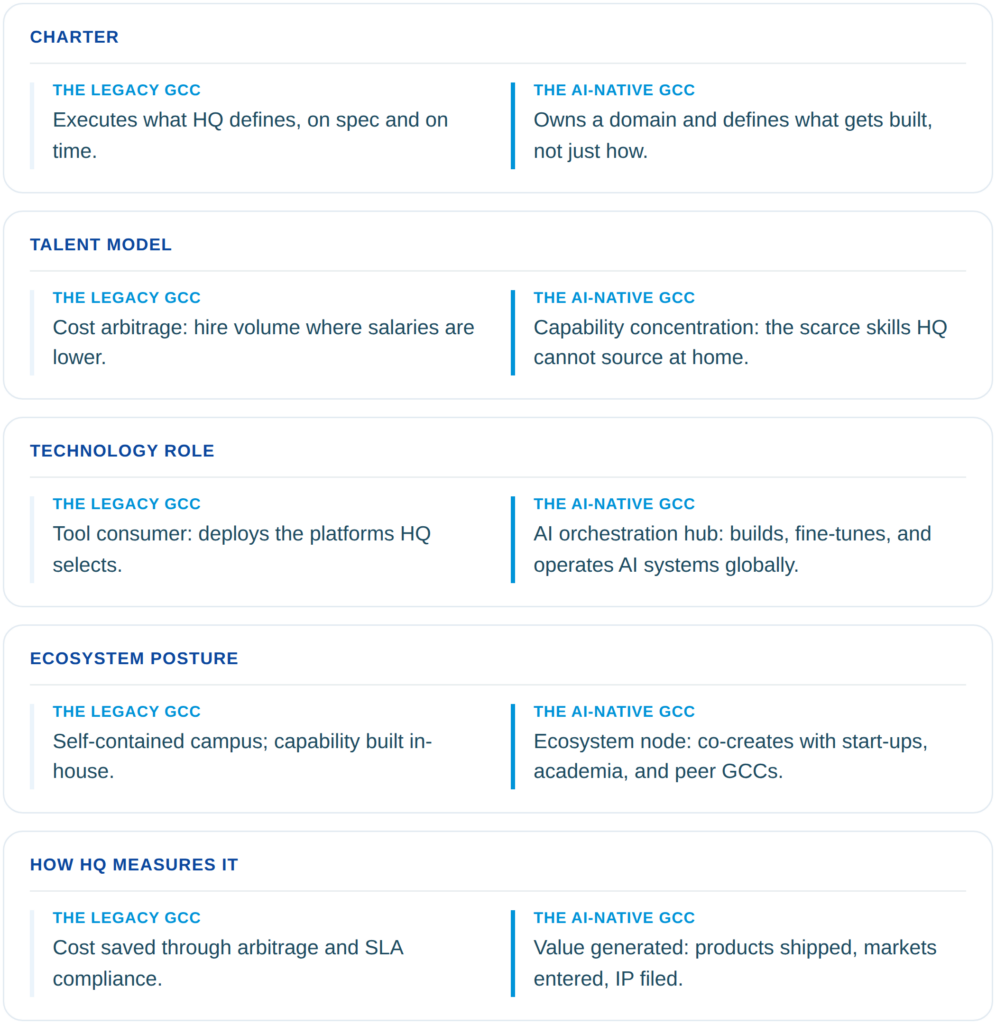
A center that gets the early calls right looks different by year three, and not because it is bigger. Its identity is clear: a real node in the global business rather than a cheaper room to run work in. Its leaders carry global responsibility and sit in planning, because they are accountable for outcomes and not just headcount. Its mandate has grown into products, platforms, AI systems, or transformation work the company depends on. And its value shows up in business terms, products shipped, markets opened, risk cut, decisions made faster, IP filed. The plainest way to know: the company would move slower, decide worse, or pay more for the same work if the center went dark tomorrow.
Get the six calls right, and Year 3 looks like this.
Delivery confidence first, then real ownership, then influence over what the company builds.
A strategic node in the global organization, not a back office.
India leaders carry global P&Ls; the senior cadre exports leaders to HQ.
India shapes HQ strategy and owns global product surface and roadmap.
Products shipped, markets entered, and IP filed, with measurable revenue influence.
The scorecard is already moving. Cost, service levels, and clean delivery still count, but they no longer mark out the best centers. The next wave gets judged on product ownership, AI in production, platform and data work, cybersecurity, and innovation built with the ecosystem. AI is the sharpest test of the lot, because it has to sit close to the problems, the data, the users, and the decisions. Hire AI talent in India but keep the strategy abroad, and you get pilots, not adoption. A center built mainly to execute can do its job perfectly and still fail the scorecard it meets three years out.
Line up the inputs, the six decisions, and the outcomes side by side and the logic is plain. India supplies the raw material, the early calls are the engine, and what the center becomes is the output.
Forget whether the center launched on time, hit its hiring number, or got labeled strategic on a slide. Three questions tell you what you really have. What does the India center own? What can it decide on its own? What would get slower, weaker, or costlier if it disappeared tomorrow? Thin answers mean the center will keep growing, but growth will not fix a design problem.
India made the setup easy. It did not make good design automatic, and that is the gap companies keep falling into. The talent, the cities, the partners, the playbook, nearly everyone can reach all of it now, so access stopped being an edge. The edge belongs to the companies that make sharper calls earlier, because the GCC you will be running in year three is being built right now, in the first six months, while every one of these decisions still looks small enough to get wrong without noticing.



 THANK YOU
FOR YOUR RESPONSE
THANK YOU
FOR YOUR RESPONSE

