





Attracting top technology talent in India is no longer just about offering competitive salaries, benefits, or a strong employer brand.
For Global Capability Centers (GCCs), the real challenge is creating roles that offer meaningful work, decision-making authority, long-term ownership, and visible career growth. Compensation may win the hire, but what employees get to own determines whether they stay.
Key takeaways
For companies setting up or scaling a Global Capability Center in India, attracting and retaining top technology talent is one of the most important challenges.
The conversation usually starts with compensation. Are salaries competitive? Are the benefits attractive? Is the employer brand strong enough to compete for experienced engineers, architects, and AI specialists?
These questions matter. But they do not fully explain why talented professionals join an organization, or why they eventually leave.
Shweta Rani, Global Chief People and Culture Officer- Zinnov, offers a different perspective:
“Top talent does not stay because a company keeps winning the bidding war. It stays when the role keeps getting bigger.”
For GCCs, the implication is significant. Talent retention is not simply an HR or compensation challenge. It is also a question of how the center is designed, what responsibilities it owns, and how much authority its people have to shape outcomes.
Zinnov identifies four things GCCs need to get right: meaningful work, decision-making authority, long-term ownership, and visible career progression.
These factors determine whether employees see the GCC as a place to execute assigned work or as an organization where they can build meaningful global careers.
Four priorities for GCC tech talent attraction and retention
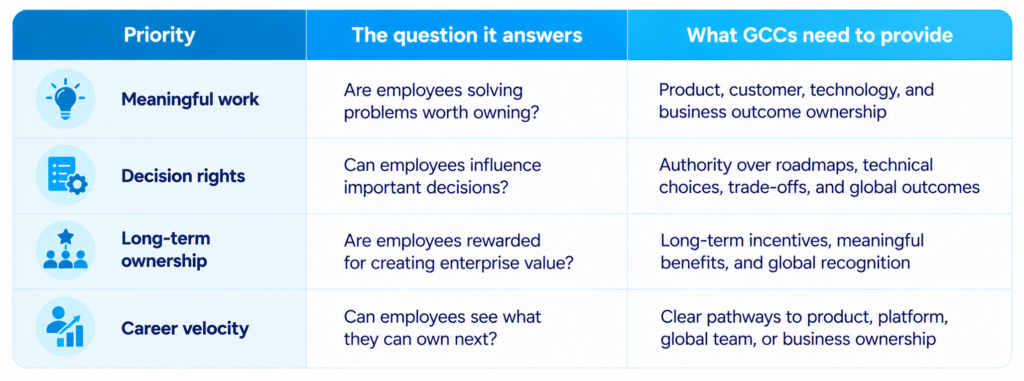
The first priority is giving people problems worth owning. Top engineers and technology professionals increasingly evaluate opportunities based on the nature of the work they will do, not simply the technologies they will use or the salary they will receive. They want to understand the product, the customer, and the business outcome their work supports.
Shweta Rani emphasizes:
“Top engineers want proximity to the product, the customer, and the outcome, not simply execution work handed down from elsewhere.”
Consider two GCC engineering roles.
Both roles may involve similar technical skills, but they offer very different levels of ownership. The second creates greater opportunities for learning, influence, and professional growth.
For GCCs, meaningful work begins with the mandate. A center responsible only for executing tasks may struggle to offer the same depth of career opportunity as one that owns products, platforms, or global capabilities.
This is why talent strategy cannot be separated from GCC strategy. The responsibilities assigned to the center determine the opportunities available to its people.
The second priority is giving employees real authority. A GCC may offer senior titles, larger teams, and expanded responsibilities. But if every important decision still requires approval from headquarters, the role may offer limited professional progression.
Shweta Rani makes the distinction clear:
“A bigger title without greater authority is not career progression.”
For senior architects, engineering leaders, and product professionals, decision-making authority is an important part of the role. They want to influence technology roadmaps, make architectural trade-offs, prioritize investments, and take accountability for outcomes.
Without that authority, even experienced leaders can find themselves managing execution rather than shaping direction.
Consider a GCC responsible for developing a global software platform. The India team may have hundreds of engineers and experienced technical leaders. Yet if the platform roadmap, architecture decisions, and priorities are controlled entirely by headquarters, the center’s ability to develop global leadership remains limited.
Giving the India team ownership of defined platform components, technical decisions, and measurable outcomes changes the nature of the opportunity.
It allows technical leaders to move beyond delivery management and take responsibility for enterprise capabilities.
Decision rights turn responsibility into ownership. For GCCs seeking to retain senior talent, the question is not simply how many leadership positions they create. It is whether those positions carry meaningful authority.
The third priority is rewarding employees like long-term owners. Competitive salaries and annual bonuses remain important. However, for senior technology professionals, long-term incentives can create a stronger connection between individual contributions and enterprise value.
Shweta Rani highlights equity-linked rewards as one way to build that connection:
“For senior architects and technical leaders, RSUs, stock options, or other long-term incentives can tie personal upside to enterprise value.”
Restricted Stock Units (RSUs), stock options, and other long-term incentive structures can help employees participate in the value created by the organization, where such programs are available and appropriate.
But financial incentives are only part of the equation. Benefits that support employees and their families, recognition from global leadership, and opportunities to contribute to enterprise-level decisions can also strengthen long-term commitment.
For example, a senior engineering leader who owns a critical global platform, participates in strategic technology discussions, and receives long-term incentives may have a stronger connection to the enterprise than someone whose role is limited to managing a local delivery team.
The distinction is between rewarding someone for performing a job and recognizing their contribution to building a long-term business capability.
The objective is to shift the relationship from employment alone toward a greater sense of stewardship and shared success.
Long-term incentives are most effective when they reinforce meaningful responsibilities and genuine career opportunities. They cannot substitute for either.
The fourth priority is making career velocity visible. For high-performing technology professionals, career growth is not always about receiving a promotion or managing a larger team.
It is about gaining access to more complex problems, broader responsibilities, and greater influence.
Shweta Rani frames the question from the employee’s perspective:
“If I perform here, what can I own next?”
That next opportunity could be a product, a platform, a global engineering team, or a business outcome. If employees cannot see a credible path toward those opportunities, they may begin looking outside the organization.
How can GCCs create visible career pathways?
A GCC needs to show employees how their responsibilities can evolve as the center matures.
An engineer may begin by contributing to a product feature, progress to owning a platform component, and eventually lead architecture or a global technology function. Similarly, an AI specialist may move from developing individual use cases to leading enterprise AI capabilities.
These transitions require deliberate planning. The center must have access to higher-value mandates, global leadership opportunities, and the decision rights needed to support career progression.
From execution roles to global ownership
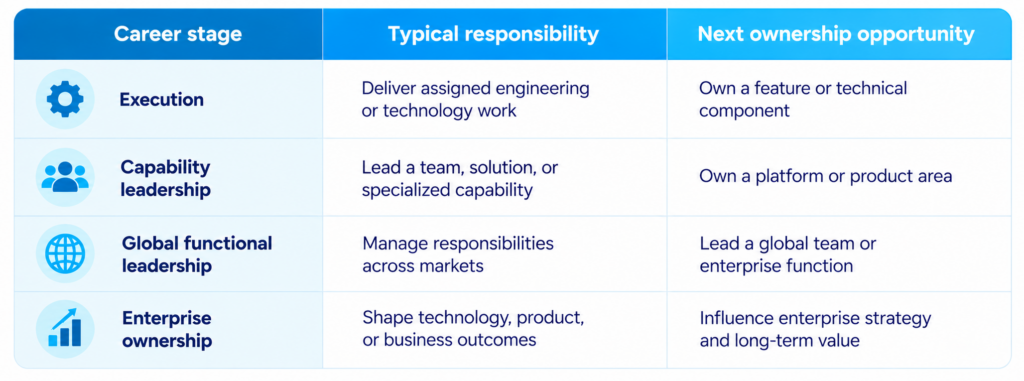
The progression is illustrative, not a fixed career ladder. The important point is that employees should be able to understand what greater ownership looks like and how they can reach it.
A GCC that creates visible opportunities for advancement gives its strongest performers a reason to build their next career chapter within the organization.
One of the most common mistakes in talent retention is assuming that every employee departure is primarily a compensation problem.
When experienced engineers or technical leaders begin considering external opportunities, companies may respond with salary corrections, retention bonuses, or revised benefits. Those interventions can be useful when compensation is genuinely uncompetitive. But they cannot resolve a role that has stopped evolving.
Shweta Rani identifies the underlying problem:
“They try to solve a scope, leadership, or ownership problem with another compensation cycle.”
Consider a senior architect working in a GCC who has spent several years delivering complex technology projects.
The compensation is competitive, the team is strong, and the employer brand is established.
But the architect has limited influence over product direction, cannot make major technical decisions, and sees no clear path toward global platform ownership.
A higher salary may address the immediate financial concern. It does not change the responsibilities of the role.
The retention challenge is therefore structural.
If the scope of the role remains unchanged, compensation alone may only delay the employee’s decision to leave.
For GCC leaders, this means retention conversations should examine the employee’s mandate, authority, leadership opportunities, and future career path alongside compensation.
A sustainable GCC talent strategy begins before the first employee is hired.
Companies need to decide what the center will own, which decisions can be made in India, how leadership responsibilities will evolve, and what career opportunities the center can offer over time.
These choices influence the type of talent the GCC can attract and the reasons employees have to remain.
Moving from compensation-led to ownership-led talent retention
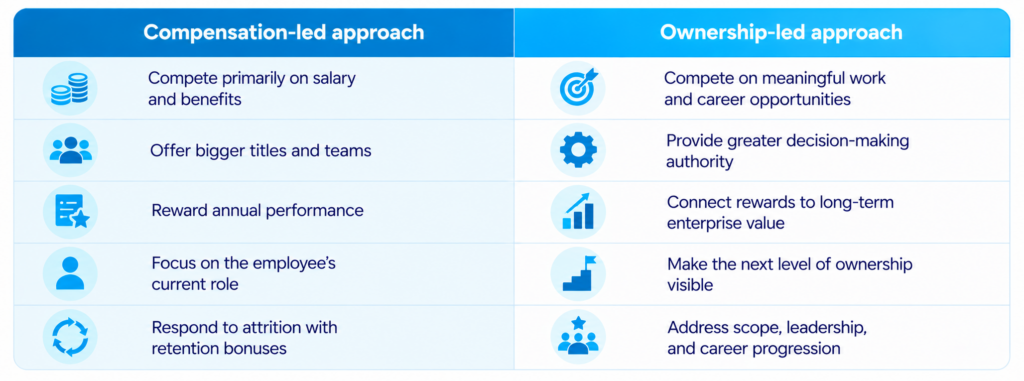
The two approaches are not mutually exclusive. GCCs still need competitive compensation, attractive benefits, and effective people practices.
But those elements work best when combined with an operating model that allows employees to grow professionally.
For US-headquartered companies establishing GCCs in India, this also requires headquarters to view the India center as a source of global capabilities, not simply additional delivery capacity.
The opportunities available to employees depend on the responsibilities the enterprise is willing to assign to the center.
The talent needs of a 100-person GCC can be very different from those of a 500-person or 1,000-person center. During the initial setup phase, companies may focus on hiring foundational leaders, technical anchors, and the first engineering teams.
As the GCC scales, the challenge shifts toward developing specialized capabilities, building leadership depth, and retaining employees who can take on increasingly complex responsibilities.
A center that expands its workforce without expanding its mandate may create more positions but not necessarily more meaningful career opportunities.
For example, a GCC may grow from 100 to 500 engineers while continuing to execute work defined elsewhere.
The organization has become larger, but its senior engineers may still have limited opportunities to own products, influence technology direction, or lead global functions.
By contrast, a center that gradually takes ownership of platforms, product areas, and enterprise capabilities can create new leadership pathways as it grows.
Scaling a GCC should therefore involve expanding both workforce capacity and the scope of responsibilities employees can own.
This is particularly important for retaining experienced technology leaders who expect their roles to evolve alongside the organization.
GCCs can attract and retain technology talent by offering more than competitive compensation.
They need to give employees meaningful problems to solve, real authority over decisions, incentives connected to long-term value, and visible opportunities to take on greater responsibilities.
These four factors reinforce one another.
Meaningful work attracts ambitious professionals. Decision rights allow them to make an impact. Long-term incentives recognize their contribution. Career velocity gives them a reason to stay.
Shweta Rani summarizes Zinnov’s perspective:
“Compensation may win the hire. But meaningful work, decision rights, long-term ownership, and visible career velocity are what turn great talent into long-term stakeholders.”
For companies building GCCs in India, the goal is not simply to hire and retain a workforce.
It is to build an organization where talented professionals can take ownership of increasingly valuable capabilities and see their future growing alongside the enterprise.
Zinnov works with global enterprises across GCC strategy, setup, talent planning, leadership hiring, and transformation.
Having supported the setup of more than 220 GCCs, Zinnov helps organizations align their talent strategies with their business mandates and long-term capability requirements.
Its GCC setup and execution approach connects workforce planning with leadership design, organizational structure, and the responsibilities the center is expected to own.
For US-headquartered companies establishing or scaling GCCs in India, this means building talent strategies that support both immediate hiring requirements and future global capability ownership. Zinnov helps enterprises plan the leadership, talent, and operating structures needed to build GCCs designed for sustainable growth.



 THANK YOU
FOR YOUR RESPONSE
