In PE Valuation Lever: How Global Talent can add 4–8X in Exit Value, we explored how globalization has become a high-impact lever for Private Equity firms facing rising costs and competitive exits. We showed how shifting 30-50% of portfolio talent to hubs like India, Mexico, and Eastern Europe delivers EBITDA gains in less than a year depending on the company size which compounds into 4-8X exit valuation uplift, with a proven IRR boost of 300-400 bps.
Having established the ‘Why,’ we turn to the ‘How.’ Below is a five-step playbook, tested across multiple Mid-market deals, that takes you from Day 0 post-close to a fully mature Global Capability Center (GCC) in three years.
Step 1: Assess Globalization Potential in the First 30 Days Post-close
Immediately post-close, embed globalization into the value creation plan by running a structured assessment to identify what work can, and should, be globalized.
Key Actions:
Current State Review: Map all business units, functions, and geographies to assess talent, process maturity, and delivery models
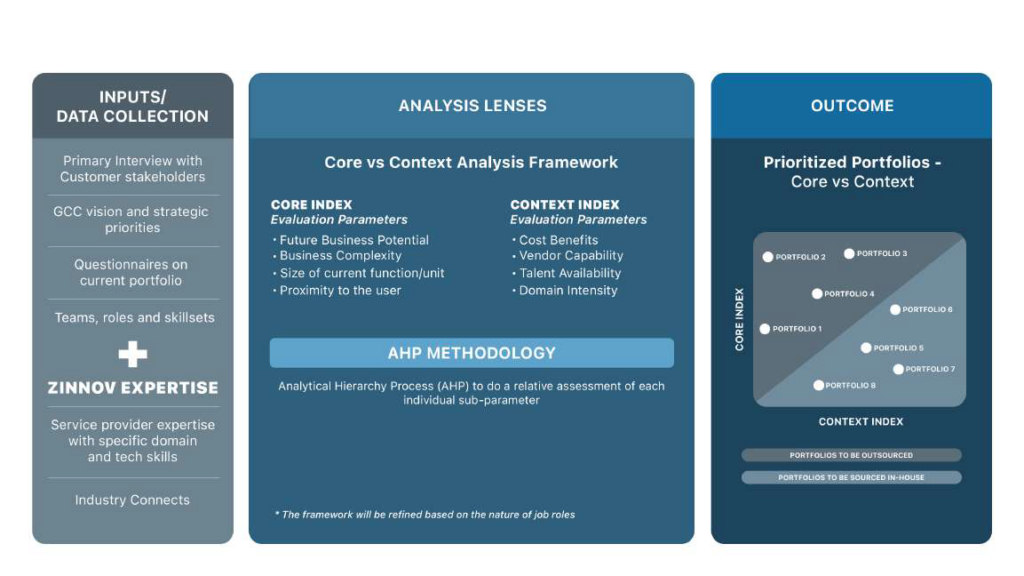
Portfolio Analysis: Identify core workloads that can be transitioned to a GCC, and non-core/ contextual functions that are better suited for outsourcing
Core (insourced): IP-heavy, recurring, roadmap-critical work you want to own end-to-end (e.g., owned product/modules, QA automation, SRE/DevOps, data & AI-ML, L3 escalation).
Transition Roadmap: Develop a phased transition plan based on business criticality (revenue/SLA impact, regulatory risk, customer-facing modules), organizational readiness (process maturity, leadership in-seat, documentation/tooling), and cost-benefit potential
Location Analysis: Identify optimal GCC locations by matching identified core workloads to candidate markets that offer:
Run-rate savings (steady state): the annualized, recurring savings once the GCC is fully ramped after overlap and the initial productivity dip.
Speed-to-impact (timing): when savings hit the P&L and fully annualize, often the biggest IRR lever.
This diagnostic helps PE firms establish clarity from the outset by aligning globalization efforts with enterprise value objectives from Day 1.
Step 2: Define a Bold, Business-Aligned GCC Vision
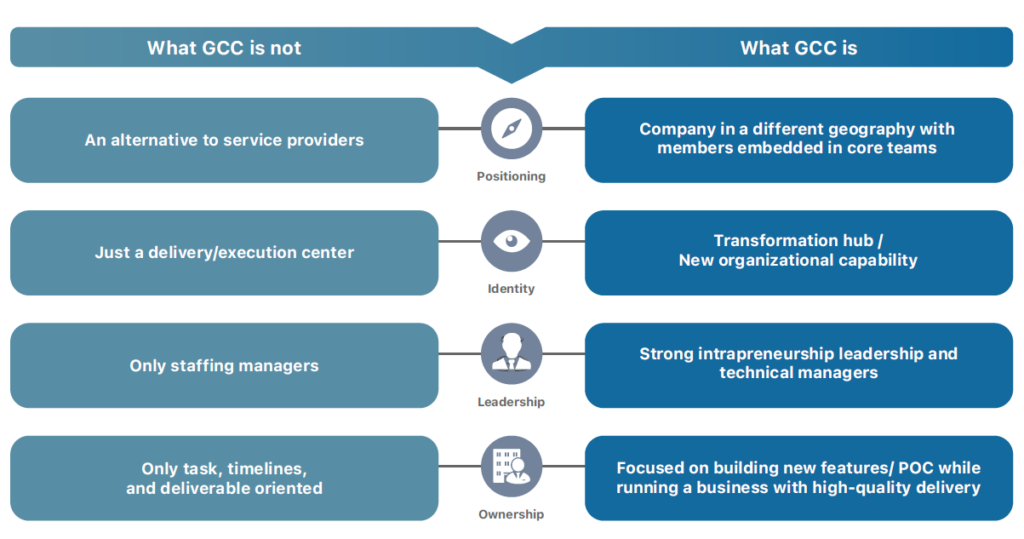
GCCs have moved well beyond cost efficiency. Today, they are strategic engines for innovation, resilience, and growth. The first step in building that kind of center is to define why it exists – its charter. A strong charter makes clear what the GCC is and is not, and anchors every decision on scope, operating model, and leadership.
Key Actions:
Set the Charter: Define the GCC’s purpose. For example, faster product cycles, enhanced data analytics, 24/7 support, or digital capability building
Align with Enterprise Strategy: Convert enterprise priorities into 3-5 GCC Objectives and Key Results (OKRs) across product roadmap, customer experience goals, and key transformation programs (e.g., cloud modernization, data/AI, security & compliance, etc.)
Design the Operating Model: Determine scope (functions, geographies), governance structures, leadership bandwidth, and integration with HQ
Secure Executive Sponsorship: Ensure buy-in across product, Engineering, G&A, and investor leadership
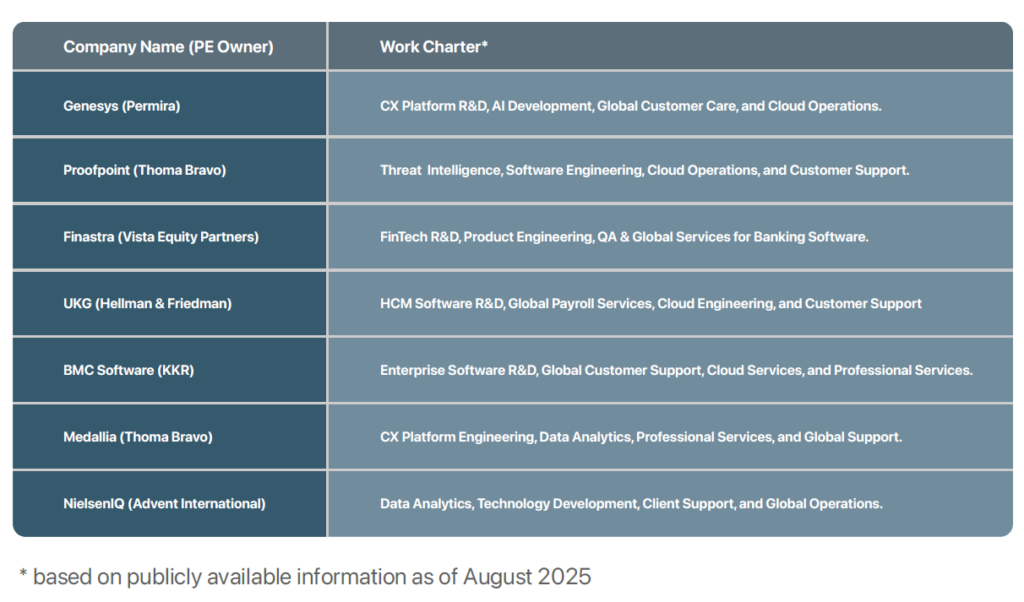
Sample GCC Charters at PE-Owned Software Companies
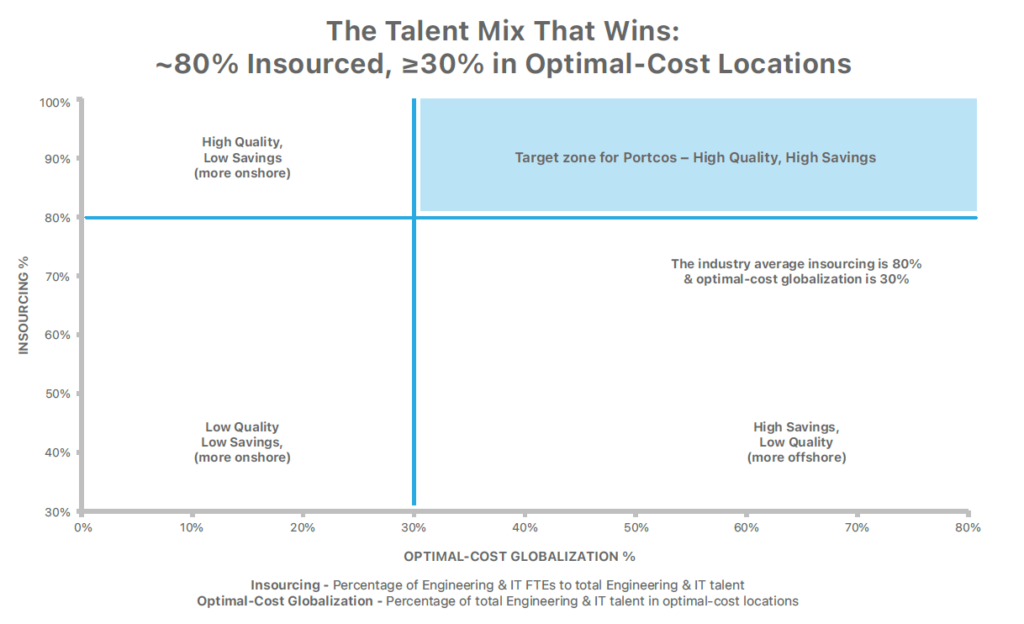
Step 3: Execute a Phased Talent Transition (Target 30% of talent in optimal cost global locations)
With the vision in place, execution begins. Transition high-ROI roles in waves to accelerate value realization with minimal disruption to the roadmap, i.e., protect committed milestones/OKRs, avoid slipped releases or missed SLAs, and keep any temporary velocity dip to ≤15-20% during overlap.
Set clear expectations: From Day 1, GCC teams should be measured on the same yardstick as HQ teams – 1:1 productivity, identical SLAs, and shared OKRs. This ensures parity in expectations and builds credibility with leadership, customers, and future buyers.
Why 30%? That’s the minimum percentage of talent in optimal cost global locations where economics and capability really inflect. Below it, leadership overhead and fragmentation erode savings; above it, you can build complete, end-to-end teams and present buyers with a credible global operating model, not a staffing patch.
Key Actions:
Prioritize Transition in Waves: Begin with functions that have standardized processes and deep global talent pools, such as Software Engineering, IT, and Finance
Build Transition Roadmaps: Align transition phases with organizational readiness and local leadership maturity
Operationalize Change: Enable adoption through structured training, change management, and strong internal communications
Monitor Velocity: Avoid overloading the GCC early on. Closely monitor output, quality, and attrition in the initial phases
Step 4: Use Outsourcing as a Strategic Complement (Target 15–20%)
Globalization isn’t binary. Use third-party partners for speed and flex capacity while the GCC stays focused on core work. Vendors can quickly cover surge, project-based, or niche skill requirements without overstaffing the center.
Why 15–20%? Big enough to handle surge and niche skills fast, small enough to keep economics, IP, and governance inside the GCC. Beyond ~20%, vendor management drag and valuation haircuts start to outweigh the flexibility benefits.
Key Actions:
Identify Tactical Functions: Outsource short-cycle tasks (e.g., data migrations, one-off integrations, cloud cutovers), transactional processes (e.g., AP invoice processing, payroll ops, standardized reporting), or niche roles (e.g., penetration testing, Oracle DBA, performance tuning, mainframe, legacy ETL) that don’t warrant a full-time GCC presence
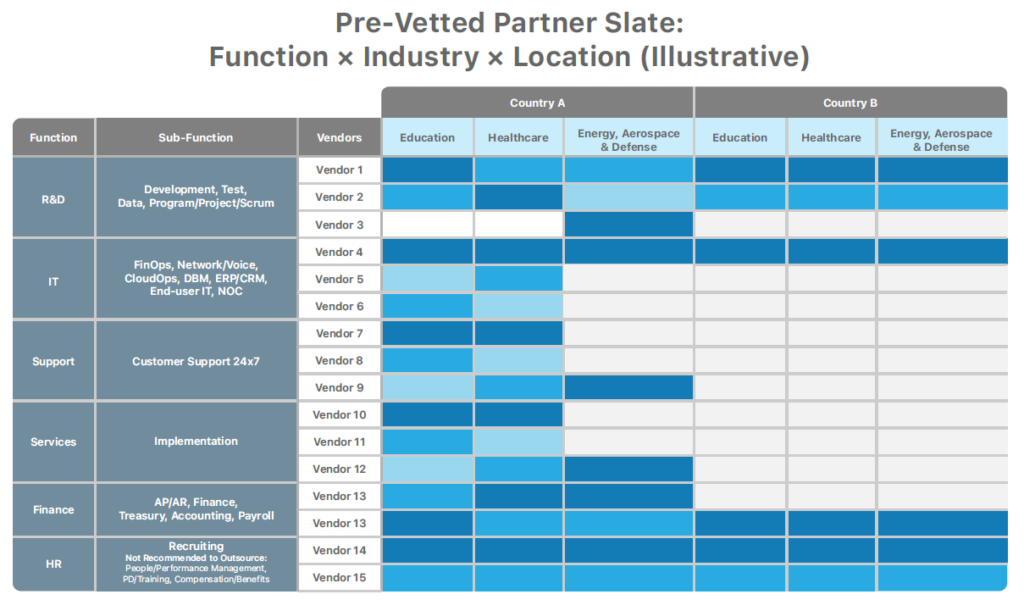
Establish a Tiered Partner Ecosystem: Maintain a pre-vetted slate of vendors mapped by function, industry domain, and delivery location to minimize ramp-up time and reduce contracting complexity
lllustrative partner matrix: The heat-map below shows how a pre-vetted ecosystem works in practice: each dark-blue cell marks a “go-to” partner already contracted for that function in a given geography; lighter shades indicate secondary options. With this ready slate, ops teams can pull capacity on demand, whether it’s R&D in Country A or Customer Support in Country B, without a new Request for Proposal (RFP) cycle, while still capping total outsourced work at ~15–20 %.
Enable Integrated Delivery: Ensure outsourced teams operate within a unified rhythm alongside GCC teams
Step 5: Scale and Mature the GCC into a Portfolio/Transformation Hub
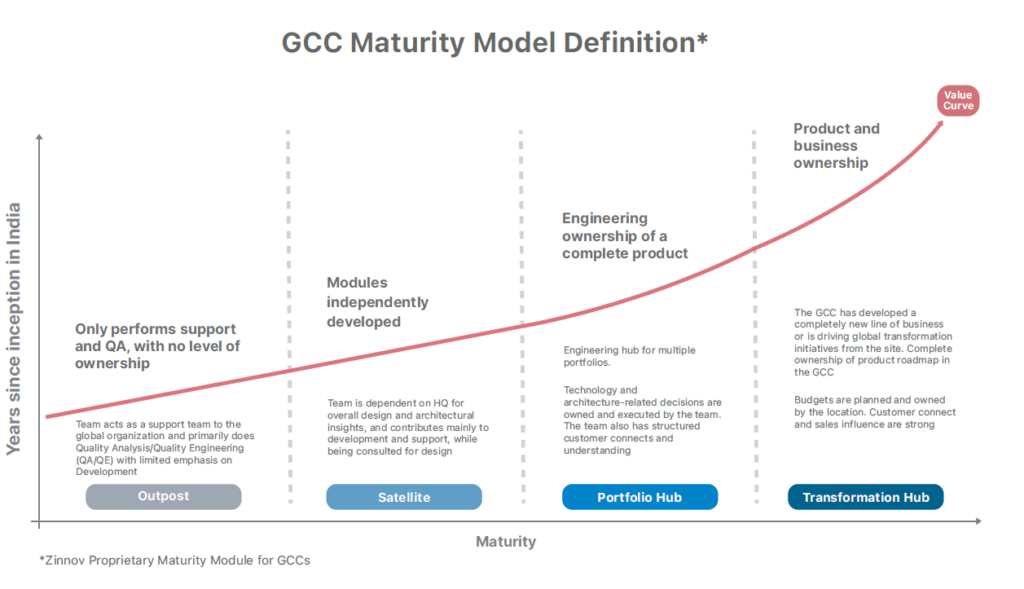
With the foundation set, the focus shifts from standing up to scaling and maturing. Zinnov’s GCC Maturity Model charts four stages of value creation – Outpost, Satellite, Portfolio Hub, and Transformation Hub. Your target: hit Portfolio-Hub maturity by Year 3, so the center moves from a cost lever to a valuation enhancer that buyers will pay for.
From Framework to Timeline
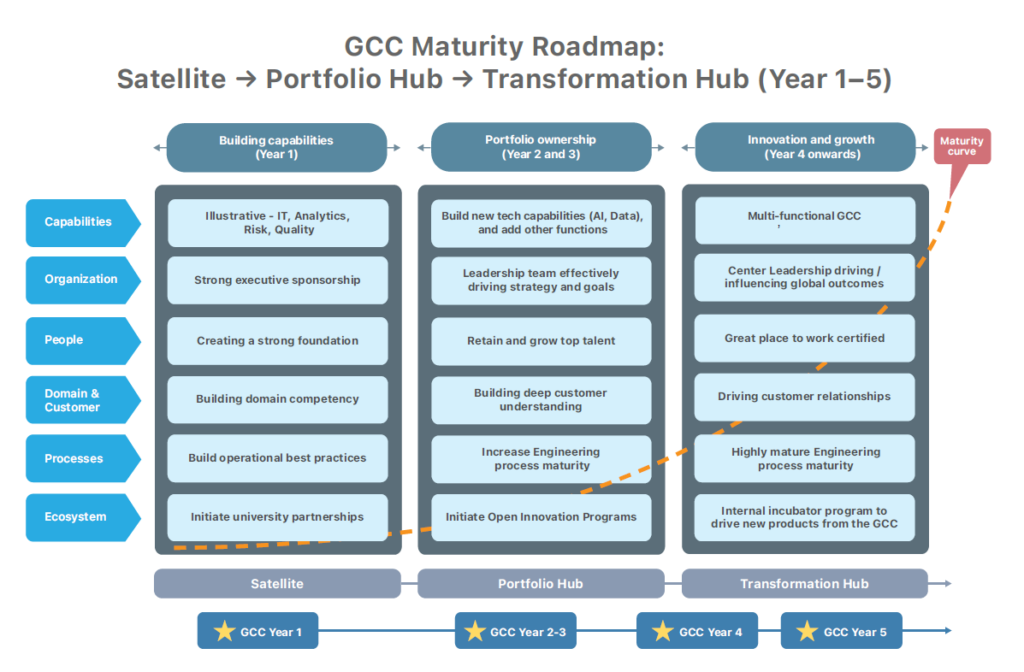
You now have the framework – charter, governance, and a balanced mix of GCC, vendor, and on-shore work. The next question is speed: How quickly can the center climb the value curve before exit?
The three-year roadmap answers that question. It shows the GCC’s progression from a Satellite building core capabilities in Year 1, to a Portfolio Hub owning full products in Years 2-3, and finally to an Enterprise-influencing hub that drives innovation and margin expansion. Each milestone aligns to the maturity model, indicating when and how to maximize valuation inside a typical PE hold.
Year-by-year Maturity Path
Year 1: Establish governance structures, build employer brand, secure early delivery wins, and establish leadership credibility
Year 2: Transition full delivery ownership, deepen cross-border collaboration, and initiate innovation pilots
Year 3: Evolve the GCC into a global hub with full-stack ownership, enterprise-wide influence, and measurable ROI
By Year 3, the GCC should be a growth engine, not just a cost center, owning road-map modules, driving innovation, and delivering measurable ROI that enhance the Exit narrative and buyer appeal.
Conclusion: Make Globalization the Default Setting in Value Creation
Globalization is no longer a support-function shift. It’s a strategic lever for building leaner, stronger, and more scalable businesses across the PE portfolio.
Firms that operationalize globalization from Day 1 unlock more than cost efficiencies. They gain:
Faster time-to-market through 24/7 development cycles
Resilient, diversified delivery models immune to local shocks – data-residency or regulatory changes, geopolitics, localized attrition surges, labor actions/strikes
Structural margin advantages that directly lift EBITDA multiples
Stronger exit narratives backed by demonstrable capability (AI/analytics teams, product & platform ownership), organizational depth (experienced leadership, end-to-end accountability, mature processes with documented SLAs), and scalable delivery (multi-hub footprint, proven hiring velocity, surge capacity, and built-in redundancy).
As global talent pools deepen and operating models evolve, the winners will be those who treat globalization not as a one-time initiative but as a default move in every value creation plan.
The playbook is proven and the upside is real, making globalization less of an art and firmly a science.
Now is the time to globalize with intention, speed, and permanence.
With 23+ years of experience in setting up and scaling 200+ global talent hubs, we help Private Equity firms unlock higher exit value through strategic globalization.
10 Mar, 2026
The reason you set up a Global Capability Center (GCC) determines the center you end up with. Here's what no one tells you, before you start.











 THANK YOU
FOR YOUR RESPONSE
THANK YOU
FOR YOUR RESPONSE

