




BACK TO Business Resilience
ZINNOV PODCAST | Business Resilience



Most companies answer the AI question by experimenting first and deciding later. At CAI Software, that order is reversed. On this episode of the Zinnov Podcast, the first in the AI Transformation Series, host Amita Goyal, Managing Partner, Zinnov, sat down with Brent Pietrzak, Chief Executive Officer, CAI Software, the manufacturing software company serving more than 15 industries, from seafood processing to aerospace.
Brent took the role in the fall of 2025 after 25 years at Flexera. In his first year he launched a company-wide AI strategy built on three decisions: one leader for AI and technology, one AI provider as core infrastructure, and a bar set at autonomous agents rather than faster coding. The conversation covers why those decisions came before any tool, how CAI measures whether the strategy is working, what the shift from headcount spend to AI spend means for hiring, and why Brent argues that AI without domain knowledge gets nowhere.
Zinnov Podcast ft. Brent Pietrzak, CAI Software Episode Summary
On this Zinnov Podcast episode, CAI Software CEO Brent Pietrzak describes building a company-wide AI strategy in his first year: a combined Chief AI and Technology Officer role, standardization on a single AI provider, vertical engineering held inside each business unit with shared services for what crosses them, and an AI-first software development lifecycle that moved products three to seven times faster within four to five months. He sets out four things a manufacturing CEO should do first, the one thing to skip, and the industry belief he thinks is wrong.
Tune in now.
PODCAST TRANSCRIPT
Amita: Welcome to the Zinnov Podcast. This is Amita Goyal, Managing Partner at Zinnov. Today we are starting something new: a new series called the AI Transformation Series. In this series, we will be talking to CXOs about what they have changed in their organizations with respect to AI, how they have organized that change, and what they have learned through the journey.
Today we have with us our first guest, Brent Pietrzak. Brent is the CEO of CAI Software, which builds manufacturing solutions across discrete manufacturing, process manufacturing and graphic communications, serving more than 15 industries. Brent took the role in the fall of 2025 after 25 years at Flexera, where he held several senior roles, including General Manager, Chief Customer Officer and, most recently, Chief Operating Officer. In his first year at CAI, he brought two companies together, added two more, and launched a company-wide AI strategy. Welcome to the podcast, Brent. Thank you for joining us.
Brent: Thank you so much. Glad to be here.
Amita: Lovely. You’ve spent your career close to very different kinds of customers: enterprises managing and optimizing their own technology environments, and now manufacturers whose daily operations run on CAI software. When you think about creating real business impact through AI, what principles stay the same across these industries, and what has changed with the customers and the products you’re serving?
Brent: Sure. I think no matter what industry you’re in, whether it’s one of our customers or another software company, if you’re going to embark on an AI journey, the right starting place is that you have to have a strategy. It sounds simple, but I interact with a lot of companies that don’t. They just start doing stuff with AI. So it’s really important that you start with your executive leadership team and have a clearly defined strategy that gives you an idea of what you want to get to.
The second part is that you need to aim high. A real AI strategy is going to include things like autonomous AI agents. It’s going to be an enterprise-wide transformation. It should, in some way, shape or form, touch every employee in the company. That’s going to be true whether you’re a software company or one of our customers. You really need to have a vision there.
The other really important part is that there are so many AI and AI-related technologies that you have to be prescriptive about what you want to use and what you do not want to use. I think that holds true for both sides of that coin.
Then the part that is a little different depending on your industry is that you have to consider what adds value to your customers. In our case, we generally serve the manufacturing industries. So what do manufacturers care about? They care about not having any downtime. They care about running more efficiently, both from a faster time-to-market perspective and in terms of making the people they have on the shop floor more efficient. If it’s really specific to what you’re doing, that’s probably better suited to having very specific domain knowledge driving it. But the principles across an AI program remain the same.
Amita: Absolutely. Very well said. So in a year, you’ve brought CAI and Print ePS together, and you’ve also added PlanetTogether and LLumin. How do you decide what to integrate and what to leave alone?
Brent: My philosophy on buying or integrating companies is that you can’t ever just leave them alone. The reasons are that you buy companies because you get great talent from the people, and you usually have a thesis that you can sell more of whatever that particular company provides. You can’t do that as effectively if it’s not integrated.
Now, the speed of that integration varies. There’s the go-to-market piece, and then there’s the back-office operational piece. Ideally, from my perspective, you’d have everything done in a timeframe of around three to six months. There are factors in the business that sometimes make it take a little longer, but if you wait and go beyond three to six months, you haven’t really changed anything, and that’s probably not why you bought the company or chose to integrate the two.
It’s really important that you move quickly. Moving quickly primarily allows the go-to-market teams to get going. If you don’t, what you end up with is a proliferation of systems behind the scenes, and that makes it that much more complicated to run the business in total. So somewhere in the three-to-six-month timeframe is usually what we’re shooting for.
Amita: That’s really amazing. So in April, you put the technology and AI roles together. Why one seat instead of a separate AI leader?
Brent: That’s a great question, and there are a number of reasons. Number one, AI and technology are so interlinked that it’s really helpful to have one person making the decisions with a lens on both. Reason number two: if you are going to have a Chief AI Officer and a Chief Technology Officer, that gets very expensive. For a company that’s probably less than a billion in ARR, it’s hard to imagine how that would be effective. If you’re talking about really large companies, I can see how it would work. But those are the two reasons.
I also think that in those roles you really want someone who is forward-looking and has strong opinions. That’s what you want out of driving a really effective AI and technology strategy. So from my perspective, you’re much better off having one decision maker there.
Amita: Makes sense. That’s a great point. That role runs the shared engineering. So how do you decide what gets built once for the whole company and what has to stay close to each division’s customers?
Brent: In our business, we serve very similar markets, but they are very different. We serve everything from seafood manufacturing to aerospace, and seafood manufacturing and aerospace are very different. So anything that’s specific to a vertical is held within the business unit and developed by those engineers. Anything that goes across all three business units is developed as a shared service.
An example, since we’re talking about AI, is how you price, package and monetize AI. We don’t want 50 pricing models. We want common pricing models that we can manage from a back-office perspective for billing. That’s a good example of something that goes across all the business units, where we would have a shared development and delivery perspective.
The other place where it would be shared is anything that’s a horizontal solution. Even though we have three different divisions, some of the solutions we sell are applicable to all three. If that’s the case, we need to consider the requirements of all the different market segments we serve. So it will be either a combination of the business units and shared services, or just shared services, depending on what it is. If it’s market-specific, we’ll develop it within the engineering group specific to the business unit. If it goes across more than two business units, we’ll typically have the shared services model look at it.
Amita: Makes complete sense. So what is the biggest bet you’ve placed in the AI era at CAI, and what was the framework behind that decision?
Brent: The biggest bet is certainly investing in a single provider of AI technology for us, which happens to be Anthropic. We had a number of different AI technologies out there, and from my perspective, we’re way better off standardizing on one as the core infrastructure. That was probably the biggest bet we made, from both a cost perspective and an operational perspective: can we get to market really, really fast?
When we started, we had maybe nine to ten different AI technologies we were using, probably more than that. Although you get some benefit from some of the unique capabilities, what you don’t get is the ability to share great things easily. That was really important to us: that we could share anything we’re doing across all the business units and across shared services. So we chose to standardize. AI’s not cheap, so that was definitely the biggest bet, from both a financial and a go-to-market perspective, in terms of what we’re going to deliver in the future.
Amita: So it’s Anthropic for you. When you funded that bet, before the ROI was proven or the advantages of having one provider were proven, what did you stop or defund to pay for it, or how did you carry that out internally?
Brent: We didn’t immediately stop anything. We had planned on spending a certain amount on AI as part of the budget process. But I think what it means long term is that there will be a balancing act. For all software companies, traditionally the majority of cost has been in headcount. Now that’s shifting to a mix of headcount spend and AI spend. The goal of AI is to make the employees we have many times more effective. So if you follow that logic, we shouldn’t need to hire as many people as we typically would going forward. That’s one of the things we’ll have to balance as the company evolves: how much do we spend on AI, and how many new hires do we actually bring into the business?
Amita: Absolutely. So before any numbers move, what’s the sign that it’s working, or what would have told you it wasn’t?
Brent: The sign that it’s working is that we measure the velocity and quality of our engineering deliverables. Within about four to five months, we could see that across different products where we were taking an AI-first software development lifecycle approach, we were going three to seven times faster than before. The only way we can tell that is by measuring it. We also had some really interesting proof points, where in the old model our teams had estimated things that would take up to 28 months, and we were able to complete them in as short as three to four weeks. Those were early signs that things were working.
What would have told me it wasn’t working is if we couldn’t have measured improvement in velocity, quality or any of the metrics you want to use, and if we didn’t have any other proof points. The other one would be general adoption. We also understand how much our employees are using AI. If adoption was really low, that would have told me we weren’t being very effective.
Amita: That’s incredible, from 28 months to three or four weeks. So in closing, if a mid-size manufacturing company CEO asked you where to start with AI on Monday, what’s the first thing you’d tell them, and the first thing you’d tell them to skip?
Brent: The first thing I’d tell them is to develop a strategy and figure out exactly what you want. Set interim goals for what it looks like to achieve that strategy, and make sure you stay on track with it. The second thing I would say is to be very thoughtful about how many different AI technologies you bring in, because it adds unnecessary complexity if you bring in a whole bunch. Many are, in theory, very inexpensive, but they create operational complexity. Number three, put somebody in charge. Give somebody the title of Chief AI Officer or Chief AI and Technology Officer, because you really do need someone who wakes up every day and thinks about what you are doing from an AI lens. And number four, think about it from your customer’s lens. You can do lots of interesting things with AI, but that doesn’t necessarily mean it’s going to benefit your customers. Always thinking about what the customers care about, as part of your strategy, is a really good starting point.
What I’d tell them not to do: some experimentation is good, but without an end goal of business results, if you just let people experiment with AI for too long, they could spend a ton of time and a ton of money on token spend without any discernible benefit. I would try to avoid that. I would also try to avoid the scenario in which AI becomes an end in itself. What I mean by that is that you have to set the bar really high. An example would be a lot of companies saying, “Hey, we’re an AI-first development organization,” when all that really means is that they’re using some type of AI tool to let their engineers code a little bit faster. That’s not much different from what was happening previously in the software world. A good goal would be to think about how many business processes, or how many of the things we are doing, will involve autonomous agents, and to think of the agents as the actual method of delivering work, because that’s the only way you can get multiple times of improvement. So I would set the bar high.
Amita: So this is a question we’re going to ask every guest: what does everyone in your industry believe about AI that you think is wrong?
Brent: What I think everybody in the industry believes about AI that’s wrong is that AI itself can make great progress without extensive domain knowledge. AI is great. It’s incredible for many different things. But what you have to keep in mind is that the domain knowledge, and the people who have that domain knowledge, are what drive the efficacy of the AI. It’s not just that you have the right AI technology; you also need the right people with the domain knowledge to make it very effective for whatever industry you serve. That’s the one thing I think people miss. You think that because people have lots of AI skills, they can just apply those to your specific industry. In some cases you can, a little, but it’s super helpful if you actually understand that industry in and of itself.
Amita: Absolutely. Thank you. Brent, thank you so much for opening the AI Transformation Series with us. It was so lovely talking to you.
Brent: It was great talking with you. Thank you for having me.
Amita: Thank you. So that’s the AI Transformation Series on the Zinnov Podcast, where we go inside one company at a time and look at how they’re driving change with AI and how they’re organizing the company to make an impact for their customers and their business. Thank you so much for joining me, Amita Goyal. See you next time.
Narrator: Thank you for listening to this episode of the Zinnov Podcast. Stay tuned for more such interesting episodes. You can listen to our podcast on Apple Podcasts, YouTube, Spotify, or any of your favorite streaming platforms.

Mohan Rao on how Samsung’s Bangalore R&D center went from delivering to spec to 14,000 patents, and why he’s now redesigning every process in it for AI.
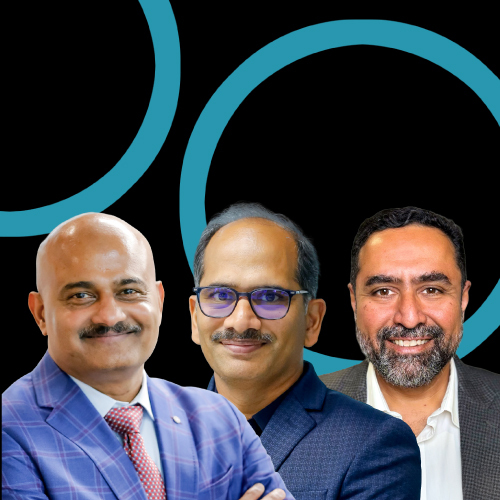
Theom’s Navindra Yadav and Ravi Sankuratri discuss enterprise AI security, data governance, building an AI-native company, and their GCC journey in Hyderabad.
Don’t miss any of our future episodes!
Also subscribe to the Zinnov Podcast on these platforms






Mohan Rao on how Samsung’s Bangalore R&D center went from delivering to spec to 14,000 patents, and why he’s now redesigning every process in it for AI.
Theom’s Navindra Yadav and Ravi Sankuratri discuss enterprise AI security, data governance, building an AI-native company, and their GCC journey in Hyderabad.
 THANK YOU
FOR YOUR RESPONSE
