




BACK TO Business Resilience
ZINNOV PODCAST | Business Resilience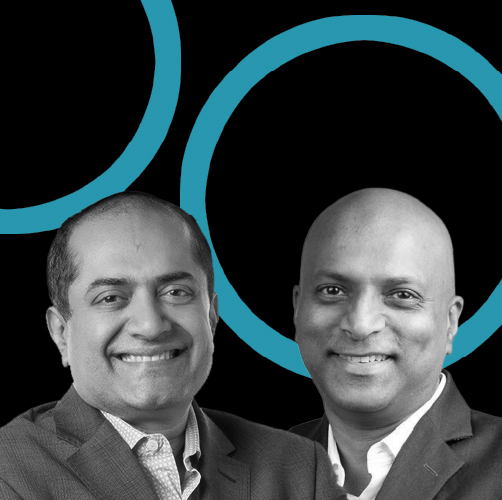



Enterprises have never been more committed to AI, yet many are still struggling to translate that investment into measurable business value.
For Dinesh Venugopal, CEO of Tenarai, this wasn’t just an industry trend. It was showing up in conversations with business and technology leaders every day. He saw a massive opportunity to help enterprises accelerate their AI journey. After three decades as Infogain, the company reinvented itself as Tenarai, shifting from a traditional engineering services model to one built around AI squads, forward-deployed engineers, and outcome-based delivery.
In this episode of Zinnov Podcast, Pari Natarajan, CEO of Zinnov, sits down with Dinesh at our New York office to discuss what prompted that shift, why so many enterprise AI initiatives never move beyond pilots, and what it actually takes to transform your own company before helping customers transform theirs.
Tune in now.
PODCAST TRANSCRIPT
Pari Natarajan: Welcome back to the Zinnov Podcast Business Resilience Series. I’m joined today by Dinesh Venugopal, CEO of Tenarai, formerly Infogain, a global enterprise AI acceleration company working with Fortune 500 companies across industries including retail, travel, insurance, healthcare, and telecom.
Dinesh brings deep cross-functional experience in product strategy, product engineering, M&A, and global operations.
Before Tenarai, he was President at Concentric Catalyst, CEO of PK Global, which got acquired by Concentric, and President at Mphasis, where we grew the business from $300 million to over $1 billion.
Welcome to our podcast, Dinesh.
Dinesh Venugopal: All right. Thanks for having me.
Pari Natarajan: Dinesh, first let’s start with this new company name, Tenarai.
What are the reasons for the name change? Infogain has been in the business for the last 30-plus years providing engineering services to customers. What are the reasons for the change?
Dinesh Venugopal: It’s a great question, Pari.
First, let me give you some context. I live in Silicon Valley, and every day you get groundbreaking news about AI.
There are new models, new tools, and new technologies getting dropped. But then you walk into a CXO’s office and ask them what benefit they’re getting out of AI. More than half will tell you that they’re not seeing much value come out of this.
We recognized this about a year ago, and we felt there was a huge opportunity to help enterprises accelerate AI adoption.
But then to do that, we quickly realized that we have to transform ourselves first.
So we pivoted around three big pillars.
Number one was our talent and delivery, so we completely redid our delivery model. We are now more engineering-oriented than delivery-oriented in the traditional sense.
We built out an AI platform, and then finally, we built out a partner ecosystem.
And I believe that in this new world, you need to have a really strong partner ecosystem to help our customers succeed.
So with all of this going on, we also started doing a bunch of use cases for our customers, and many of them got into production.
And the customers were delighted by the progress that we made along with them on this journey.
And so we looked at ourselves and said, “Hey, this new company requires a new identity,” and that’s how Tenarai was born.
So when you think of Tenarai, think of us as the one who’s obsessed with outcomes, helping our customers achieve outcomes as opposed to doing projects and technology-led plays like we used to do before.
So this is a big transformation for us. We first did our transformation ourselves and then decided on a new identity.
Pari Natarajan: Very, very interesting.
So you started working in a newer model using all of the newer AI technology, and then that required a change in identity.
Dinesh Venugopal: That’s right.
Pari Natarajan: Interesting.
Pari Natarajan: Last week I was at a conference with a whole lot of CIOs, and one thing which came out is the board is pushing them hard on AI, and then they’re spending quite a lot of money.
If you look at Anthropic’s revenue growth, 10x revenue growth in a year, you’re starting to see this consumption and spend on AI.
But when we come to measurable results, there are two things I heard.
One, they’ve made these massive bets on large platforms, but there are significant failures.
Or they’re taking shots at very small use cases that aren’t getting them enough results.
And you’re working with them day to day. How are you creating measurable results for your clients? Some examples?
Dinesh Venugopal: Yeah. So very interesting.
One of the things you see in enterprises today is what I call pilot purgatory.
They’re stuck in pilot mode, and they are thinking about how to get out of pilot mode, from proof of concept to proof of value.
Pilots are very easy to do in the AI world, and that’s where a lot of the spending happens.
The tokens get spent, a couple of CXOs come in, they sit in the office and do a proof of concept.
But when you really look at what it takes to go into production, you need enterprise context, you need the data to be in the right place, you need security, and you need governance.
So only if you have all of those things set up do you see results in the new world.
So customers that have adopted what we call a three-layered approach.
There’s a foundational layer. You’re deciding what LLMs to choose there, what governance models you want there.
And then the middle layer is what we call the AI readiness layer.
Is your data in the right place? Do you have the agentic frameworks that you need?
And then the top layer is what we call the business value layer.
Business value is how do you create actual use cases that can create value.
So if you start just from the top, you’ll be in pilot land.
If you start just from the bottom, you won’t have anything to show.
So you need all three layers to fire to show the value, and that’s where we are seeing any customer that adopts this three-layered approach start to see a lot more value happen much quicker than just doing proofs of concept.
Pari Natarajan: Very interesting.
To drive the three-layered approach, what we see is many of the customers don’t seem to have internal know-how.
Because they need to continue to run their existing business, a significant chunk of their bandwidth goes into driving that.
They don’t seem to have internal know-how.
Pari Natarajan: This whole concept Palantir talked about, forward-deployed engineers, and some companies are using them as well. Too expensive, but still using them.
What is your approach to get your customers to adopt these three areas?
Dinesh Venugopal: So we have completely transformed the way we interact with customers.
We’re not calling it go-to-market; it’s a customer engagement model.
The first is we have this concept called AI squads.
So AI squads are dedicated AI experts dedicated to customers, so they have the customer context, they have the domain context, and they also know the technology required to solve problems.
So once the AI squads start working with the customer to identify the problem and say, “What is the first proof of value that we can show?” then we start deploying our forward-deployed engineers.
And how do they come together?
Because forward-deployed engineers kind of have to have three things in that group.
We call it a forward-deployment engineer pod.
First, you have to have a really good understanding of customer context.
Where do they come from?
People who are already working with the customer and have been doing so for a very long time.
Second, domain context, and that’s where you bring the industry experts.
And third is technology context. What tools do you use? What partners do you use? What ecosystem do you use?
And that’s when you start seeing real value.
And that’s why smaller, more nimble, more agile companies like us are able to help our customers adopt AI faster, and that’s why we’re able to accelerate their AI journey.
Pari Natarajan: One of the interesting things about your company that we always liked at Tenarai is that you are a much smaller company, but your client base is Fortune 500.
Especially with the AI transformation these companies are going through, they have access to all the large companies.
What is the reason they keep coming back to you compared to working with the larger partners?
Dinesh Venugopal: In this new world, when you start working with a company like us, we start with outcomes in mind. That’s a big mindset shift that we made.
When you start with outcomes in mind, customers look at us and say, “These folks have been working with me for a while. We have built that trust.”
Our NPS is very high. We have an NPS of 83, which means they really like working with us.
So that’s the first step. They trust us, they work with us.
In this new world, when you start working with a company like us, we start with outcomes in mind. That’s a big mindset shift that we made.
When you start with outcomes in mind, customers look at us and say, “These folks have been working with me for a while. We have built that trust.”
Our NPS is very high. We have an NPS of 83, which means they really like working with us.
So that’s the first step. They trust us, they work with us.
They’re saying, “Let me give this small company, this nimble company, this agile company that’s at the forefront of AI adoption a chance.”
And we start working with them.
The moment we start working with them, we’re not selling them anything. We’re saying, “Let’s do a proof of concept.”
And the proof of concept is not in demo mode. It is in their sandbox.
We say, “Look, within six weeks we can actually prove value.”
For one of our customers, I’ll give you an example.
We’re doing a concept called Dark Factory for them. They call it Smart Factory, but Dark Factory.
In that model, we have just three engineers working together to completely code on a new brownfield-plus-greenfield project and figure out within weeks whether this model will work in production.
They’re creating these features for production.
That is a great model, and we’ve seen examples of customers working with us on leading-edge initiatives.
Now imagine working with a larger company. They will come in with PowerPoint.
And by the way, Pari, one important thing—every client I speak to has got pitch fatigue. AI pitch fatigue.
If you go in with a PowerPoint deck and show them, they’re just going to throw up all over you.
They’ll say, “I’m tired of pitches.”
That’s why our approach works. They trust us. They’ve worked with us. They know our engineering capabilities. They know we can do technology.
Now bring all of that together.
Pari Natarajan: Very interesting.
And you’re also using your AI squads and FD model, where people have the context of the company, the industry, as well as the technology prowess to bring all that together and build the three layers.
Dinesh Venugopal: And I completely agree.
I think building the FD model internally has been one of the hardest things we’ve ever done.
How do you identify what an FD is? Who should be an FD? How do you build that?
How do you get existing people trained to become FDs?
What context are you missing?
We started with a hackathon in the company. We had 5,500 people participate.
I won’t tell you how many were selected, but only a small percentage made it through as FDs.
It’s not that others didn’t qualify. It’s just that we wanted a ready-made FD, and only a small percentage qualified.
Those folks are now being trained and developed into full-fledged FDs who can work on these very exciting customer projects.
Pari Natarajan: Okay. So you’ve been able to train them. It’s not something that has to be hired entirely from outside.
Dinesh Venugopal: We are also hiring from the outside.
Pari Natarajan: A little of both.
A combination of people who already have customer context, plus people coming in from the industry. So you’re able to build that team together.
Correct.
Dinesh Venugopal: Correct.
For what we’re hiring, it has to be one of the three.
Customer context you can’t really hire.
Domain context you can hire to some extent.
And technology context—if someone is very strong in one or two technologies, we can hire them as well.
That’s how we put the pod together to make this happen.
Pari Natarajan: Got it.
I want to switch into the next wave, moving from GenAI to an agent model.
When we think about AI deployment, we think of three types of deployment.
One is individual productivity. You and I use it on a day-to-day basis.
Second is enterprise workflow automation. We tried that with RPA, and it didn’t really work. Now AI shows a lot of promise in driving enterprise workflow automation.
But the third is more exciting: building new capabilities for the organization.
Jensen Huang talks about the world’s GDP being $100 trillion and AI potentially making it $500 trillion.
So it’s really about capacity enablement for enterprises.
Agents seem to play a big role across all these areas.
What is your experience in deploying agents? Are there real case studies where you’re seeing them create measurable outcomes?
Dinesh Venugopal: Absolutely.
I think agentic AI is probably one of the most important technology shifts I’ve seen in my career and lifetime.
Like I said, I’ve been in Silicon Valley.
We worked together many years ago, Pari, and we’ve seen many technology shifts. But this is one of the biggest.
Adoption, however, is a rare commodity.
Agentic AI adoption in enterprises is a rare commodity.
But I can tell you where it has worked.
One example is in insurance claims processing.
After an accident, you take pictures. AI analyzes those pictures, helps process claims, and what once took two weeks can now be done in four hours.
That’s a case of process re-engineering.
And it’s working really well. You can see immediate cost benefits and immediate time savings.
We’re also working on cases where the process is not just re-engineered but reimagined.
That’s where I think the Jensen Huang example comes into play.
That’s where you’re going to see phenomenal, nonlinear value.
Take an accident scenario.
A lot of times, you’re notified either by the car or by phone. That’s the starting point of the entire experience.
You can get emergency services involved, get help to the customer, and manage the entire experience.
The photo and claims process become just one part of a broader journey.
That’s the difference between process reimagining and process re-engineering.
We’re seeing value in both.
Process re-engineering is where we’re seeing use cases getting implemented today.
Process reimagining is where we’re seeing business models shift and value creation become much more nonlinear.
Pari Natarajan: Interesting.
So this is moving from individual productivity to business efficiency, enterprise efficiency, and almost business expansion.
Dinesh Venugopal: Exactly.
It’s completely changing the experience.
You have to reimagine the whole thing.
I was working with a customer on L1 and L2 support.
They came to us and said, “We want to add a chatbot.”
We asked them, “What outcome are you trying to achieve?”
They said, “We just want to implement a chatbot quickly. We want AI.”
So we asked again, “What are you actually trying to do?”
They said, “We’re trying to reduce customer wait times significantly.”
In the RPA world, we would have looked at the process, identified automation points, and automated them.
And yes, you get benefits from digitization.
But digitization is different from AI-led transformation.
What we discovered was that they weren’t really looking for a chatbot.
They wanted to reduce customer wait times.
And no amount of chatbot implementation alone was going to solve that.
So we analyzed every instance of customer wait times, identified the broken processes, and reimagined them.
The result was a pathway to reducing customer wait times to zero.
Pari Natarajan: Yeah. And so in this scenario, a traditional tech services business is based on time and material and the number of consultants you deploy, right?
And also, profit has been at the bottom of the pyramid. You have more junior engineers, you have senior technical architects, and that’s how you go to market.
Now you’re moving into outcomes for the client. You’re focused on outcomes for the client.
How is your business model changing to capture the value from the change in how you work with customers?
Dinesh Venugopal: Pari, I’ll tell you something.
I’m going to make a provocative statement.
I think the era of the knowledge worker is over, right?
You’re not going to be hired by your customer for what you know.
And that shift is dramatically happening, and I’m seeing that shift happening right in front of me.
And every AI project that we work on—the reason customers are looking at outcomes is not because outcomes are an easier or better way to measure.
They’re not able to identify and tell you how many engineers are needed for a project because of AI efficiencies and process efficiencies.
How much is the cost going to be?
So they rely on saying, “I want these outcomes done. I’m modernizing your entire store for you. I want these modernized, and here is what my cases should look like. Tell me what it would cost me.”
And so it is not fixed price.
It’s not, “You do a project, and I have these five stories.”
It is not about productivity in terms of how many story points you complete.
All of those are important, and there are paths to success.
But it’s truly outcome-based and saying, “This is the outcome we are looking at.”
“I want to reduce customer wait times.”
“I want to reduce the number of clicks customers are making before something gets into a cart.”
“I want abandonment rates to be lower.”
Let’s focus on those outcomes and then start working together on how to achieve them.
And the confidence that we have when we take on something like this is that AI and technology, when applied correctly, are so nonlinear.
If we have the data in the right place, and if you have a unified data platform—which this customer does—it becomes much easier for us to make those commitments as opposed to a POC.
Pari Natarajan: So the clients are willing to pay you part of the efficiency gain as value?
Dinesh Venugopal: So we have a model where we have a base price.
And then we gain-share based on what we do.
That’s one model.
The other model is, “I want these outcomes done.”
Because these aren’t one-off projects. They’re multi-year projects.
In phase one, this is what I want to get done, and here is how I define success.
For us, it’s a big change because we’re all used to a different model.
But the moment I tell my teams that the knowledge-worker era is done, people wake up.
And they say, “Look, we have to focus on outcome engineering.”
Pari Natarajan: Yeah. I was going to ask you this question.
This change, as the CEO of a company going through this transformation, I’m sure isn’t easy.
You have multiple stakeholders.
You have your client organization.
How has the transformation been within your own organization?
Dinesh Venugopal: I think the first thing is humility.
Humility is a virtue in this kind of environment.
The humility to know that you don’t know a lot of things, and that you have to rely on other people to make things happen, especially in the AI world.
I think that’s an important thing for a CEO to understand.
You start listening more to customers, listening more to employees, and listening more to investors.
All three bring different perspectives.
When we started this transformation, it felt like the story of the blind men and the elephant.
If I talked to employees, they saw one part of it.
For them, it was AI adoption.
When I talked to customers, it was enterprise AI adoption and outcomes.
When I talked to investors, the question was, “What value are you creating?”
It felt like everyone was looking at something different.
One of the biggest challenges I had was helping all three groups see the bigger picture.
Customers needed to understand that our ability to deliver outcomes comes from our own transformation.
Our teams are different.
The FD model is important.
The AI squads are important.
Investors needed to understand that this is a major transformation.
The industry is not going to be what it used to be.
The value being created is fundamentally different.
That dramatic shift is a critical part of managing this change.
And I think we’re only at the beginning.
The transformation is barely done.
I think we’re just seeing the tip of the iceberg.
Pari Natarajan: It’s interesting.
So humility and the ability to communicate change effectively to different stakeholders—be it employees who are probably worried about what it means for their job and career, investors in terms of value for their investment, or clients in terms of the outcomes you deliver.
Each one of them is different, but you need to bring the communication together.
Dinesh Venugopal: And you can’t address each of them separately because it’s all an interconnected story.
It is not three different stories.
They’re all interconnected because they’re going to see our transformation and change.
Customers are going to see how we are moving existing resources they like working with into an FD model.
They’ll see that shift and say, “I don’t want to move my people.”
So we have to explain why this is an important shift.
To investors, the question is, “I’m seeing these changes. How does this really create value?”
To employees, like you said, there are two important things.
One, they’re always concerned about their jobs.
At the same time, they see excitement.
How do you balance the two?
So we have this concept which, unlike all other changes, is different.
The shift to cloud—you could learn certifications and become a cloud expert.
The shift to digital—you could learn new technologies and certifications.
You could learn Java and build a career around it.
But this one is different.
Employees need to transform.
We have this concept called iTransform.
I can’t teach you Cloud 5.5 because by the time I finish teaching you and you get certified, Cloud 6.0 is already here.
How do you teach that?
This transformation is very personal.
You have to transform yourself.
This is something we are driving.
We have this Tenarai iTransform initiative, and every employee has a story about how they have transformed.
Pari Natarajan: Well, thank you, Dinesh.
I think in a very short time you took us through the need for a change in identity from Infogain to Tenarai and helped us understand how customers are gaining value from AI.
More importantly, you shared the difficult transformation a CEO must go through in driving this change within a company.
It seems like this is just the beginning of the transformation, and a lot more needs to be done over the next several years.
Maybe we’ll get you back next year and have a conversation about how this transformation has progressed.
Dinesh Venugopal: Yeah, I agree, Pari.
Really enjoyed the conversation, as always.
I love talking to you.
Very excited and delighted about what the future holds for us.
Looking forward to it, and we’ll talk to you soon.
Pari Natarajan: A big thank you to our listeners for tuning in to the Business Resilience Podcast.
Till the next one, this is your host, Pari Natarajan.
Sarv Saravanan of Commvault discusses how AI, GCCs, and resilience are reshaping customer experience. Tune in now.
In this episode of the Zinnov Podcast, Kristine Henley, AWS, shares insights on SMB growth strategy, AI, and partner ecosystems. Tune in now.
Don’t miss any of our future episodes!
Also subscribe to the Zinnov Podcast on these platforms






Sarv Saravanan of Commvault discusses how AI, GCCs, and resilience are reshaping customer experience. Tune in now.
In this episode of the Zinnov Podcast, Kristine Henley, AWS, shares insights on SMB growth strategy, AI, and partner ecosystems. Tune in now.
 THANK YOU
FOR YOUR RESPONSE
THANK YOU
FOR YOUR RESPONSE
