In Moneyball, there’s a scene where old‑school baseball scouts sit in a room and argue about which player “looks like a hitter.” They talk about stance, confidence, even the shape of a jawline.
Then Billy Beane walks in with a different question: What do the numbers say?
Once the Oakland A’s started using real data instead of gut feel, they could spot undervalued players, build a competitive team on a limited budget, and prove that scouting by instinct alone was leaving too much on the table.
Most Learning & Development (L&D) functions are still in that pre‑Moneyball phase. Global Capability Centers (GCCs) are pouring money into L&D, leadership programs, digital academies, new platforms, content subscriptions. Calendars are full, dashboards are busy, and yet one basic question is surprisingly hard to answer:
That’s the gap Zinnov’s Learning Maturity Framework is designed to close.
Why Learning Maturity Matters?
Before talking about frameworks and models, it helps to be clear on why assessing maturity is worth leaders’ time.
A structured maturity lens gives organizations:
A data‑driven view of current L&D capabilities, instead of relying on impressions.
A way to align learning strategy with business objectives, so learning plans don’t drift away from real priorities.
Benchmarking against industry practices, making it easier to see where you are ahead and where you’re behind.
A basis for targeted investments in people, technology, partners, and content, instead of doing everything, everywhere.
A clearer story on the ROI and impact of learning, which is what CXOs ultimately care about.
In simple terms: a maturity assessment tells you where you stand today, where you should be, and what it takes to move.
The Gap in Typical Maturity Models
There are well‑known learning maturity models in the market. Many of them do a solid job of diagnosing where an organization stands today.
They’ll tell you:
“You’re at Level X.”
“You’re slightly above industry average on technology, and below on culture.”
Useful, but incomplete.
What they usually don’t spell out is:
If you are at this level and want to reach that level, what exactly needs to change, across leadership, culture, processes, technology, and measurement.
Who will partner with you to make that journey real, beyond handing over a scorecard.
That’s the space where Zinnov’s Learning Maturity Framework is deliberately designed to go deeper, from diagnosis to a practical roadmap and, if needed, execution support.
Zinnov’s Learning Maturity Framework: A 4×4 View
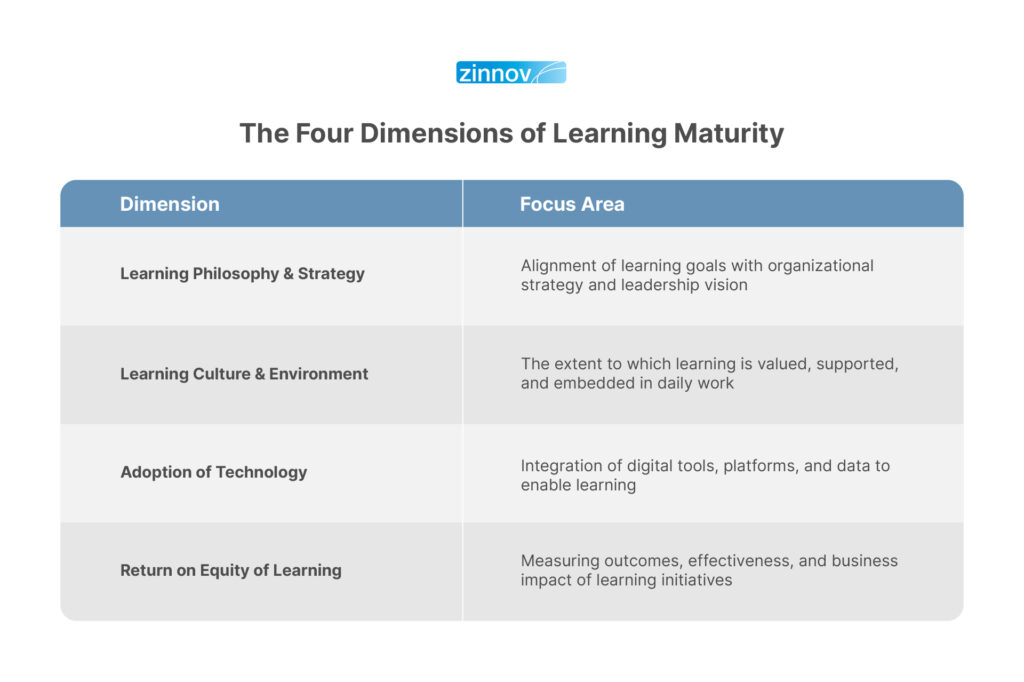
At the heart of our approach is a simple idea: a healthy L&D function rests on four core dimensions, each of which can be measured and improved.
Learning Philosophy & Strategy How clearly learning goals are aligned with organizational strategy and leadership vision. Do leaders see learning as a lever for growth, or as a support function?
Learning Culture & Environment The extent to which learning is valued, supported, and woven into daily work. Do managers encourage learning? Do employees feel safe experimenting and asking for help?
Adoption of Technology How well digital tools, platforms, and data are used to enable learning. Is the LMS a content dump, or is it an integrated part of how people learn and perform?
Return on Equity of Learning How outcomes, effectiveness, and business impact are measured. Are there clear metrics beyond completion rates and smile sheets?
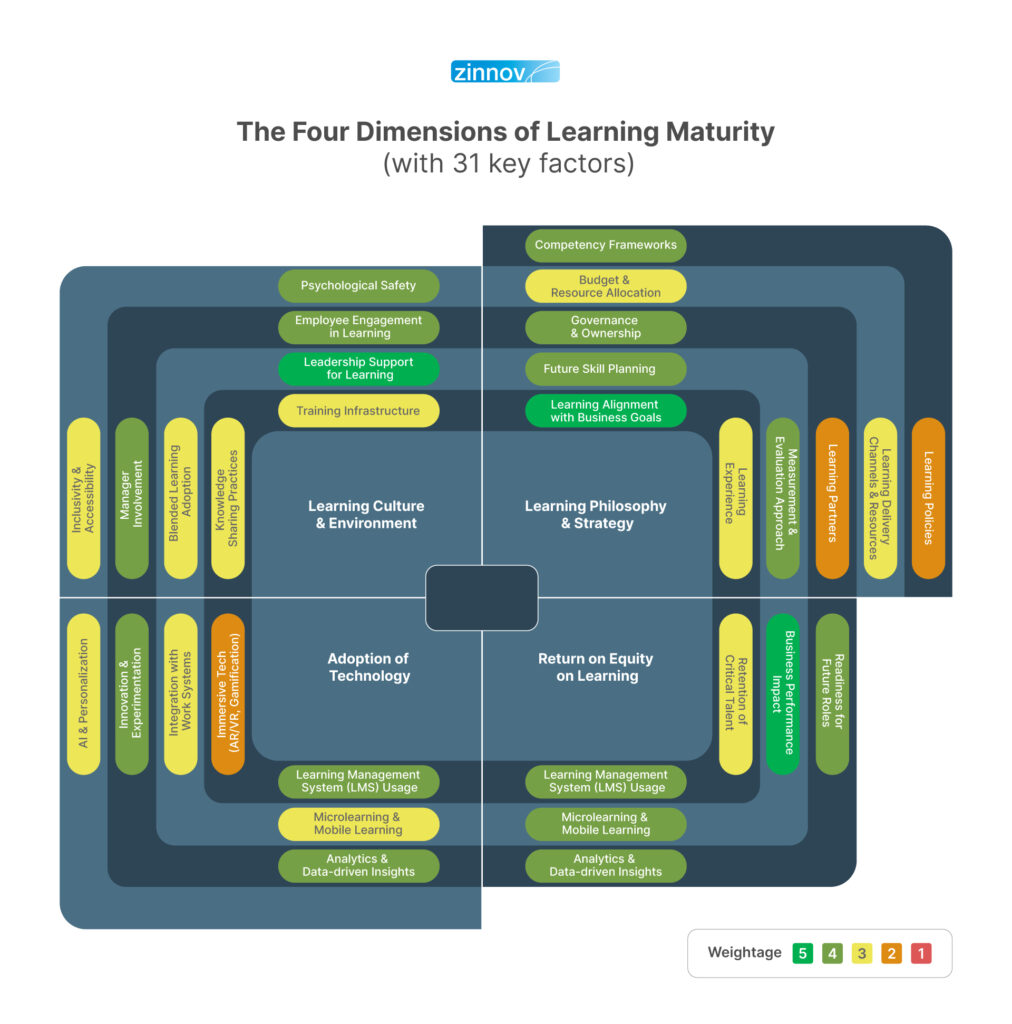
These four dimensions are then broken down into 31 key factors, spanning areas such as:
Leadership support for learning
Psychological safety and inclusivity
Microlearning and mobile learning
Integration with systems of work
Analytics and data‑driven insights
Budget and resource allocation
Talent mobility and internal hiring
We use this visual in our conversations with CHROs and L&D leaders from GCCs as a way to make the complexity of L&D visible on a single page.
The Four Maturity Levels
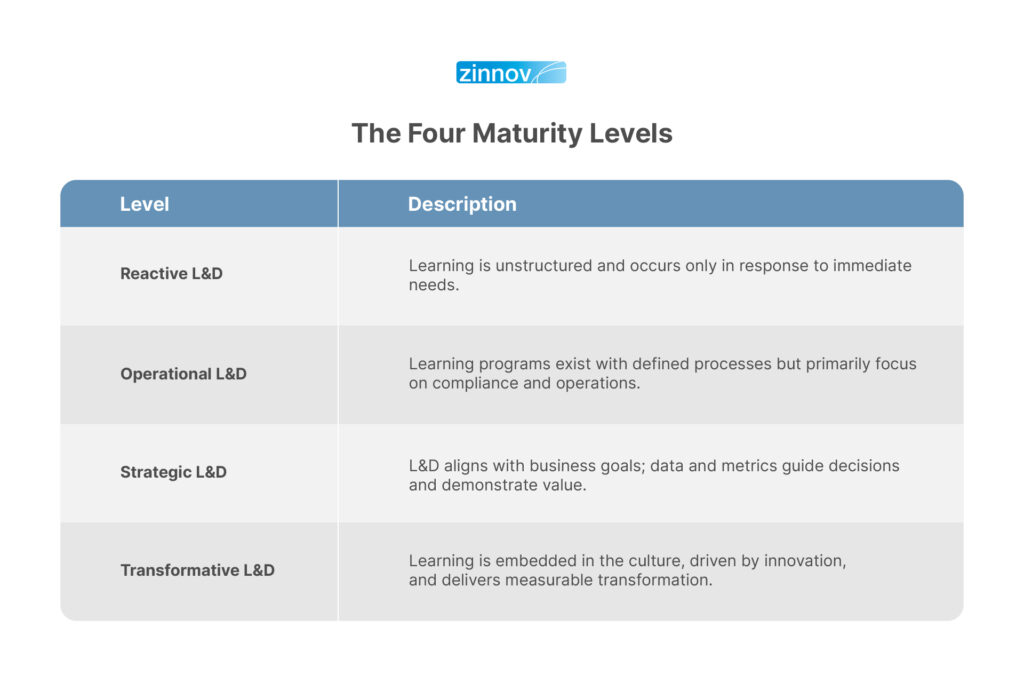
Across these dimensions and factors, a GCC can sit at one of four maturity levels:
Reactive L&D Learning is unstructured and largely event‑driven. Programs happen in response to immediate needs or escalations.
Operational L&D There are defined processes and annual calendars, but the focus is heavily on compliance, onboarding, and operational consistency.
Strategic L&D L&D is tightly connected to business goals. Data and metrics guide decisions, and leaders look to L&D to solve real capability gaps.
Transformative L&D Learning is embedded in the culture. Employees continuously build skills, innovation is encouraged, and the impact of learning is visible in business results.
Most GCCs we meet sit somewhere between Reactive and Operational on some dimensions, and closer to Strategic on others. The objective isn’t to chase a perfect score everywhere, it’s to know where to double down.
A Data‑Driven Assessment, Not a Gut Call
So how do we actually assess learning maturity?
Think of how a Great Place To Work–style assessment runs:
Top‑down view: Leadership shares its perspective through structured forms and discussions.
Bottom‑up view: Employees answer a detailed survey about their lived experience.
The two views are brought together to see where the stories align and where they diverge.
Zinnov’s Learning Maturity Framework follows a similar philosophy.
Leadership inputs We gather evidence and inputs from senior GCC leaders and L&D owners – strategy documents, org structures, budgets, governance mechanisms, and current initiatives.
Employee survey across four pillars We run a stringent survey built around the four dimensions. This goes out to employees across levels, asking about how they experience learning, support, tools, and culture on the ground.
Scoring each dimension Each dimension gets a score based on a defined formula. We don’t rely on a single question; multiple items roll up into a score for each pillar.
Arriving at a holistic maturity score The pillar scores are combined to create an overall maturity score, which is then mapped to the four levels – from Reactive to Transformative.
Surfacing the story behind the score Numbers are the starting point. We then overlay qualitative insights from interviews, workshops, and artifacts to interpret why a dimension scores the way it does, and what that means for the business.
What GCCs Actually Get
Experts who lead this work at Zinnov, describe the offering as having two clear tracks:
1. Standalone Learning Maturity Project
Here, the focus is to diagnose and recommend:
Assess the current L&D environment across the four dimensions.
Pinpoint strengths, gaps, and hidden risks.
Provide a prioritized roadmap of actions that can move the organization up the maturity curve.
For many GCCs, this itself is a powerful outcome: a concrete, shared language for where they are and where they want to go.
2. Extended Partnership: Running L&D with You
Sometimes the roadmap is clear, but execution capacity is limited.
In those cases, GCCs can choose to hand over parts of their L&D charter to Zinnov for a defined period, typically six to twelve months.
That could include:
Designing and running key learning journeys
Setting up and optimizing platforms and tools
Building internal capability academies
Putting in place measurement and governance mechanisms
In other words, the maturity assessment becomes the starting point for a managed L&D engagement, where our team helps translate recommendations into day‑to‑day reality.
Where This Conversation Goes Next
For us, the Learning Maturity Framework is not a slide deck or a one‑off diagnostic. It’s a way to have deeper, more honest conversations with CHROs, business leaders, and L&D teams from GCCs about:
What learning really needs to deliver in the next 6–12 months
Which dimensions are holding them back today
What it will take to shift from a training calendar mindset to a capability‑building mindset
And because the approach is grounded in data, from leadership and from employees, it creates momentum for change rather than debate about opinions.
Want to Explore Your GCCs Learning Maturity?
If you’re curious about where your GCC sits on this maturity curve, or you want to see what a tailored assessment could look like for your context, we’d be happy to talk.
We can walk you through the four dimensions and 31 factors.
Share anonymized patterns we’re seeing across companies similar to yours.
And, if it makes sense, design a focused maturity assessment that fits your scale and priorities.
Reach out to our team to start a conversation on your GCC’s learning maturity – and where it can go next. Connect with us at info@zinnov.com
10 Mar, 2026
The reason you set up a Global Capability Center (GCC) determines the center you end up with. Here's what no one tells you, before you start.











 THANK YOU
FOR YOUR RESPONSE
THANK YOU
FOR YOUR RESPONSE

