







High-performer attrition is the blind spot in India’s GCC talent data. Here is what the numbers say and what leading GCCs are doing about it.
Every GCC leader we speak to this year is cautiously optimistic about attrition.
Overall attrition is 16%. The workforce has settled. The board is satisfied.
They are right. And they are missing the most important talent risk of 2026.
Overall attrition across India’s GCCs moved from 15.4% in 2023, dipped to 13.3% in 2024, rose to 15.1% in 2025, and sits at 16% in 2026. Leaders read the 2024 dip as stabilization. The data since has told a different story.
High performer attrition followed the same arc, but never fully recovered. It peaked at 17.5% in 2023, fell to 15.1% in 2024, and has risen steadily since. It sits at 16.5% today, above the overall average and climbing.
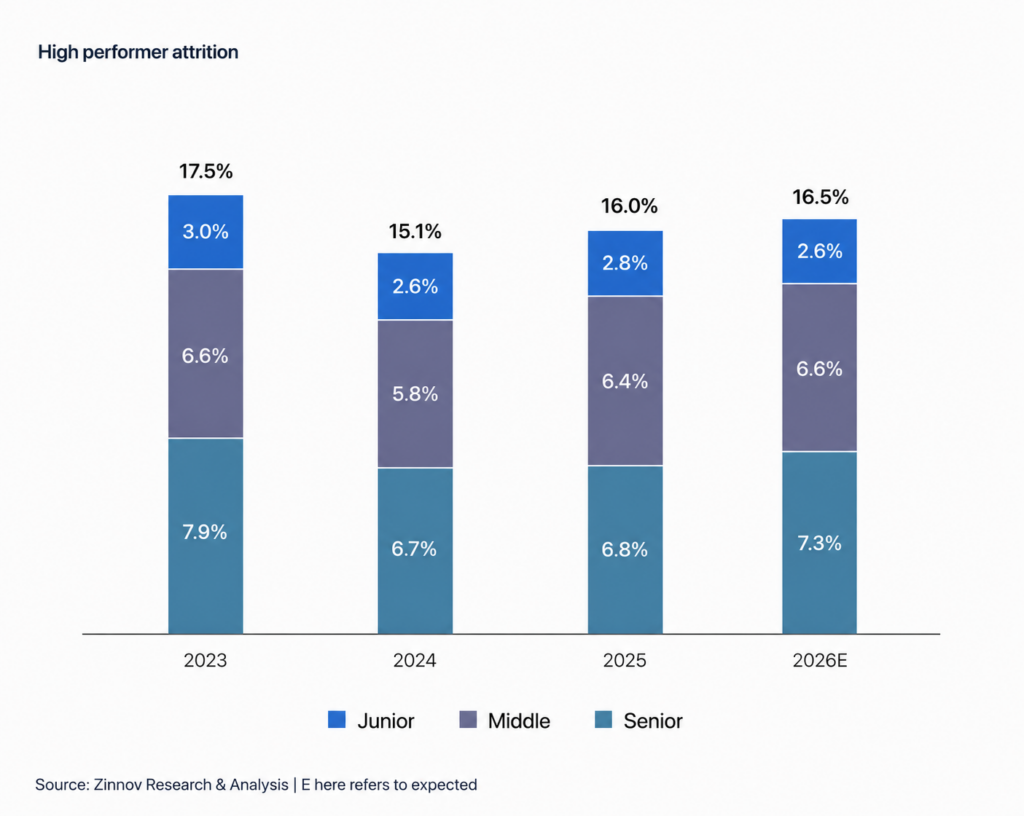
The gap looks small. It isn’t. Aggregate attrition weighs every departure equally, the engineer rebuilding your AI infrastructure and the analyst processing routine reports count the same. What it measures is who stayed. Whether the right people stayed is a different question entirely.
In AI and Cloud roles specifically, attrition runs between 18-25%. Average tenure in these positions has compressed to 18–24 months, meaning the engineer you spent six months recruiting and twelve months developing is likely to leave before reaching full productivity.
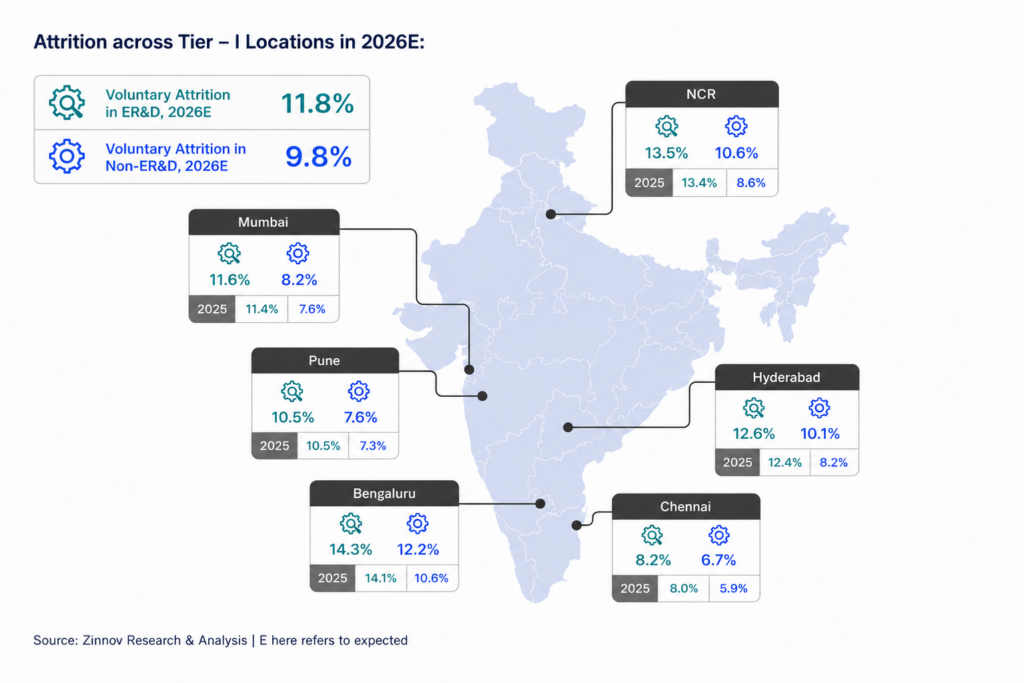
Bengaluru’s voluntary ER&D attrition sits at 14.3%, the highest of any Tier-I city. Chennai is at 8.2%. Tier-II cities report 10–15% lower attrition across the board, and over 80% of GCC leaders believe retention is meaningfully stronger there. For GCCs concentrated in Bengaluru and Hyderabad, location strategy has quietly become retention strategy and the ones recognizing this early are making deliberate choices about where they build their next technical teams.
Nearly 80% of high performers report experiencing FOBO: Fear of Becoming Obsolete, driven by the rapid pace of skill decay.
The data identifies three specific exit drivers:
None of them are compensation.
These engineers are making decisions based on learning velocity. Skills in AI, Cloud, and Cybersecurity are becoming obsolete in approximately 2.5 years. High performers have internalized this timeline. The question they are sitting with is precise: Is this role making me more valuable in 2027 than I am today?
When the answer is no, regardless of what the role pays, they move. To wherever the fastest learning is happening.
Compensation benchmarking, annual skills libraries, structured learning frameworks, these are stability interventions applied to a velocity problem. The GCCs retaining this cohort have accepted that you cannot solve a learning velocity problem with a pay raise. They have redesigned the architecture of work itself, introducing Learning Sprints, dedicated 20% off-project time for high performers to build high-decay skills like Agentic Workflows through self-directed learning or internal gigs. Alongside this, leading GCCs are extending ESOPs and RSUs to mid and junior-level technical specialists not as a compensation instrument, but as a signal that the organization views these individuals as long-term partners in what is being built.
9.8%. That is the average annual salary increase across India’s GCCs in 2026. The number presented to global HQ and approved without debate.
The same organization paying 9.8% on average is paying 21.1% for AI/ML engineers. 20.0% for Cybersecurity. 19.2% for NLP specialists. Top performers are receiving 17.2% nearly 1.8 times the average. Niche skill premiums are running at 18.1%.
Five parallel talent markets. One budget cycle. GCCs applying broad-based increases across this diverged workforce are making their most critical talent feel average. In a market where tenure in AI roles has compressed to 18–24 months, feeling average is enough to prompt a decision.
Over 85% of GCCs have moved to differentiated compensation structures, separate pay bands, scarcity premiums structured as monthly allowances added to base, and front-loaded RSU vesting that creates early financial commitment. The ones that haven’t are not saving money. They are accelerating the exit of engineers who are already weighing their options.
India’s GCC talent market has split.
On one side: a stabilising majority whose departure would be manageable. On the other: an accelerating minority whose departure is strategically consequential.
The leaders defining GCC performance in the next three years are the ones who have separated these two cohorts in their data, in their compensation architecture, in their retention strategy.
The ones relying on aggregate numbers are managing the wrong problem with the right confidence.
The SIAH 2026 Report provides high-performer attrition data segmented by level, function, and location alongside the retention frameworks and compensation structures leading GCCs are deploying this year.
To explore more insights, download the SIAH 2026 Report.



 THANK YOU
FOR YOUR RESPONSE
THANK YOU
FOR YOUR RESPONSE

