







Based on Zinnov’s 220+ GCC setups, scale-ups, and transformations
In a masonry arch, the keystone sits at the top and looks like every other stone. Its significance is invisible until someone tries to remove it – at which point the arch does not weaken. It falls.
The enterprises that built the most consequential Global Capability Centers (GCCs) eventually discovered something structurally similar. Just like the keystone, the true importance of a high-performing GCC often becomes visible only over time. What begins as one capability among many gradually becomes central to how the enterprise operates. Across more than 220+ GCC engagements, we found that this evolution follows a remarkably consistent pattern.
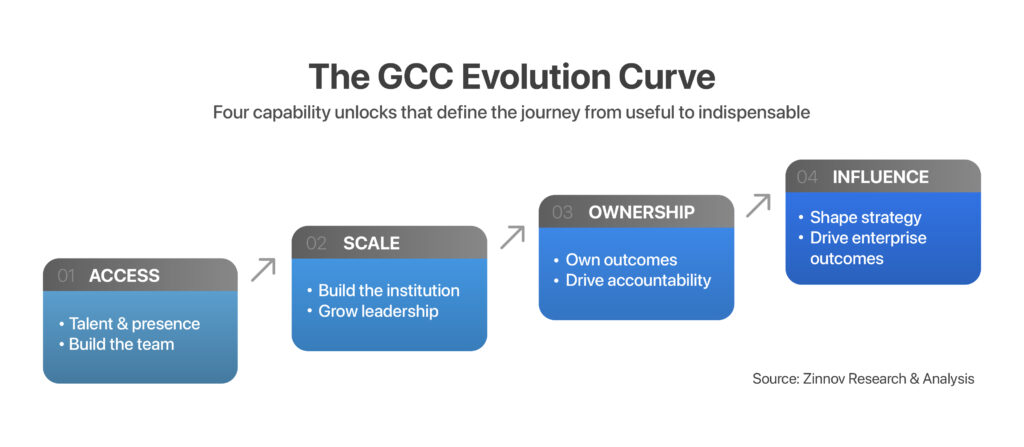
Software & Internet companies account for nearly half of the GCC engagements analyzed. The more telling story, however, lies in the remaining 53%. Healthcare, BFSI, Automotive, Electronics, and Telecom now feature prominently, reflecting how the GCC model has expanded well beyond its traditional technology roots. For these industries, the conversation is no longer about whether to establish a GCC, but what capabilities it should build, how quickly it should scale, and how much ownership it should assume.
The company profile tells a similar story. Organizations generating under USD 500 Mn in annual revenue sit alongside enterprises exceeding USD 50 Bn, demonstrating that the GCC model has become relevant across both growth-stage companies and global enterprises. That broader shift is mirrored in India’s GCC ecosystem, which today comprises 2,117 centers, employs 2.36 Mn professionals, generates USD 98.4 Bn in revenue, and includes 506 Forbes Global 2000 companies. When organizations of this scale and diversity converge on the same operating model, the differentiator is no longer the decision to build a GCC, but the decisions made after it is built.
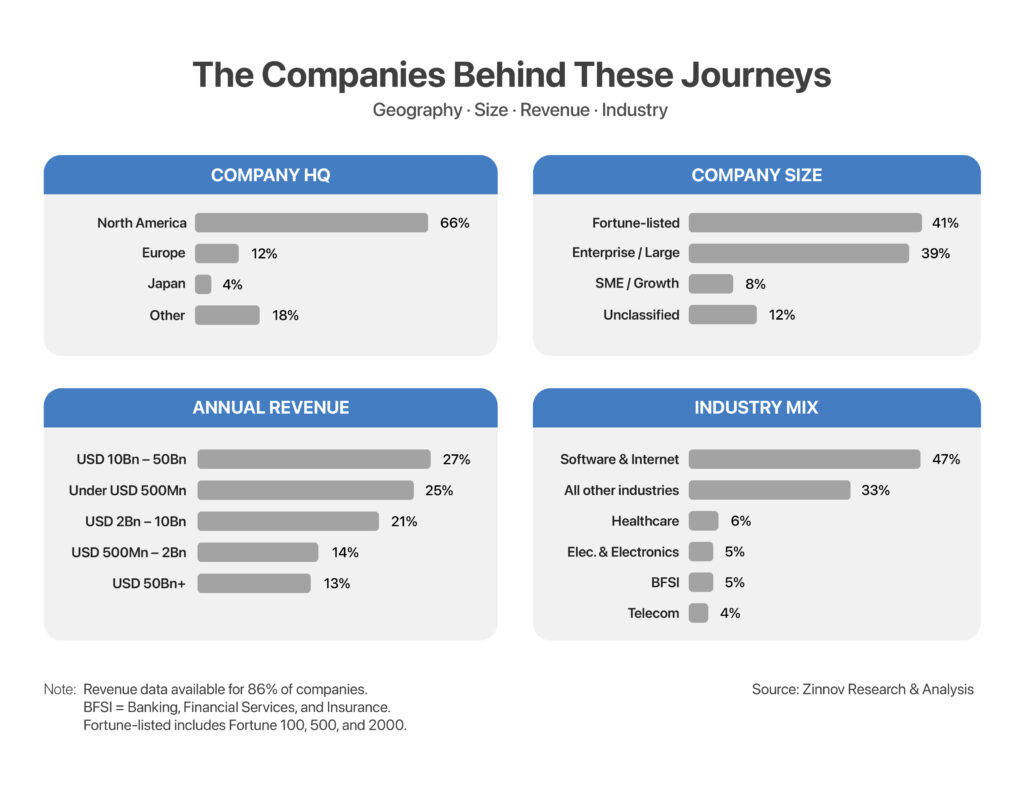
The companies in this body of work that built something genuinely consequential moved through the same four capability unlocks – not at the same speed, but in the same sequence. What they unlocked in each phase created the conditions for the next. For enterprises setting up GCCs in India or scaling existing centers, here is what that progression looked like from the inside, and what it demands of the enterprise on the other side of the relationship.
Every GCC journey begins with a location decision. For the organizations represented across these 220+ GCC engagements, India consistently emerged as the preferred destination for building long-term capability. HMH, a US-based K-12 edtech company, spent over a year evaluating options across three continents before arriving at the same conclusion as most.

Mercari, establishing its first engineering center outside Japan, reached the same answer through a different lens. More than half of their engineering team in Tokyo already comprised non-Japanese nationals, with Indians representing a large and consistently high-performing share. The track record made the decision straightforward.

The Access stage marks the beginning of every GCC journey. What differentiates the organizations that go on to build high-impact centers is not how they establish them, but how they build on that foundation. Talent opens the door; the decisions that follow determine how the GCC evolves.
For companies setting up GCCs in India, the defining challenge in the first 12 to 24 months is institution-building. Establishing the operating model, leadership team, governance mechanisms, and cultural foundations requires deliberate investment long before rapid growth becomes the priority. These decisions rarely feature prominently in the original business case, yet across the GCC engagements we observed, they consistently distinguished the organizations that scaled with confidence from those that had to strengthen their foundations later.
Wayfair‘s experience reflects a reality many organizations encounter when building a GCC from the ground up.

The importance of laying these foundations early becomes evident in how some organizations approached the setup itself. Agilon Health established and incorporated its India office in just four months, despite launching the initiative during India’s second wave of COVID.

Data Axle, a 50-year-old data and marketing solutions company, also began with the challenge of building its India organization from scratch.

Scale is the phase that most organizations underinvest in and most GCCs pay for later. The centers that moved through it well recognized that the investment in institution is the precondition for being trusted with ownership.
As GCCs mature, their role begins to evolve. The conversation shifts from executing work to owning outcomes, with teams taking end-to-end responsibility for products, platforms, and innovation. This is the stage where a GCC begins to move beyond delivery and become a strategic part of the enterprise. Bazaarvoice‘s journey reflects that progression.
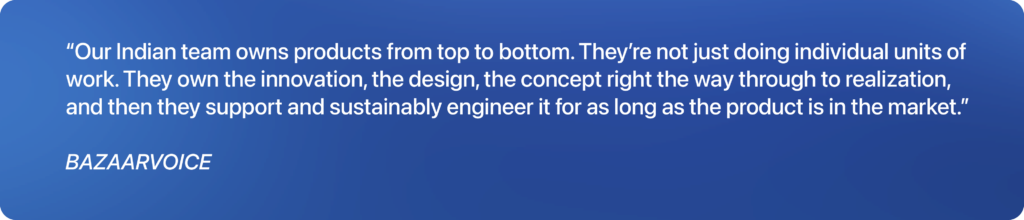
The Bazaarvoice India site leader put the shift in more precise terms: the India team “is counted on to build customer-impacting capabilities.” The distinction between delegated to and counted on is structural. Delegation assumes that accountability stays at headquarters and execution goes to India. Being counted on means the accountability has moved.
HMH built its India center with that endpoint in view.

Ownership is the point where a GCC’s mandate begins to expand beyond execution. As responsibility grows, the center becomes more deeply integrated into the business, creating the conditions for its role to evolve further.
The final stage of the journey is marked by a broader role in the enterprise. Verizon‘s India organization illustrates this progression – from a 30-member cost-arbitrage center established in 2001 to a 6,400-plus strong organization, where 75% of the workforce contributes to strategic programs and a significant part of the company’s 5G launch was driven from India.
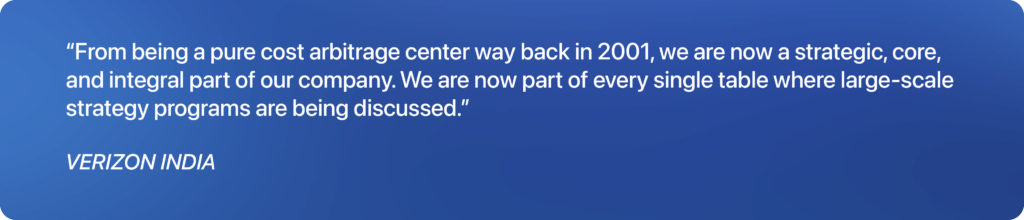
KLA, a semiconductor process control company, described the same stage of evolution by focusing on what had changed within the organization over time.

Continental‘s experience highlights how priorities evolve as GCCs mature. The company summed it up in a single sentence.

That shift is reflected beyond individual organizations. Global leadership roles based in India have grown at a CAGR of nearly 40% over the past five years, reaching 6,500 roles in 2024 and projected to exceed 30,000 by 2030. As GCCs take on broader responsibilities, they are increasingly expected to contribute not only through capability and execution, but also through leadership and strategic influence.
Every GCC begins with a clear mandate. Across these 220+ GCC engagements, the organizations that created the greatest enterprise value were those that continually expanded that mandate as their capabilities evolved.
Bazaarvoice’s India team now owns products end to end. Verizon’s India organization contributes to enterprise-wide strategy. KLA measures success through leadership maturity and value creation. Different journeys, but a common outcome: GCCs whose role extended far beyond their original purpose.
Like the keystone in an arch, the significance of a high-performing GCC is rarely evident on day one. It becomes clear over time, as the enterprise comes to rely on it not just for execution, but for capabilities that shape how the business grows and competes.
Every high-performing GCC starts somewhere. The best ones keep evolving.
Building, scaling, or rethinking your GCC? Let's continue the conversation at info@zinnov.com



 THANK YOU
FOR YOUR RESPONSE
THANK YOU
FOR YOUR RESPONSE

