





Cost remains an advantage, but it is no longer the primary differentiator for companies setting up Global Capability Centers (GCCs) in India.
Between 2022 and 2024, the cost of a comparable engineering team in India rose from about 35% of its US equivalent to about 36%.
Over the same years, the centers themselves became something else.
For most of the previous two decades, a center earned that kind of ownership slowly, after years of proving itself on low-risk work.
A factor that barely moved cannot explain a shift that large. Nitika Goel, Managing Partner and CMO at Zinnov, starts her answer there.
Asked whether cost is still the main reason companies set up GCCs in India, she says: “I think that is now the wrong question.” Cost still gets the business case approved. Nitika Goel calls it a lag indicator:
“It tells you why companies came here. It does not tell you why they will win here.”
Nitika Goel, Managing Partner & CMO, Zinnov
In Zinnov’s view, the winners will be decided by capability density.
India has 2,117 GCCs employing 2.36 Mn people and generating USD 98.4 Bn in revenue. They belong to 506 of the Forbes Global 2000, roughly one in four of the world’s largest companies. These companies hire from the same talent pools, lease space in the same technology parks and pay broadly the same rates.
Game theory judges an advantage by how it moves a player against rivals, and a move every player can make at the same price moves no one.
“If every global enterprise has access to the same cost advantage, cost stops being an advantage. It becomes table stakes.”
Nitika Goel, Managing Partner & CMO, Zinnov
Paying table stakes buys a seat. Who wins depends on what each player does after sitting down.
Take two insurers, as an illustration, that open centers in Hyderabad in the same year on identical economics. One assembles a claims AI team within five months, pairing machine learning engineers with former claims adjusters under a product lead who has authority to ship. By year two, it owns a product. The other spends a year hiring engineers while headquarters decides what to point them at. It remains a line item on someone else’s budget.
Capability density is how quickly a company can bring AI talent, product leadership, engineering depth, domain expertise and decision-making authority together in one place.
The AI layer in India is already deep.
The scarce asset is the combination. Machine learning engineers are hard to hire anywhere. Engineers who also understand claims adjudication, clinical trial data or retail pricing are rarer, and they are the people who turn a model into a product. A center that sits close to an industry’s operations can put that combination together faster than a team assembled across several countries.
Decision-making authority is moving to India too. 64% of GCC site leaders in India now also hold a global functional role, so more decisions are made where the work is done.
Often it does. A $400 million software company opening its first center will usually win approval on cost, and it should build that case carefully.
The trouble arrives around year three. A center approved on savings gets measured on savings, and savings flatten once the center reaches its planned size. With nothing else to show, it struggles to justify its next round of investment. It is also competing for engineers against centers that were built to own products.
The practical move is to win approval on cost and to name, in the same business case, the first capability the center will own.
For GCCs, the measure that captures this is time to capability: how long it takes from the enterprise deciding it needs a new capability to a team in India shipping it. Hiring speed, talent depth, leadership quality and the center’s authority all show up in that one number. A useful companion is the share of the center’s decisions made without escalating to headquarters.
Both measures serve the question Goel wants every enterprise to ask of its India center:
“What can I build from India that changes the competitive position of the enterprise?”
Nitika Goel, Managing Partner & CMO, Zinnov
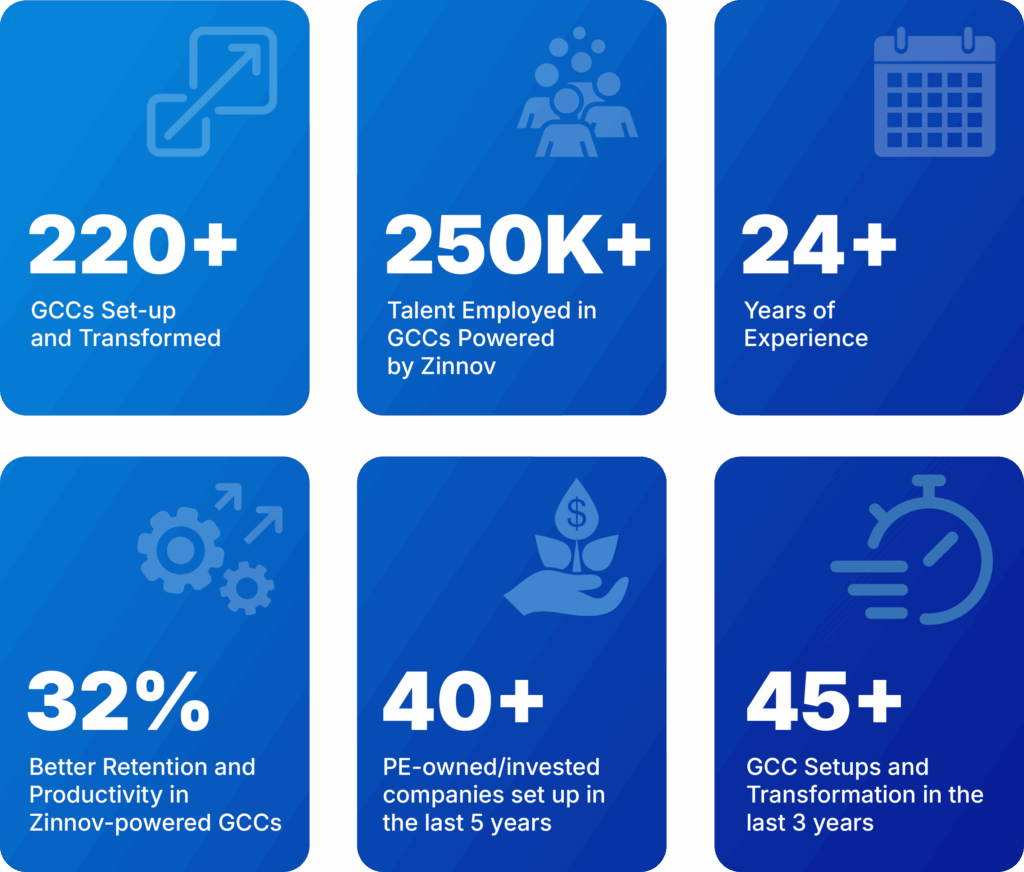
Zinnov has helped set up and transform more than 220 GCCs. Our GCC-as-a-Service model builds a center the company owns from day one, covering location, entity setup, center head hiring and the first team, with the whole setup designed around the capability the center exists to build.



 THANK YOU
FOR YOUR RESPONSE
THANK YOU
FOR YOUR RESPONSE
