





Watch the full video diving deep into global workforce planning where, Pari Natarajan, CEO & Co-founder, Zinnov and Amita Goyal, Managing Partner, Zinnov discuss on how to create the best talent and location strategy for a GCC setup.
For instance, private equity firms and their portfolio companies prioritize speed and high-value outcomes, while large enterprises focus on maximizing value creation, often while managing higher levels of risk.
A Global Capability Center (GCC), commonly referred to as a Captive Center/Global In-house Center (GIC), is an offshore or nearshore entity fully owned and operated by a parent company. These centres typically operate a wide array of specialized services, ranging from Information Technology (IT) and Research and Development (R&D) to complex back-office functions. GCCs play a pivotal role in driving innovation, enhancing cost-efficiency, and accessing diverse talent pools.
India leads with over 2117 Global Capability Centers (GCCs), driving innovation and strategic growth. India’s dominance in the GCC landscape is driven by its vast tech talent pool, cost efficiency, leadership arbitrage, robust digital infrastructure, and a business-friendly regulatory environment. GCCs in India also benefit from a mature ecosystem, and strong synergies with allied industries, including a thriving Start-up ecosystem and a dynamic Tech Services Sector. Cities like Bengaluru, Hyderabad, Mumbai, Pune and NCR have emerged as key innovation & transformation hubs, fostering a vibrant and collaborative environment for global Enterprises.
Bengaluru (1080+ GCCs) and Hyderabad (515+ GCCs) continue to lead as India’s top GCC hubs, driven by their advanced infrastructure, deep talent ecosystems, and strong innovation networks. Chennai, Mumbai, Pune and National Capital Region (NCR) are also emerging as key destinations, offering robust infrastructure and access to skilled professionals. Meanwhile, Tier 2 cities like Ahmedabad, Coimbatore and Thiruvananthapuram are gaining traction due to lower operational costs, improving infrastructure, and a growing pool of diverse talent, making them attractive alternatives for GCC setup & expansion.
Indian GCCs are addressing talent retention by offering competitive salaries for niche skills, investing in upskilling, and fostering career growth. With a highly skilled workforce and a mature ecosystem, India is seeing a rise in end-to-end product ownership, driving high-quality work and deeper engagement. A culture of open communication, recognition, and well-being initiatives further strengthens employee loyalty, ensuring a stable and motivated workforce in an increasingly competitive market.
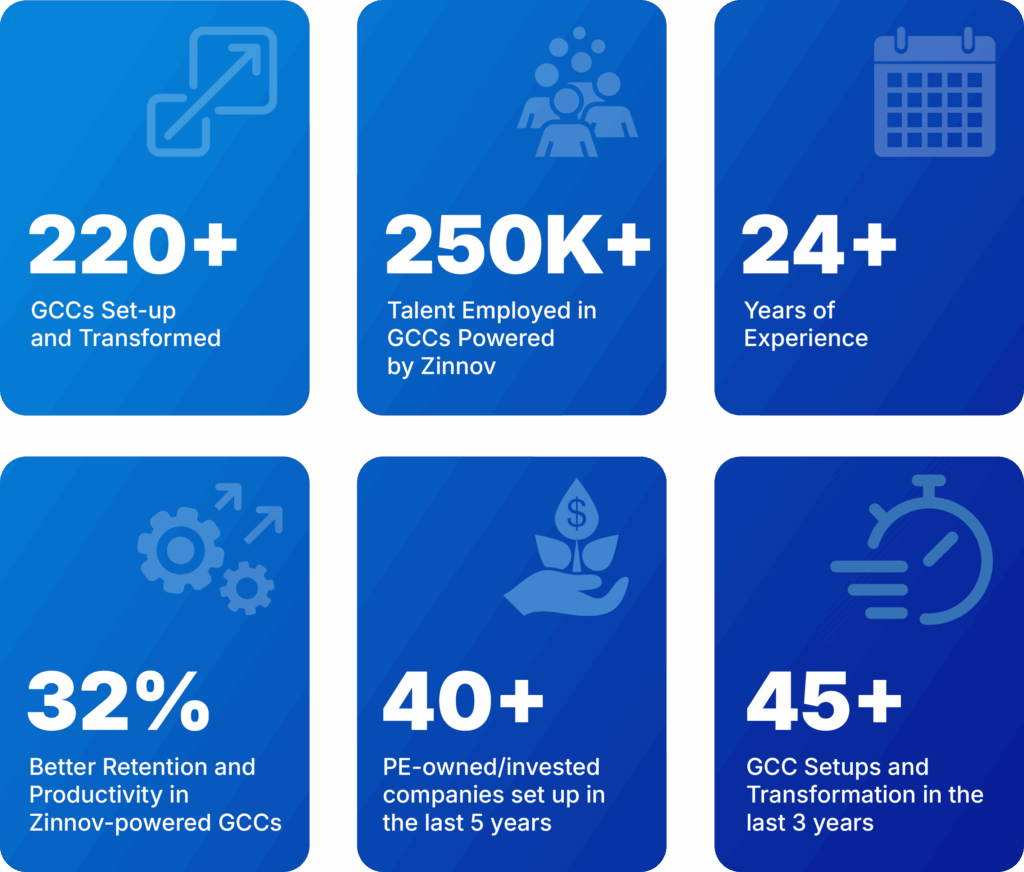
We are a leading strategic global consulting firm, having over 24 years of experience in setting up and transforming 220+ GCCs in India. We enable global enterprises to set up, scale, transform their GCCs. We provide end-to-end support- location selection, talent strategy, organizational design, governance, benchmarking, and beyond.
The deep ecosystem knowledge and hands-on execution support make them a go-to partner for both first-time GCC entrants and mature enterprises optimizing value.
Depending on the scale and complexity of the operation, it typically takes between 3 to 6 months to set up a fully functional GCC in India. With the help of a GCC consulting and setup expert and a robust setup playbook, companies can fast-track this process and achieve operational readiness in record time. Zinnov has successfully partnered with organizations like Agilon Health to establish their India GCC, helping them navigate talent strategy, legal and regulatory frameworks, infrastructure planning, and cultural integration. Leveraging such expertise not only reduces setup time but also ensures long-term scalability and strategic alignment with global business goals.
As of 2026, India is home to over 2117 GCCs, employing more than 2.36 million professionals. These centers have matured well beyond their original mandate of cost arbitrage, evolving into strategic hubs that drive innovation, digital transformation, and global product ownership.
With access to world-class talent at scale and favorable economics, companies are increasingly co-locating leadership, R&D, and technology functions in India. This growth is being fueled by the rise of digital-first enterprise models, AI-led disruption, and expansion into Tier-II and Tier-III cities, firmly positioning India as the global epicenter for enterprise innovation and transformation.
GCC as a Service (GCCaaS) is a managed approach that enables organizations to establish and scale a Global Capability Center without navigating the complexities of building one independently. Instead of managing every aspect from strategy and entity setup to hiring and operations, organizations leverage a partner-led model to accelerate time-to-value. Zinnov’s GCC as a Service model provides end-to-end execution support across strategy, location assessment, legal and compliance, talent acquisition, operational readiness, governance, and scaling. This allows enterprises to launch a fully operational GCC faster while reducing execution risks and enabling a smooth transition to an independent operating model when the organization is ready.
AI-native GCCs are designed with artificial intelligence embedded into every stage of their operating model rather than treating AI as an add-on capability. Organizations should begin by defining an AI strategy aligned with business objectives, identifying high-value AI use cases, establishing robust data and cloud infrastructure, and hiring specialized talent in Generative AI, Machine Learning, MLOps, and AI governance. Building Centers of Excellence, implementing responsible AI practices, and creating reusable AI platforms enable GCCs to become enterprise innovation hubs that drive productivity, customer experience, and new business opportunities.
Zinnov supports organizations throughout the GCC lifecycle, from strategy to scale. The engagement typically begins with developing the business case, selecting the optimal location, and designing the operating model. Zinnov then assists with legal entity setup, talent strategy, leadership hiring, governance frameworks, transition planning, and operational launch. Beyond establishment, the firm also helps clients scale capabilities, strengthen innovation, improve employer branding, and evolve the GCC into a strategic business partner that delivers measurable value across technology, engineering, digital transformation, and business operations.
Establishing a GCC in 2026 requires a strategy that goes beyond cost optimization. Organizations should focus on building digital-first, AI-enabled capability centers that can drive innovation, product engineering, analytics, cybersecurity, and enterprise transformation. Key priorities include selecting locations with strong digital talent ecosystems, adopting cloud-native infrastructure, embedding AI into business operations, implementing flexible hybrid work models, and creating governance structures that encourage collaboration with global business units. Success depends on building a GCC that is positioned as a strategic growth engine rather than an operational support center.
Healthcare and retail organizations are increasingly using GCCs as strategic innovation centers to accelerate digital transformation. In healthcare, GCCs are driving advancements in AI-powered diagnostics, clinical data analytics, patient engagement platforms, regulatory technology, cybersecurity, and digital health solutions. In retail, GCCs are enabling intelligent supply chains, omnichannel commerce, demand forecasting, customer personalization, pricing optimization, and AI-driven merchandising. By combining deep domain expertise with advanced digital capabilities, GCCs are helping organizations improve customer experiences, enhance operational efficiency, and respond more effectively to rapidly evolving market demands.



 THANK YOU
FOR YOUR RESPONSE
THANK YOU
FOR YOUR RESPONSE
