







When a business comes under pressure, getting bigger often feels like the obvious answer. More customers. More capabilities. More revenue. More scale.
In Technology Services, acquisitions have long followed this approach. Companies bought businesses to enter new markets, strengthen capabilities, or accelerate growth they could not build quickly enough on their own. That logic is beginning to change.
AI is improving productivity across software engineering, cloud, enterprise applications, and managed services. Customers increasingly expect providers to share those gains. At the same time, providers need to invest in AI capabilities, new delivery models, and commercial transformation.
For many mid-sized Technology Services firms, those two realities collide. They need to protect today’s revenue while funding tomorrow’s business.
Consolidation is emerging as one way to bridge that gap.
A recent proposed merger between two mid-sized Technology Services companies reflects this shift. On the surface, it looks like another consolidation story: complementary capabilities, broader customer relationships, and greater scale. Look a little deeper, however, and a more important question emerges.
What happens when two companies facing similar growth pressures decide that becoming bigger is the best path to becoming stronger?
The answer depends on how the market itself is changing.
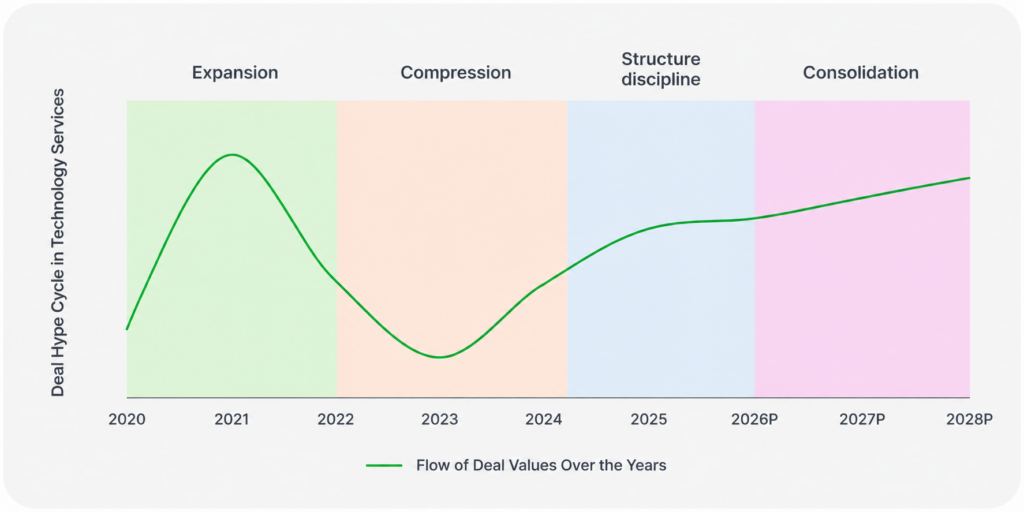
Over the last few years, Technology Services M&A has moved through distinct phases. Expansion gave way to compression as growth slowed and valuation expectations reset. That was followed by greater capital discipline. The market is now entering a phase where consolidation is becoming a strategic response to these pressures.
Large Technology Services providers have diversified portfolios, stronger balance sheets, and greater capacity to invest through disruption. Smaller specialists can concentrate resources on a narrow set of differentiated capabilities.
Mid-sized firms, however, face a more complicated tradeoff. They have established revenue streams, delivery organizations, and customer relationships to protect, while also needing to invest in capabilities that could fundamentally change how those services are delivered and purchased.
The challenge becomes more pronounced when organic growth slows.
Consider a company whose reported revenue continues to increase through acquisitions while its existing business grows at a much slower rate. Another acquisition may improve its reported growth, but it also adds integration costs and increases the capital required to transform the combined business.
The decision is therefore about more than acquiring revenue. It is about whether the company can fund and execute its next phase of growth independently.
Buyers are also becoming more selective about the acquisitions they pursue.
According to Zinnov’s H1 2026 Technology Services M&A analysis, deal volumes declined 44% year over year to 279 transactions. Yet five transactions accounted for 66% of disclosed deal value.
Capital continues to move, but buyers are concentrating their investments in businesses with a stronger strategic rationale.
For mid-sized firms, this creates a choice: invest independently, acquire capabilities, or combine with a larger platform that can support the transition.
Consider two mid-sized Technology Services companies.
Company A has expanded through acquisitions, building a broad services portfolio, while Company B brings established enterprise relationships, a profitable delivery business, and experienced engineering teams.
Both have viable businesses, but slower organic growth is becoming a challenge as customers reassess the economics of traditional services. A merger would give the combined entity greater scale, a broader customer base, and more financial resources.
But while the revenue base expands immediately, the underlying challenge of driving growth remains.
The value of the merger will depend on what the companies can achieve together: entering new customer segments, extending specialized capabilities across their combined client base, or developing offerings that create new demand.
These opportunities need to be evaluated before the transaction closes, rather than assumed to follow from increased scale.
The changing growth equation is also reshaping acquisition valuations.
Zinnov’s H1 2026 analysis shows that differentiated Technology Services assets, with deep industry expertise, strong technology partnerships, and proven AI capabilities, commanded average transaction multiples of 16.7x EV/LTM EBITDA, compared with 10.6x for generalist businesses offering broader, less specialized services.
The difference reflects the value buyers place on capabilities and market positions that are harder to replicate.
Three considerations are becoming particularly important: time, capabilities, and customer access.
An acquisition can accelerate entry into a market that would otherwise take years to develop. It can provide specialized expertise that customers already value. And it can create opportunities to extend those capabilities across established enterprise relationships.
Consider a Technology Services company acquiring a specialist with proven AI solutions for insurance underwriting. The value extends beyond the technology or engineering team. It may include domain knowledge, experience navigating regulatory requirements, established customer relationships, and delivery methods that have already produced measurable outcomes.
If the acquirer can extend those capabilities across additional insurance customers, the combination creates an opportunity for organic growth. But buyers must also consider how durable that advantage will remain.
AI capabilities that appear scarce today may become widely available within a few years. A company with an attractive historical growth rate may also face contract repricing as customers seek productivity benefits.
Buyers must therefore distinguish between capabilities that are valuable today and competitive advantages that can sustain growth over the investment horizon.
This also changes how acquisition prices should be evaluated. A lower entry multiple may appear attractive, but the investment required to reposition the business could erode that advantage.
Conversely, paying a premium for proven capabilities may be justified when the buyer can demonstrate how those capabilities will generate additional customer value.
The question is what the acquisition provides that the buyer cannot build as effectively on its own.
An acquisition can create the resources needed for change. Whether those resources are used effectively depends partly on the ownership model.
A private equity-backed platform typically operates within a defined investment horizon. That can create urgency around leadership decisions, commercial improvements, capability development, and operating model transformation.
A conglomerate-backed acquirer may bring substantial financial resources and a longer investment horizon. It can support capability development, absorb short-term margin pressure, and give management time to execute its plans.
Both approaches offer advantages.
Patient capital provides room to transform. Its value depends on whether management uses that time to make the necessary changes.
For Technology Services companies, those changes may involve redesigning delivery around AI, introducing new pricing models, strengthening sales capabilities, and reallocating investment toward higher-growth Services.
They also involve decisions about people.
In founder-led Technology Services firms, considerable value may reside in leadership relationships, engineering expertise, and organizational culture. Losing those strengths during integration can weaken the acquisition thesis. Yet preserving every existing structure may also limit the operating changes required.
The buyer must determine which capabilities and relationships need continuity and where the combined organization requires a different approach. This makes the post-merger operating plan central to the investment decision.
What changes in the first 12–24 months should be as clearly defined as the financial benefits expected from the acquisition.
Consolidator, Platform, or Target?
AI-led compression is likely to encourage more small and mid-sized Technology Services firms to evaluate consolidation.
Some will become consolidators, acquiring businesses that strengthen their capabilities and market access. Others will become platforms for larger businesses seeking to expand. Specialist firms with differentiated capabilities may become attractive acquisition targets.
Remaining independent can also be a viable strategy for businesses with a credible path to sustainable growth. Each option carries different capital requirements, execution risks, and implications for leadership. For CEOs and investors, the immediate decision is which path offers the strongest opportunity to create value.
That requires clarity on three questions: What is the business capable of achieving independently? What advantage would a merger create? And what must change after the transaction to realize that advantage?
A larger revenue base can improve competitive positioning. Additional capital can support investment. Acquired capabilities can open new opportunities. But these benefits need to translate into stronger organic growth, more durable customer relationships, and a business model that can remain competitive as AI changes delivery economics.
For mid-sized Technology Services companies, consolidation may provide the means to navigate AI-led compression. The real investment decision is whether the combination creates a business capable of growing differently.
As Technology Services companies navigate changing growth dynamics, making the right decisions around investments, acquisitions, and long-term strategy is becoming increasingly important. To explore the opportunities for your business, connect with us at info@zinnov.com.



 THANK YOU
FOR YOUR RESPONSE

