




BACK TO Business Resilience
ZINNOV PODCAST | Business Resilience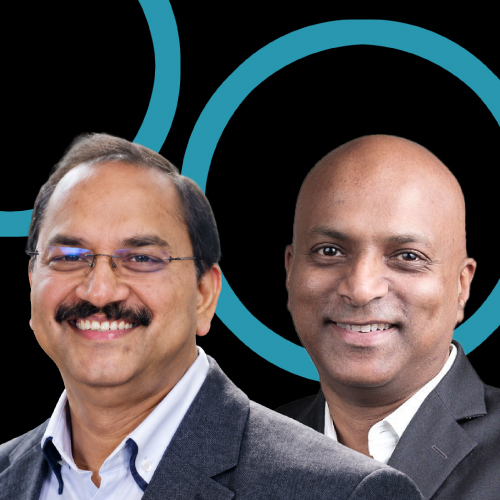



Everyone knows Samsung. Far fewer know that Samsung R&D Institute India-Bangalore (SRIB), its second-largest R&D center outside Korea, has filed around 14,000 patents in the last decade, growing that count by about 20% a year. Even fewer know the man who runs it joined as an engineer in 1997, when the office built telephone systems for small offices.
In this episode of the Zinnov Podcast, Mohan Rao Goli, Corporate Vice President & Managing Director, talks to our CEO, Pari Natarajan, about:
• From one email to 5G. A casual note to a mentor in Korea brought 3G to Bangalore; a first commercial 3G phone followed in 2003, then full 4G software ownership, then global leadership of 5G commercialization. Mohan tells it from the inside.
• How SRIB became an IP engine. A brainstorm, a Samsung CSO saying “let’s patent it,” and a team that had to look up what a patent was. Today: 14,000 patents and standard-essential IP in communications.
• Making engineering AI-native. SRIB is decomposing product development, recruitment, IP filing, and employee engagement into tasks and asking which AI should own. Mohan explains the one question that drives it.
• GDP: Goals, Domain, Productivity. The framework he built this year when asked what engineers should unlearn, and what he chose to focus on instead.
• “The model debate is gone.” What he believes matters instead: on-device vs. cloud, and personalization without giving up privacy.
• What India taught Samsung. Why “best audio” here means loudness over fidelity, why Galaxy cameras are tuned differently for India, and how Finance+, built for UPI-first consumers, became a sell-out tool across emerging markets.
Thirty years in, this is a conversation about the next thirty. Tune in.
PODCAST TRANSCRIPT
Pari: Welcome to another episode of the Zinnov Podcast. I’m your host, Pari Natarajan, CEO of Zinnov. My guest today is Mohan Rao, Managing Director and Corporate Vice President at Samsung R&D Institute India-Bangalore. Mohan joined Samsung in Bangalore in 1997, building telephone systems for small offices. He has run the center since 2023, which means he has watched this place change from the inside, at every level of it, for nearly his entire working life.
Samsung has now been in India for 30 years. Today, we are talking about the next 30. Mohan, welcome.
Mohan: Thank you, Pari. Every time I come to this office, I get some excitement.
Pari: Absolutely. Let’s start from your beginning. You started as an engineer in 1997. Now you’re leading thousands of engineers at Samsung. You have yourself filed hundreds of patents. Tell us a little bit about your journey in Samsung.
Mohan: Absolutely, Pari. Back then, my focus, and even today my focus, is on the technology.
Pari: Once an engineer, still an engineer.
Mohan: Yes. Precisely. I have built my career in wireless communications. Every generation of communication technology takes about a decade to realize, define, materialize and mature. So these three decades of SRIB can also be told through the generations: 3G, 4G, 5G.
In the case of 3G, I still remember when I joined Samsung there was a mentor, Mr. Cho. I went on a business trip to Korea and it was very hectic. I wrote a mail to him casually because I had a prior engagement with him, and he said, “Come over.” He was about 60 kilometers from where I was in Seoul, and it was a very hectic business schedule, as you know in Korea.
Pari: Yeah.
Mohan: But he said to come over. On the day we were leaving, we were having breakfast in the morning because our flight was in the evening, and he sent an engineer to pick me up and take me there. So we had no option; we had to go. When we went there, he said, “We are coming to Bangalore after three weeks, and we are setting up wireless 3G communication development.” Not in our organization; they were already talking to some others in the Bangalore ecosystem.
So we came back and started preparing. Then they came here, evaluated everything, and he asked me to lead the technology. That’s where, I would say, the big breakthrough happened in wireless communications. Since then, we made an impact in 2003 with the first 3G commercialization phone.
Pari: So the initiative you took early on, when you went to Korea, was a really big trigger for this breakthrough.
Mohan: A big trigger. Right. And that created more opportunities. We got into multimedia and system software. All these technologies started coming down to us. Then in the 4G case, we had to create ownership. They asked us to take ownership and do the entire software development in Bangalore. In the 5G case, the leadership asked me to take global leadership of 5G commercialization. That’s where I started taking on global roles. We commercialized 5G, and now I’m here heading SRIB.
Pari: Congratulations. It’s an amazing journey, from starting as an engineer, to supporting 3G development, to building some of the modules of 4G, to running a global 5G program for the company.
Mohan: Thank you so much, Pari. But not just me. The entire team, my leaders, my engineers: we had a common shared vision, and that made it happen.
Pari: So tell me this. If you look at most of the global companies here in India, they focus largely on delivering to the specs, to what has been defined. Companies are changing and getting into higher value. You are focused on creating IP and have built a massive set of patents from here. How did you move into a center which is driving value?
Mohan: The constant question that comes to our minds is: can we be relevant in the industry? This technology keeps changing. So how do we create our own moat in this technology? Because Samsung has built a very strong R&D ecosystem across the world. So how should SRIB, Samsung Bangalore, be relevant and be distinct?
It also happened in a very casual discussion between me and my engineers. The same person, the CSO, came here to Bangalore, and we were discussing and brainstorming. Suddenly a certain idea came up at the discussion table, and Mr. Cho said, “Hey, let’s patent it.” Back then we didn’t know what a patent itself was. It took some time for me to understand: oh, there is a patent process, so we can secure the ideas.
Since then, in the last 10 years, we have created almost 14,000 patents, with both the Indian Patent Office and the US Patent Office. Every year we are increasing by almost 20%. Not just that: we created core, standard essential patents in the communications industry. In other technology streams, we have what we call core IPs. Those IPs are very valuable assets for Samsung Electronics itself.
Pari: It’s fascinating how building IP became the core of the Samsung R&D team here. How is the R&D team in Bangalore different from the others? You have teams across the world. You are the second-largest R&D team for Samsung outside of Korea. You have centers in Silicon Valley close to Apple and Google. You have centers in Vietnam and Poland. How is the Bangalore center different?
Mohan: I’ll be a little cautious here, Pari, because I don’t want to say that Samsung will not go anywhere else for anything. Like I said, Samsung has built a very strong R&D ecosystem across the world, and they are adding value to the entire R&D itself.
What makes the Bangalore center a little distinct, in my opinion: the first thing is domain knowledge. We have chosen certain technologies, like wireless communications, because so many leaders came up there and we created a greater impact. The second one is vision intelligence. It started with multimedia, but over a period of time we thought the camera would become the central focus. So we started using computer vision algorithms, and then we thought AI could multiply vision-related solutions, so we complemented it with AI technology. Now it has become vision intelligence.
The third one is system software. Consumers see the product; they don’t distinguish hardware from software.
Pari: Correct.
Mohan: So how do you integrate the software very well with the hardware? The journey started with device drivers. But these embedded systems are power-hungry, performance-centric and memory-constrained, and all of that has to be kept in balance. So we started creating more systemic algorithms to create that balance. Then so many AI models came up: vision models, language models. How do you make them on-device AI? The model has to be quantized, optimized, and it has to run on this tiny device called a smartphone. For example, in the Galaxy devices, 200-plus AI models are embedded into the device itself.
Pari: So you started with domain capability in wireless and vision, and when AI came in, you were able to adapt to that.
Mohan: Adapt to AI, and take it further. This kind of domain knowledge we have built strongly. That’s why, in these particular domains, global R&D, I mean Korea, looked to Bangalore itself.
Pari: You’ve done a phenomenal job of building for global, but Samsung also has a much higher market share in India compared to anybody else, and you build for the India market. Give us some insights on the India market that is different from global markets, and how you innovated for that and took it global.
Mohan: Very valid, Pari. There is so much happening in India. People see it as a low-cost market and all those things, but we looked at India through a different lens. In my opinion, we can make very complex technologies here. I’ll give you three examples.
The first is audio. In the West, we do audio tuning to maintain the balance between loudness and fidelity, and people like that because there is silence everywhere. When it comes to the Indian context, people use devices outdoors, in a noisy environment. That balance between loudness and fidelity won’t work in India. So we need a separate AI model to handle these audio characteristics, where we focus more on loudness than fidelity, so that people here will appreciate it. Here, the best audio quality in India means better volume, better loudness. That’s the Indian context.
The second is the camera. When we tune the color schemes globally, there are certain color schemes and certain climatic conditions, whereas India is very different. Our colors are more vibrant, with more textures. So how do you tune the smartphone camera to meet Indian characteristics? That’s where the image quality enhancements happen.
Pari: Interesting. These examples are specific to India. Were there other locations in the world where this was relevant, so you were able to export this technology to those countries?
Mohan: Yes. For example, we created another stream called Finance+. In India, as you know, we are the UPI world. We always use UPI; the credit card is almost forgotten. In order to give Indian consumers the affordability to buy any Galaxy device, we created microfinancing with partners here: Finance+. People started using Finance+. For example, students, with their pocket money as an EMI, are getting the Galaxy device experience.
Pari: Yes.
Mohan: It is working out very well for us in India. This instrument became a sell-out instrument, and it went to all emerging countries where credit card penetration is not that high.
Pari: Fascinating.
Pari: Switching gears a bit. We touched upon AI initially, but when we think about AI, we think about it in three layers. One is individual productivity, where you and I use AI on a regular basis, and engineers use AI. Then enterprise productivity. And then frontier capability, something new for the company as well as for customers. How are your engineers using AI to improve their productivity, or how they deliver technology?
Mohan: Very interesting question, Pari. Thanks for asking. We have been seeing how AI is accelerating or multiplying productivity. I see it as the overall engineering process: how AI is influencing engineering productivity, and how products are getting differentiated. We’ll talk about product differentiation later.
Since you asked about engineers’ productivity: we often hear that with all these AI tools, individual productivity and engineering workflows have been improving. What we at Samsung believe is that, while we are giving engineers awareness, access and acceptance to choose whatever tools they are comfortable with, we are also thinking about redesigning the entire development process itself. Not just the development life cycle, the product development life cycle, the project life cycle, but also the recruitment process, the IP filing process, even the employee engagement process. All of them we are trying to redesign to make them AI-native.
Because these processes are hardwired in our minds; for so many years we have been following the same process. Had the AI tools been there back then, would we have done it the same way? I don’t think so. So by decomposing each process into several tasks, we are saying: these tasks can be done better by AI; some of these tasks require humans, engineers, to be involved; some tasks may not be relevant anymore; and some tasks need to be added. With that, we are completely redesigning to make them AI-native processes. Once we make the process right, and once we give that awareness, training and learning to the people, people are quick to adopt it, and automatically they will become AI-native.
Pari: Very interesting. You’re not just doing the technology development process, but everything around it, from hiring, to engaging, to releasing the product, including filing patents. You’re able to use AI and reinvent the processes.
Mohan: Correct. That’s correct.
Pari: You talked about reinventing processes, but let’s also think about the next decade for your engineers. Are there skills we need to unlearn? We have been learning for the last 20 years. With AI coming in, are there skills you think we should unlearn?
Mohan: I asked this question honestly at the start of this year: what do we need to be relevant, what do we need to unlearn, with AI? I think instead of focusing on that, I created a framework called GDP. It’s not gross domestic product. By GDP, I mean the goals, the domain knowledge, and the productivity gains.
G is for goals: the goals we might not have been able to achieve without AI because of certain complexities, or that we were phasing into a separate phase. With AI, what kind of goals can we achieve this year?
D is domain knowledge. Our fundamental strength is domain knowledge. How do we multiply this domain knowledge using AI? What is the extra space we were lacking, and how is AI helping us to know about it? Take stock of it.
P is the productivity gains. Whatever productivity gains we are having with the AI tools, the extra effort we now have, how do we utilize it and channel it into the newer ambitions we are creating? So I asked for this GDP to be created, and it will become Samsung’s GDP.
Pari: Goals, domain, productivity. Those are the three terms you’re driving. We talked about engineers leveraging AI on a day-to-day basis around the processes. But the more exciting part of AI is how it is used in your products, and how you’re delivering products that are differentiated compared to your competition. What is happening there? What can we expect after LLMs? LLMs have been around for the last few years. What can we expect in the next few years?
Mohan: Good question again. We created Galaxy AI a few years back. It’s a beautiful framework, with which we are able to make a lot of AI models complement the core domain technologies to create better experiences for people.
In the future, I think there are three folds in which AI will evolve to differentiate products and create better experiences. The first is multimodal. AI models will start accepting multimodal inputs and operating in a multimodal way, whether it is image, video, audio, maybe physical signals. The second is agentic experiences, because platforms are becoming agentic. Orchestration is happening. People are conversing with devices in natural language, and the device agents are understanding the user better and creating experiences.
The third, which is very close to my heart and which I believe is going to be very important for everyone’s life, is personalization. Any generic AI approach will not create a good personalized experience. The AI has to be personal. It should understand me: what I like, what I don’t like, what style I write in, what style I converse in with my friends, my family, my colleagues. How AI can touch my day-to-day life and create that personalized experience is what will make people cherish it, and that will become true success for AI.
Pari: Great. So there is a lot of very interesting, exciting innovation in the works for the next few years. How do you see India playing a role in all of this, in overall AI development? There’s always the question: we don’t have our own models, or at least not enough models.
Mohan: Actually, that model debate is gone now, Pari, to be frank. Agentic experiences are not so much about the models themselves, because there are so many models coming from the US and China. It is about how we fine-tune these models to meet specific purposes. For example, there are certain challenges: how to maintain privacy and yet create better experiences.
Pari: Personalize, but still manage privacy.
Mohan: Personalize, but manage privacy. In some cases we have to keep the models on the device itself. In some cases we have to run them in the cloud. So what is the tipping point? Where does it have to run on-device, and where does it have to go to the cloud? That is a very important decision to make. It’s not as easy as we think; it’s a very complex decision point that has to be arrived at.
Pari: Got it. So systems engineering becomes very critical, and agent engineering becomes critical. India could dominate in some of those areas.
Mohan: Correct.
Pari: So what are you looking forward to in the next decade?
Mohan: I would say that our processes have become AI-native processes, and our people have become AI-centric people. Our products will have an AI model, whether it is LLMs, LVMs, LBMs, behavioral models, actionable models, vision-language-action models, multimodal actionable models; so many models will come up. So there is AI to take care of product differentiation and innovation. Together, what I can say is that SRIB will become SRIB.AI: the AI-first organization for the Samsung R&D ecosystem.
Pari: Great. Thanks, Mohan. SRIB is a pride of India, I would say, for the kind of innovation and patents you have filed. It’s a lighthouse for other technology companies building capability in India. Thanks for all the hard work, not just for Samsung, but also for the ecosystem.
Mohan: Thank you, Pari. That is a very interesting point. The Indian ecosystem is so vibrant, thanks to our academia, the startup ecosystem, and consulting firms like you creating greater insights for all of us. That makes us think beyond what is coming and prepare well in advance, so that we can be relevant in the subsequent years also.
Pari: Thanks, Mohan. I enjoyed the conversation today.
Mohan: Thank you, Pari. It’s my pleasure.
Pari: Thank you, everyone, for joining us today. Till the next podcast, this is Pari Natarajan, your host.
Theom’s Navindra Yadav and Ravi Sankuratri discuss enterprise AI security, data governance, building an AI-native company, and their GCC journey in Hyderabad.

Explore AI and enterprise transformation with Erica Volini, from work redesign and human adoption to data and leadership. Tune in now.
Don’t miss any of our future episodes!
Also subscribe to the Zinnov Podcast on these platforms






Theom’s Navindra Yadav and Ravi Sankuratri discuss enterprise AI security, data governance, building an AI-native company, and their GCC journey in Hyderabad.
Explore AI and enterprise transformation with Erica Volini, from work redesign and human adoption to data and leadership. Tune in now.
 THANK YOU
FOR YOUR RESPONSE
