







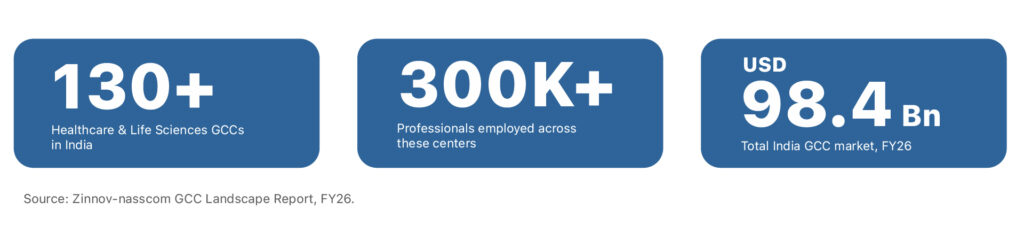
Nearly half the world’s top 50 Life Sciences (LS) companies now have a presence in India, and most of that growth happened in just the last five years.
We’ve worked on 250+ GCC engagements globally, and Healthcare is following a path that Tech and BFSI (Banking, Financial Services, and Insurance) walked a decade ago, just faster and with more friction. Heavier regulation, longer product cycles, and fewer functions that can move offshore make this a harder journey than most other industries.
Novo Nordisk, for instance, opened a small finance and data-processing office in Bengaluru in 2007. Today that same center runs 17 functions, including R&D, biostatistics, safety monitoring, and commercial launch support for its GLP-1 and obesity drug portfolio. The company has even scaled back its headcount growth plans in favor of AI-driven productivity. The Bengaluru team now owns filing timelines, not spreadsheets.
That shift, from back-office support to strategic ownership, is happening across Healthcare in India. But GCCs in Pharma, MedTech, Providers, Payers, and Contract Research Organizations (CROs) are each getting there differently.
What’s driving all of it has little to do with medicine itself. Legacy systems, manual processes, scattered compliance work, and a shortage of the right talent slow every part of the industry down, long before a clinical outcome ever enters the picture. The companies pulling ahead are the ones giving that operational layer the same rigor and investment they’d give a clinical trial. India’s GCCs are increasingly where that work gets done.
Segments referenced throughout this blog:

That rebuild starts the same way for every company: by deciding what to hand over first. Every segment enters India differently, based on what kind of work makes up most of their day-to-day cost.
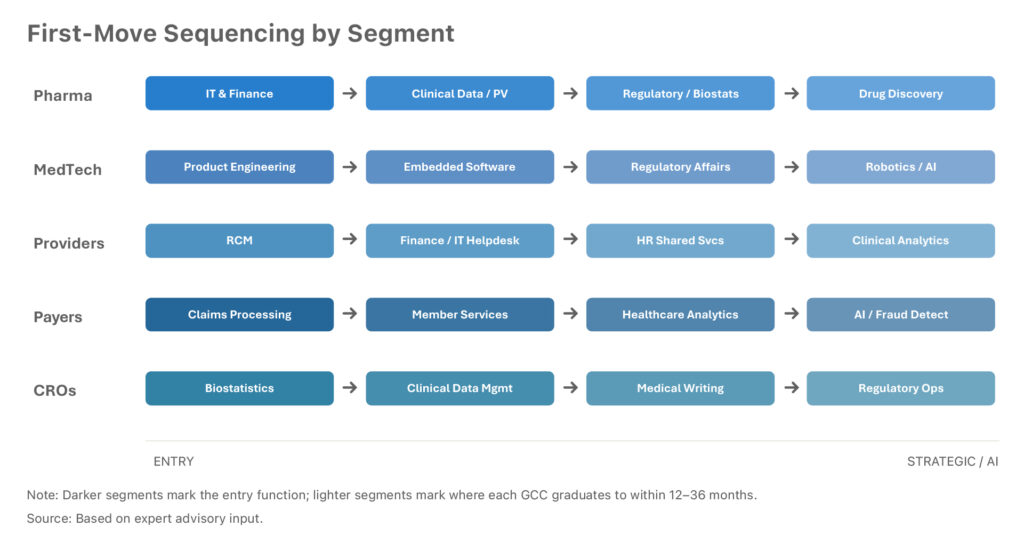
Pharma usually starts with IT, finance, and other enabling functions. Over 60% of early-stage work at top pharma GCCs falls here. The first wave is typically data management, clinical data programming, and drug safety case processing, work that’s well-documented and easy to benchmark from day one. Regulatory affairs and biostatistics follow within a year or two. Drug discovery comes last, once the center has proven itself.
MedTech takes a different route because its real risk sits in product design rather than patient data. Medtronic’s Hyderabad center, running since 2011, is now the company’s largest R&D site outside the US. Stryker’s Bangalore center, about 2,800 people, works on digital engineering and robotics, including its Mako surgical platform.
Providers, including integrated delivery networks (IDNs, health systems that own hospitals, clinics, and often insurance too), move the most cautiously. HCA Healthcare’s Hyderabad center, launched in 2025 with a committed USD 75 Mn, is built around revenue cycle management (RCM), finance, IT support, and HR. Two things explain the caution: hospital boards are less familiar with how GCCs work compared to Pharma leadership, and patient data comes with tighter rules under the Health Insurance Portability and Accountability Act (HIPAA) and the Centers for Medicare & Medicaid Services (CMS).
Payers start with claims processing and member services, then move into AI-driven fraud detection and utilization management. Optum has been in India since 2002, branded under the Optum name from 2011, and now employs 30,000+ people across Noida, Bengaluru, and Chennai. Carelon Global Solutions runs 17,000 to 18,000 people in India out of a global team of about 25,000, roughly 70% of its workforce.
CROs start with biostatistics, clinical data management, and medical writing, then expand into trial monitoring and regulatory support. IQVIA, Labcorp, ICON, and Syneos all run India operations, and more of these are shifting from vendor contracts to fully owned centers.
Across every segment, the pattern is the same: start with safe, well-defined work, then earn your way into higher-judgment functions as trust builds.
Zinnov tracks GCC maturity across four stages: Outpost, Satellite, Portfolio Hub, and Transformation Hub. Only about 27% of all GCCs make it to Portfolio Hub within five years, so where a segment sits on this curve says a lot about how much real ownership it’s earned.
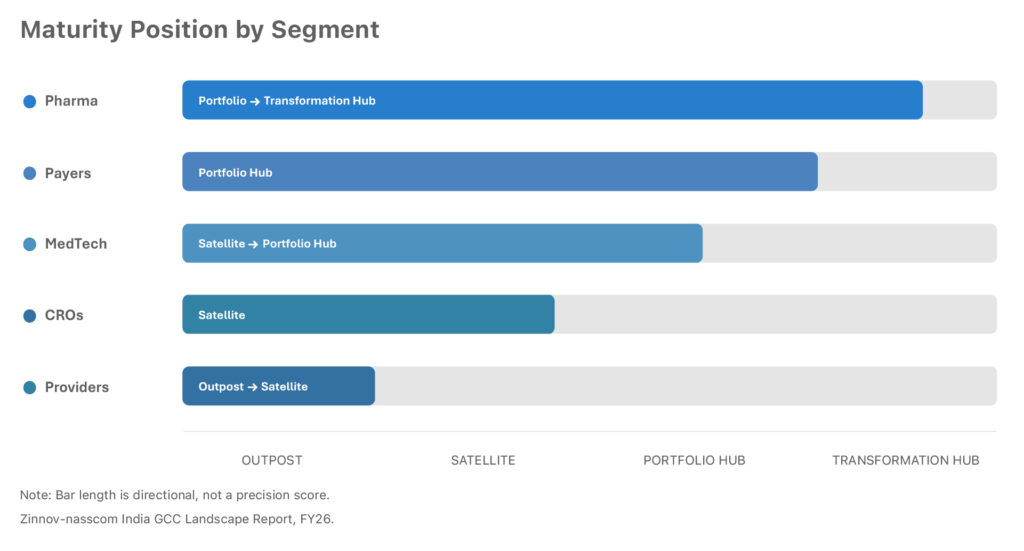
Pharma leads the curve, with some centers 15 to 20+ years old and the deepest integration into global drug development of any segment. Novartis’s Hyderabad center, its largest global hub with 9,000+ employees, contributes directly to drugs like inclisiran and Pluvicto. Leadership describes the work as complex and high-value, central to how these drugs actually get developed. AstraZeneca’s Chennai based Global Innovation & Technology Centre, expanded in 2024 to become its largest GCC in the world, is directly tied to a USD 80 Bn revenue target for 2030. That leadership position really belongs to a smaller group of large, established centers, though. Pharma companies that entered India more recently, or that run smaller India operations, are still working through the basics of clinical data management and regulatory submissions, several years behind the pace Novartis and AstraZeneca set.
Payer-services is the second most mature segment, and closing the gap with pharma quickly. What’s holding it back from pharma’s level isn’t capability, it’s data-privacy governance, the tighter compliance work that comes with handling claims and member data at scale. Optum processes 166 Mn+ claims a year and launched Optum Real in March 2026, an AI platform that’s shown up to 80% fewer avoidable denials in pilots. Once that governance layer is fully built out, payer GCCs are positioned to keep closing the distance.
MedTech sits third, strong on engineering but weaker on regulatory and commercial work, which keeps it a step behind the two leaders. Medtronic has also put USD 50 Mn into a Pune center focused on software, AI, and connected care, a sign the segment is investing beyond its original engineering base.
CROs sit in the Satellite stage, still shifting from vendor-run arrangements to fully owned centers.
Providers remain the least mature segment of the five. Bedside care can’t move offshore, so a hospital system’s India center will always be capped in how central it can become, regardless of how long it’s been running.
One exception worth watching: Providence’s Hyderabad center built a sepsis early-warning model that performs well enough (per Gartner’s coverage) that Providence is exploring licensing it to other US hospital systems. If that works, some provider GCCs could start contributing to their parent company’s revenue, alongside the cost savings they already deliver.
Maturity is one axis. What a center is even allowed to do is another, and that’s governed by a much simpler rule than most executives expect. The real dividing line comes down to physical presence more than regulation. The simplest test: does the work need a physical body, a signature carrying personal legal liability, or a specific licensed location? If yes, it stays put. If the concern is really about data sensitivity or how complex the work is, it can usually move, and leading Pharma GCCs have already proven that.
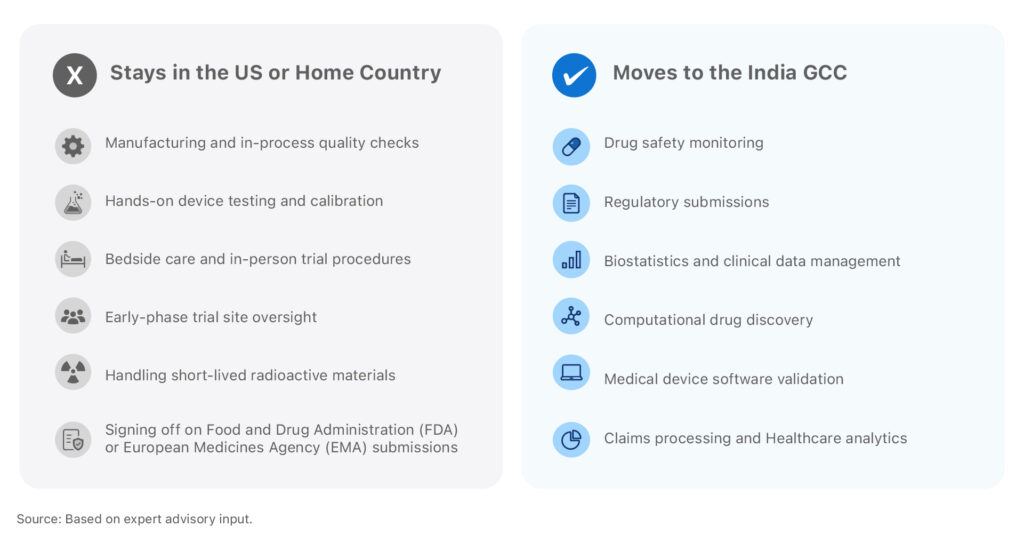
Even in advanced treatment areas, the same split holds:
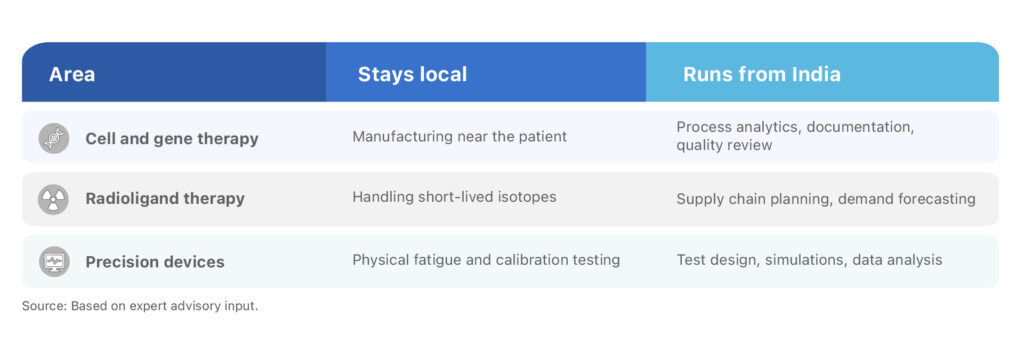
Novartis’s team manages the supply chain for Pluvicto, its radioligand cancer therapy, entirely from India, a working example of how this split plays out in practice.
None of this works without the right people running it, and that’s where most Healthcare GCCs actually get stuck. The hardest roles to fill sit at the intersection of deep healthcare knowledge and strong technical skill, usually people with 8 to 15 years of experience in both.
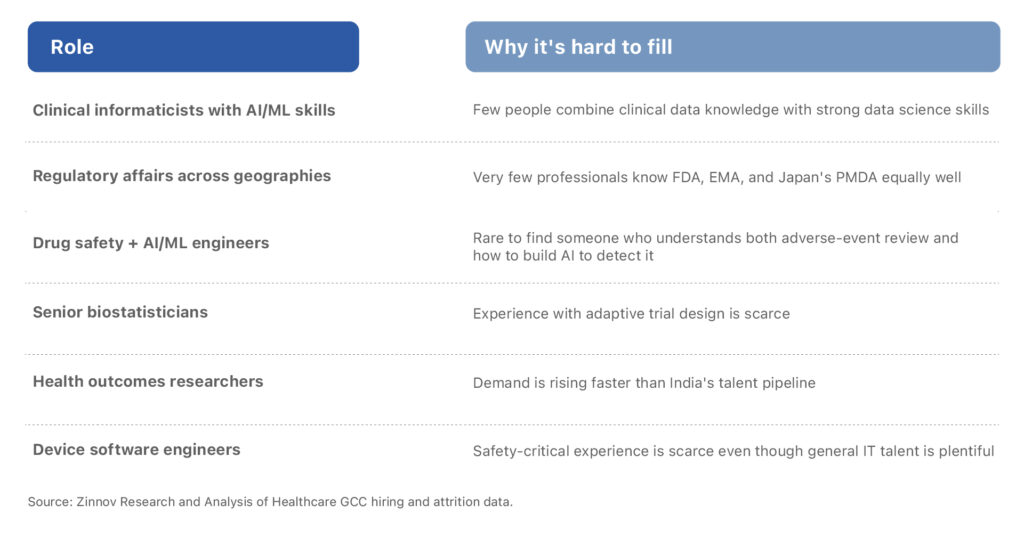

Healthcare GCCs are competing for this small talent pool against CROs, other Pharma companies, IT majors, and AI startups willing to pay a premium. Bengaluru and Hyderabad lead hiring, Pune is growing for MedTech, and smaller cities can’t yet supply this kind of senior talent.
Talent is one constraint a GCC can eventually solve by hiring and training well. Regulation is different, since the rules are set externally and change on their own schedule. Here’s where each one stands today, and what it’s actually meant to protect:
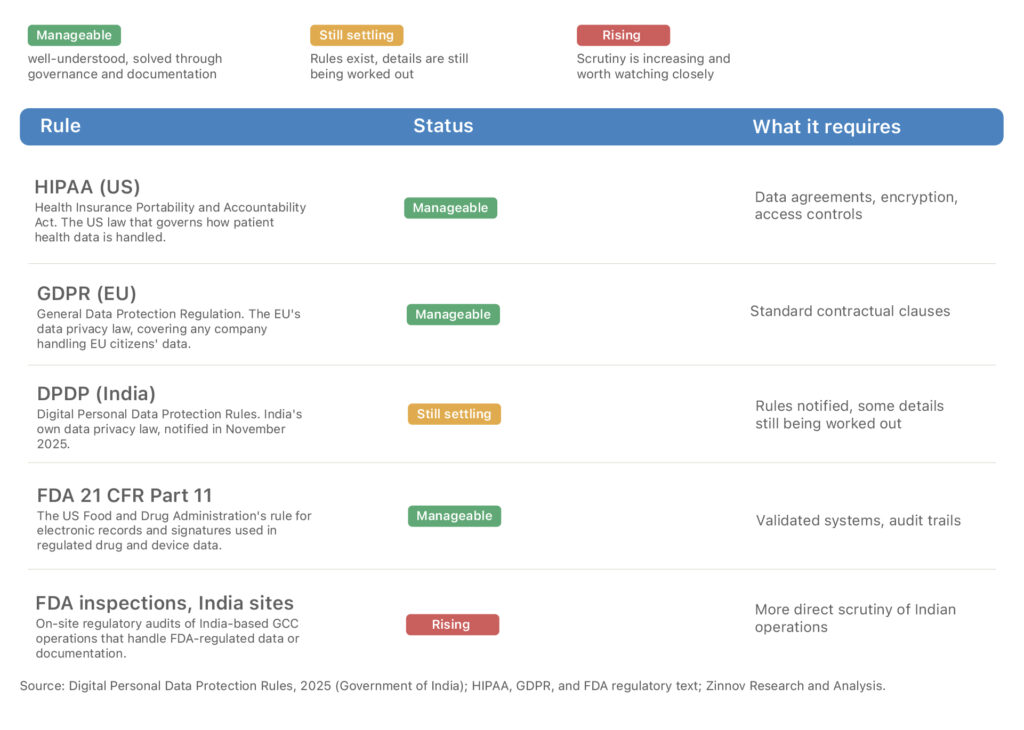
HIPAA allows patient data to be processed outside the US, as long as the right agreements and safeguards are in place. Optum runs a 30,000-plus person operation under exactly this model. GDPR works the same way for EU data, using standard contractual clauses.
India’s own DPDP Rules were notified in November 2025, the first real domestic data law Healthcare GCCs now have to work with. Under this law, data can move out of India by default, and the government has the power to block transfers to specific countries if it chooses to. For centers handling both US and EU patient data, this adds a third layer of compliance on top of HIPAA and GDPR, and it’s a live issue since India’s IT ministry has floated compressing the compliance timeline to as little as 12 months.
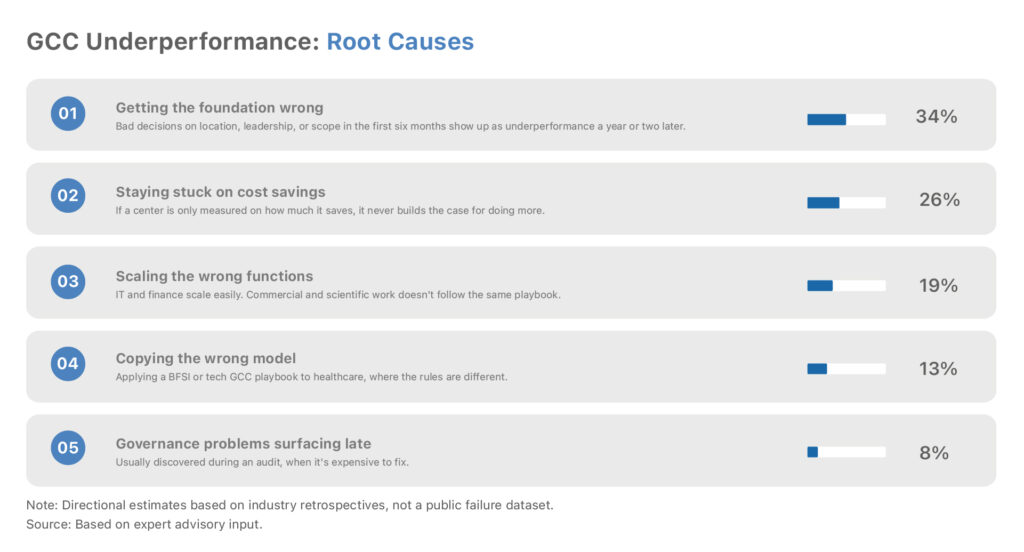
Get the regulatory and talent picture right, and a center still isn’t guaranteed to succeed. Most GCC failures don’t look dramatic. They just never grow past the basics. The most common causes, roughly ranked by how often they show up:
Running through every segment above is one force that’s rewriting the timeline for all of them at once.
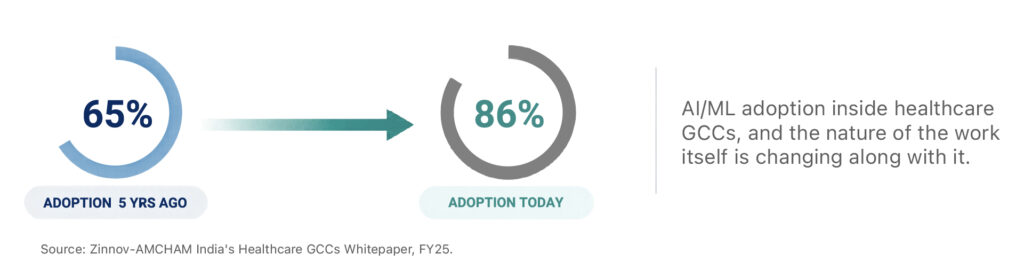
AstraZeneca is building out digital twins and agentic AI in its India centers. Novo Nordisk has used AI to speed up regulatory drafting and safety reviews, aiming to cut time-to-market by up to two-thirds. Cohere Health, a digital health startup with under 1,000 employees globally, opened a Hyderabad center in February 2026 focused entirely on AI-driven prior authorization, and claims it’s automated up to 90% of that workflow.
The same technology also puts jobs at risk. About 55% of India’s overall GCC work is exposed to automation. The centers that come out ahead are the ones that already own their function end-to-end, where AI becomes a tool they control. Centers doing narrow, repetitive tasks are the most exposed.
Put the maturity curve, the talent gap, and the regulatory picture together, and three things stand out about where each segment is headed next.
One signal worth tracking: How many new Healthcare GCC announcements specifically mention India’s data rules or the SHAKTI program as part of their plan? That’s a good early sign of which centers are being built for where the industry is headed rather than where it’s been.
Figures in this section reflect directional estimates based on expert advisory input.
Source: Based on expert advisory input; Union Budget 2026-27.
What separates a GCC that earns real ownership from one that stays stuck is rarely capability. India already has the engineers, analysts, regulatory specialists, and increasingly the AI talent to do almost anything a global healthcare company needs done. What separates them is whether the parent company treats its India center as a place to send work, or as a place to build ownership. Pharma took two decades to make that call. Payers are making it in half the time. Providers are only just starting to, and the next few years will show which path they take.
That’s the thread this series will keep pulling on, segment by segment, center by center: how much of the business each company is willing to let its India team actually own.



 THANK YOU
FOR YOUR RESPONSE
THANK YOU
FOR YOUR RESPONSE

